
Church Transportation Guide: Buses, Drivers, and Safety
How to plan a church transportation program: who the bus serves, what size fits, who drives, and which safety features and costs to plan for.
By Dominic Menard - National Director of Marketing & Technology
Published • Last updated
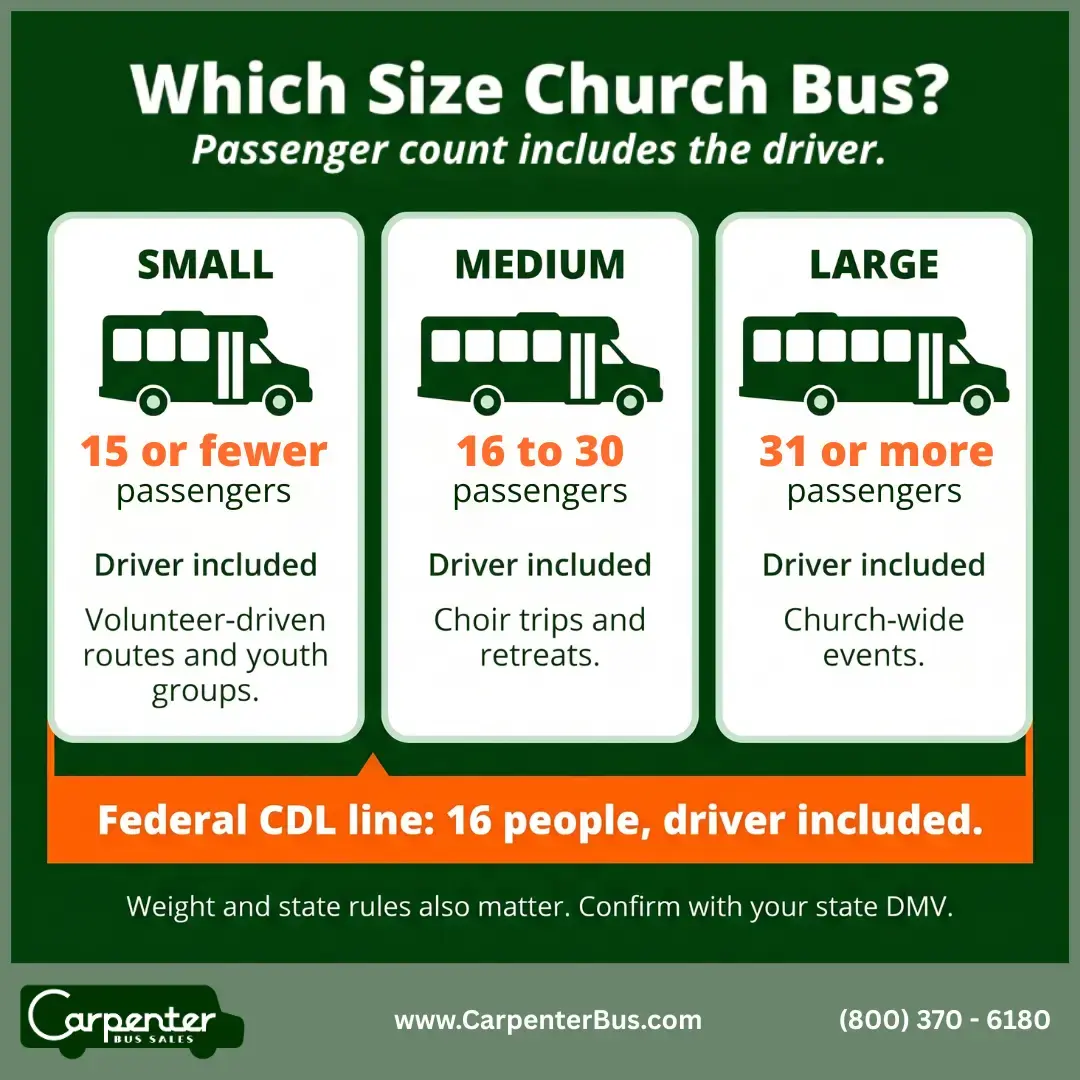
Carpenter Bus Sales recommends that a church transportation program start with four decisions: who the bus serves, what size fits that group, who is approved to drive it, and which safety features it needs. Passenger counts include the driver, and federal rules require a CDL (commercial driver's license) for a vehicle designed to carry 16 or more people including the driver.
Does your church need a transportation ministry?
Your church is ready for a transportation ministry when group trips keep arriving at different times, senior members attend fewer events because driving is hard, or travel costs keep families home. One shared church bus can address all three problems, and it gives the church a vehicle it controls.
What are the signs it is time to buy a church bus?
- Group travel arrives scattered. Missed turns and traffic delays turn retreats, conferences, and choir trips into a coordination problem. A bus lets everyone arrive together.
- Seniors attend fewer events. Some older members avoid driving at night, in bad weather, or over long distances. Shuttle service keeps them connected to worship and fellowship.
- Cost limits participation. When an event is far away, airfare, train tickets, or charter fees can put it out of reach for some families. A church-owned bus lowers that barrier.
What can a church bus do for your ministry?
A church bus supports more than Sunday pickups. Churches can build programs around a bus in several ways:
- Rides for families, seniors, and youth who do not have reliable transportation to services and midweek programs.
- Youth retreats, conferences, vacation Bible school, mission trips, and Sunday school outings, with the group traveling together.
- Local outreach, such as moving volunteers and supplies to food pantries, shelters, and after-school programs, or giving rides to community events.
- Fellowship on the road, where trips become time for conversation, prayer, and singing.
- A visible welcome. Graphics and lettering turn the bus into a rolling sign for your congregation.
What size bus does your church need?
Carpenter Bus Sales defines a small bus as 15 passengers or fewer, a medium bus as 16 to 30, and a large bus as 31 or more, with the driver counted in every total. Size your bus to your usual riders and your largest regular trip, then plan for the next few years of growth.
Carpenter Bus Sales delivery records show that roughly two-thirds of the buses Carpenter Bus delivered since January 2022 (records through July 2026) were small buses with 15 passengers or fewer.*
*These figures describe Carpenter Bus deliveries to all customer types, not a national market figure.
| Size | Passengers (driver included) | Federal CDL baseline | Where it fits |
|---|---|---|---|
| Small bus | 15 or fewer | Below the federal 16-person trigger. Weight, use, and state rules still apply. | Volunteer-driven routes, youth groups, and small senior groups |
| Medium bus | 16 to 30 | Designed for 16 or more people, so a CDL with a Passenger (P) endorsement applies.* | Congregations that need 16 to 30 seats, choir trips, and retreats |
| Large bus | 31 or more | Designed for 16 or more people, so a CDL with a Passenger (P) endorsement applies.* | Church-wide events and large-group travel |
*This is the federal baseline only. CDL requirements vary by state and by vehicle configuration, so check with your state DMV or licensing agency before choosing a size.
Buying too small means leaving riders behind, and buying too large means paying for seats that sit empty. If your riders fit within 15 seats, the 15 passenger bus guide shows how that size works for a church, from licensing questions to what to check before you buy. You can compare layouts and configurations in every size on the church buses page.
Is a church van a better fit than a bus?
Choose a van for occasional, short trips and tight parking, and a bus for groups that move on a schedule. Carpenter Bus Sales sells both, including passenger vans, wheelchair vans, and wheelchair minivans, and many organizations run one of each, using the van for daily trips and the bus for group outings.
Rick Cassels, Regional Sales Manager at Carpenter Bus Sales, frames the choice around use rather than vehicle type. A van is easier to drive and park, costs less to fuel, and drives more like a car, so it suits a few short trips. A bus suits scheduled group transportation because of its stairwell, center aisle, storage, and duty cycle. He also tells buyers to ask the people who will drive what they are comfortable handling.
- Passenger vans. A fit for small groups, errands, and midweek routes that do not need a full bus.
- Wheelchair vans. Wheelchair vans hold 2 to 8 wheelchair positions, which suits seniors and members who use wheelchairs. Wheelchair vans also stay under the federal passenger count that triggers a CDL, but confirm your state's rules.
- Wheelchair minivans. A smaller step for a church that needs accessible rides for one or two riders.
Carpenter Bus sells vans from Forest River Vans, FR Conversions, and ADA Boy Vans. The 15 passenger van versus 15 passenger bus comparison covers the decision in depth, including what federal guidance says about newer vans. Browse the full van inventory.
Who should drive your church bus, and what should your driver policy say?
Carpenter Bus Sales recommends a written policy that no staff member drives a church vehicle on a trip they lead, and that only drivers on an approved list take the wheel. Licensing depends on the vehicle and your state, so confirm requirements with your state DMV and your insurance agent.
Why should the trip leader not drive?
Leading a trip means managing headcounts, schedules, and the surprises that come with any group. A driver needs to focus on the road, not on whether the back row is behaving or the restaurant reservation is confirmed. Separating the roles is also better for the ministry:
- It involves more people. Retirees, shift workers, and parents who would never teach a class may welcome the chance to serve by driving.
- It builds relationships across generations. A younger adult driving a senior trip, or a retired grandfather driving youth to camp, creates connections that may not happen in the church lobby.
- It keeps the minister equipping others. Ministry stays shared instead of resting on one person.
Some exceptions are reasonable: short in-town trips with minimal logistics, a different staff member who is not leading the event, or an emergency when no volunteer is available. The standard practice should still be a dedicated driver.
What does federal law say about CDLs for church bus drivers?
The Federal Motor Carrier Safety Administration (FMCSA) states in its guidance on 49 CFR 383.3 that a church bus driver needs a CDL when the vehicle is designed to transport 16 or more people including the driver, or has a gross vehicle weight rating (GVWR) of 26,001 pounds or more, and it also applies when a vehicle carries placarded hazardous materials.
That federal baseline is not the whole answer. Requirements vary by state and by vehicle configuration. Some states, including California and Connecticut, apply stricter rules to churches and nonprofits, not looser ones. A seat count alone does not tell you that a specific driver or vehicle is exempt, so confirm with your state DMV. The CDL and driver license guide explains the licensing questions in more detail.
What belongs in a church bus driver policy?
Carpenter Bus recommends putting these steps in writing and reviewing them each year:
- Keep a list of approved drivers, and allow only people on that list to drive.
- Check each driver's motor vehicle record for recent tickets or accidents.
- Confirm the driver has experience with large vehicles, and require a road test with a church staff member before the first trip.
- Send the approved driver list to your insurance agent before the trip.
- Train drivers on pre-trip inspections, seat belt and boarding procedures, and emergency and bad weather plans.
- Set up a reservation and scheduling system so one group at a time uses the bus.
What are the key features to look for in a church bus?
Look first for church bus safety features: a seat belt at every seat, low-step entry with grab handles, a backup camera, anti-lock brakes, marked emergency exits, and climate control that reaches every row. Then add features for the people you carry, such as a wheelchair lift for seniors or storage for youth gear.
Which church bus safety features matter most?
This checklist covers the church bus safety features to confirm before a bus goes on the road:
| Feature | Why it matters | What to check |
|---|---|---|
| Seat belts at every seat | Seat belts are the most basic way to reduce injuries in sudden stops or accidents. | Lap or three-point belts that are easy to reach and use, especially for children and seniors. |
| Low-step entry, grab handles, and non-slip flooring | Riders of all ages and mobility levels board the bus. | Grab bars near the door and traction on the steps and aisle. |
| Backup camera and lighting | Large vehicles have blind spots, and church parking lots are busy on Sundays. | A working camera, exterior lights, and aisle lighting for early mornings and evenings. |
| Anti-lock brakes and stability control | A fully loaded bus takes longer to stop, and stability systems can help reduce rollover risk. | ABS on the bus, stability control where offered, and regular brake inspections. |
| Emergency exits and equipment | Riders need to leave quickly if something goes wrong. | Marked exits with instructions, a first aid kit, a fire extinguisher, and escape windows or roof hatches that meet federal safety standards. Train drivers and volunteers before each trip. |
| Wheelchair securement | Riders who use wheelchairs must be secured in transit. | Four-point tie-downs, lap and shoulder belts, and a lift or ramp that is inspected regularly. |
| Climate control | Overheating or freezing creates health risks, especially for children and seniors. | Front and rear heating and air conditioning, with airflow that reaches every row. |
Manufacturer specifications change by model year and configuration. Confirm the exact equipment on the bus you are considering before you buy.
Which features fit youth groups and senior groups?
Different ministries need different features. This table matches features to the group you serve:
| Feature | Best for | What to look for |
|---|---|---|
| Low-step entry and grab bars | Seniors and youth | Wide doors, grab bars, and optional electric step risers. |
| Seat belts on every seat | All groups | High-back padded seats. Easy-clean vinyl for youth, and wider seats with armrests for seniors. |
| Front and rear heat and air conditioning | All groups | Ducted airflow, so comfort does not depend on which row a rider sits in. |
| Storage space | Youth and senior trips | Luggage and gear for youth. Room for walkers, canes, and oxygen tanks for seniors. |
| Wheelchair lift | Senior ministries | ADA-compliant configurations. Side-entry lifts preserve seating space. |
| Entertainment and charging | Youth groups | A PA system, USB charging ports, and Bluetooth sound. |
Most Carpenter Bus buses can be configured with a rear or side wheelchair lift, but not every bus can take one. Commercial lifts from Braun handle up to 800 pounds. See the wheelchair buses for current options.
For youth and childcare transport, an activity bus (MFSAB) is built to the same federal structural safety standards as a yellow school bus. It does not carry stop arms, flashing red lights, or yellow paint, and private organizations can buy one. Carpenter Bus Sales does not sell yellow school buses.
Which church bus accessories and storage options are worth adding?
Storage is the add-on to plan first. Rick Cassels, Regional Sales Manager at Carpenter Bus Sales, says inadequate storage is the post-purchase regret he hears most often from customers. Church bus accessories worth pricing out include rear or overhead storage, a PA system, USB charging, and lettering.
- Storage. Plan for luggage, supplies, and musical instruments. Ask about rear cargo space and overhead racks.
- Sound and charging. A PA system helps with announcements and programs, and USB ports keep phones and tablets charged.
- Lettering and graphics. Church name, logo, and contact information show your congregation on every trip.
What do church bus prices look like?
New church vans start around $75,000, and new church buses start around $100,000 and rise with passenger capacity, chassis, and features such as a wheelchair lift. Used church buses generally range from $40,000 to $80,000, depending on year, mileage, and condition. These are general ranges from Carpenter Bus Sales, not quotes. Find your salesman for current pricing.
Should your church buy or lease a bus?
The answer depends on how often you will use the bus, your cash flow, and whether you want ownership or flexibility. Leasing keeps upfront costs low. Buying gives your church full control of the vehicle and long-term savings. Your Carpenter Bus Sales representative can walk through financing and lease options for your situation.
Should your church buy a new or used bus?
A new bus brings the latest features, full customization, and Carpenter Bus Sales warranty coverage. A used bus costs less up front, and our guide on what to look for when buying a used bus can help you compare. Browse new buses and used buses, and compare the budget against the mileage you expect to run.
What does a church bus cost to own?
The purchase price is only part of the budget. Plan for these ongoing costs:
- Insurance and fuel.
- Licensing, registration, and driver training.
- Maintenance. The Carpenter Bus service department can help set a preventive maintenance schedule for your bus.
Henry Headden, President and Owner of Carpenter Bus Sales, who has been with the company since 1973, says a well-maintained commercial bus typically lasts 10 to 15 years, or 150,000 to 250,000 miles, and that regular preventive maintenance is the biggest factor. That is a service-life range for a well-maintained bus, not a guarantee for any specific bus.
What warranty comes with a new church bus?
Carpenter Bus Sales includes PlatinumCare at no charge on every new bus and van sold to churches, ministries, and senior care communities. Carpenter Bus Sales offers the only 8-year unlimited mile warranty in the industry for churches, ministries, and senior care communities. See the warranty department for the full program.
| Program | Who receives it | Price | Term | Coverage |
|---|---|---|---|---|
| SilverCare | Every new bus and van buyer | Free | 5 years or 60,000 miles | Entire vehicle, bumper to bumper |
| GoldCare | Any new bus buyer who upgrades | $800 one time | 7 years or 70,000 miles | Entire vehicle, bumper to bumper |
| PlatinumCare | Churches, ministries, and senior care communities | Free | 8 years, unlimited miles | Entire vehicle, bumper to bumper |
The three programs differ in term, mileage, eligibility, and price, not in what they cover. All three have a $100 deductible per claim and exclude routine maintenance and consumables such as wiper blades, filters, and fluids. Coverage ends at whichever limit you reach first. Carpenter Bus Sales warranties are not transferable, although a manufacturer chassis warranty may transfer under that manufacturer's terms.
Used buses do not include a Carpenter Bus Sales warranty, and any remaining factory warranty still applies. An optional service contract, which is not a warranty and focuses on the powertrain rather than the whole vehicle, is available on qualifying used buses. Ask your representative whether a specific bus qualifies and what the contract covers.
How do you launch and grow a church transportation program?
Launch a church transportation program by announcing routes and pickup times in your bulletin and on your website, posting clear contact information for ride requests, and writing down who may reserve the bus. Then track ridership, so you know when to add trips, a second bus, or a larger vehicle.
- Announce routes, pickup times, and who the program serves in your bulletin, on your website, and from the pulpit.
- Post contact information so members can request rides.
- Use the reservation system and driver policy from the section above from the first week.
- Track ridership to spot trends in who rides and when.
- Budget for an additional or larger bus as the church transportation ministry grows, and keep training drivers.
Frequently Asked Questions
Does church insurance cover volunteer drivers?
Whether your church's insurance covers volunteer drivers depends on your carrier and your policy. Carpenter Bus recommends sending your approved driver list to your insurance agent for approval before the trip, because insurance carriers set their own age and driving record requirements.
Is there an age limit for volunteer church bus drivers?
Insurance carriers set their own age and driving record rules, and younger drivers may cost more to insure or be excluded from large vehicles. Ask your insurance agent for the exact limits in your policy before approving a driver, and check your state's rules for the vehicle you drive.
Is a 15 passenger van safe for church trips?
A newer 15 passenger van is a different vehicle from the older vans behind the reputation. The National Highway Traffic Safety Administration states that electronic stability control means rollover is no longer a danger for newer 15 passenger vans. NHTSA still recommends seat belts for every occupant, regular tire checks, and experienced drivers.
What should your church do next?
Start by counting your riders on a typical Sunday and your largest regular trip, driver included, then draft your driver policy before choosing a bus. Carpenter Bus Sales representatives can match bus or van size, accessibility, storage, and warranty to your ministry, your riders, and your budget.
Carpenter Bus Sales is family owned since 1953, has sold over 10,000 buses, and is America's #1 Church Bus Dealer.
Find your Carpenter Bus Sales representative to talk through your church's situation, or call (800) 370-6180.
