Do You Need a CDL to Drive a Bus? Shuttle, Church, and 15-Passenger Rules
The federal line is 16 occupants including the driver. But California, Connecticut, and several other states set a lower bar for churches and nonprofits. Here is what applies in all 50 states, plus what it costs to reclassify a bus you already own.
By Dominic Menard - National Director of Marketing & Technology
Published • Last updated
Quick answer: Federal rules require a Commercial Driver's License plus a Passenger (P) endorsement whenever a vehicle is built to hold 16 or more people (driver included) or carries a GVWR or GVW of 26,001 pounds or higher. Stay under both thresholds and a standard driver's license is normally sufficient. A few states, California and Connecticut among them, impose tighter limits for churches and nonprofits, so always verify local requirements before assuming the federal floor is the only rule that counts.
Churches, senior-living operators, and small schools contact us constantly with the same practical question: how many of our people can legally drive this bus? This guide covers the federal baseline, the states that raise the bar, and the realistic options when the vehicle you already own does not match the drivers available to you.
Jump to:
- Federal Rules: The Two Numbers That Matter
- What Is a Non-CDL Bus
- Vehicle-by-Vehicle Breakdown
- Vehicle Modification vs. Driver Training
- California, Connecticut, and Other Stricter States
- CDL Requirements by State
- FAQs
Federal Rules: The Two Numbers That Matter
Whether a CDL is required comes down to two clear thresholds.
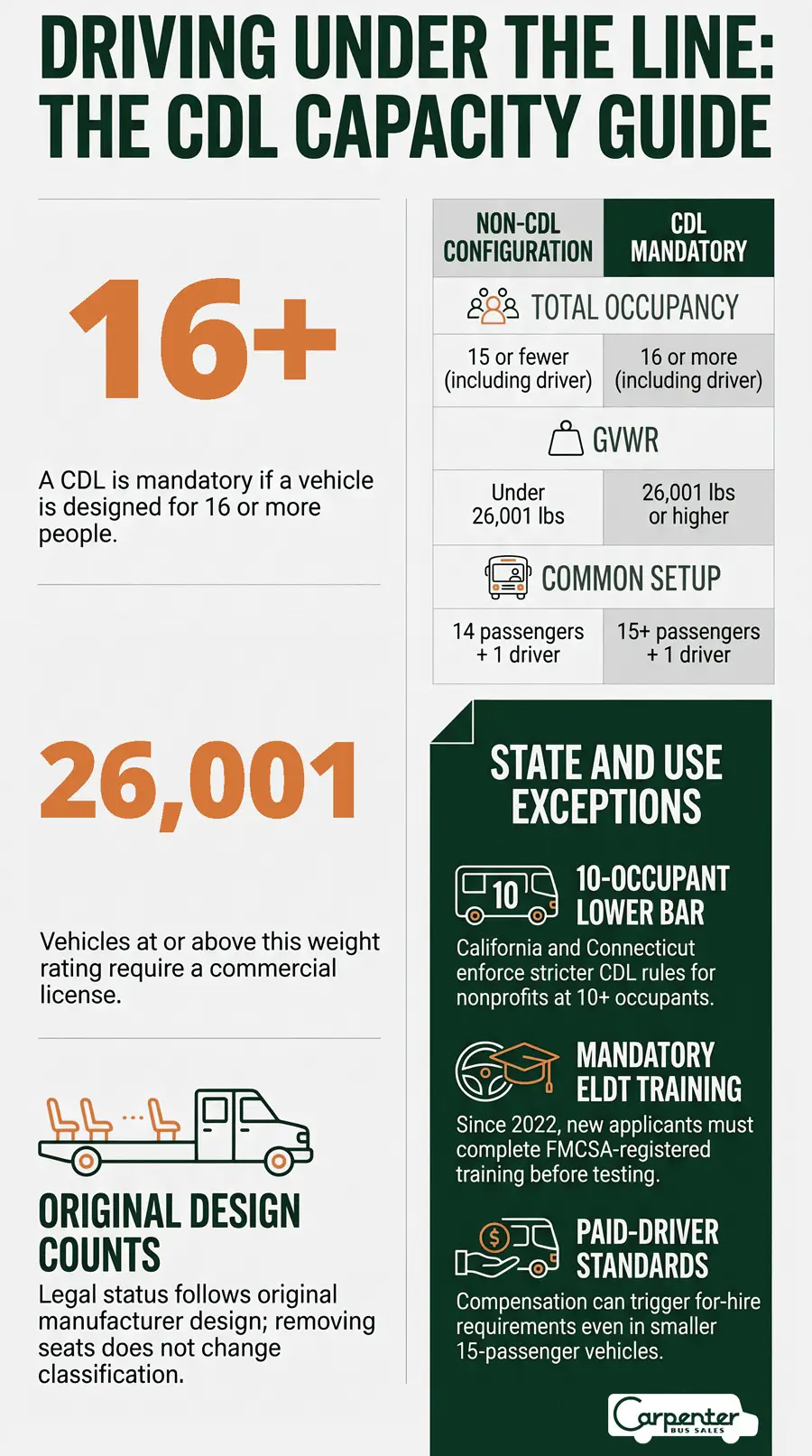
A CDL with a Passenger endorsement is mandatory if either condition is met:
- The vehicle is designed to carry 16 or more people, including the driver
- The vehicle has a GVWR or GVW of 26,001 pounds or more
When neither threshold is crossed, a regular driver's license is enough in the majority of states. That standard is set by 49 CFR Part 383. States may adopt stricter rules; they may not adopt weaker ones.
Does the 16-Passenger Count Include the Driver?
Yes. This is the detail most buyers overlook. The number is total occupants, not passenger seats alone. After helping hundreds of organizations navigate the same decision, the rule is simple: count every person the vehicle is designed to hold, including the person behind the wheel.
In everyday terms, a bus marketed as a "15-passenger bus" is usually configured for 14 riders plus the driver, 15 people total, and therefore sits under the federal line. A bus that offers 15 passenger seats plus a driver's seat reaches 16 total and requires a CDL for every driver. That single extra seat can separate a vehicle that a driver with a regular license may operate from one requiring a CDL-qualified driver.
What Is a Non-CDL Bus?
A non-CDL bus is a purpose-built coach deliberately kept under the federal thresholds: 14 passengers plus the driver (15 total) and both GVWR and GVW below 26,001 pounds.
These vehicles typically measure 20 to 24 feet and ride on Ford or Chevrolet chassis. They are true bus bodies with higher ceilings, a proper entry door, and usable luggage space rather than vans. Once organizations understand the licensing arithmetic, this is the configuration most churches, senior communities, and small schools ultimately choose.
"Non-CDL bus" is an industry shorthand, not a legal classification. It simply describes a bus engineered to remain on the safe side of the 16-occupant line.
Browse non-CDL buses for sale, including non-CDL 15-passenger options built specifically to stay under the federal threshold.
Other License Terms You'll Run Into
Anything above the federal thresholds requires a CDL. A few additional terms often create confusion:
Commercial Driver's License (CDL). The national standard. Class A, B, or C is assigned according to the vehicle. Buses requiring a CDL generally need the Passenger (P) endorsement, which is tested separately. For a single bus designed to carry 16 or more people including the driver, Class C with P endorsement generally applies when both GVWR and GVW are below 26,001 pounds; Class B with P endorsement generally applies at or above that weight threshold.
Chauffeur's license. A state-level credential some jurisdictions still use for for-hire vehicles such as limos or taxis. Many states have folded the concept into regular or commercial classes, yet the term continues to appear. A chauffeur's license does not replace a CDL on a 16-plus-passenger bus.
Class E, Class F, and other state classes. Certain states create intermediate categories that activate on weight or passenger count before the federal CDL threshold is reached. That is why the state-by-state section later in this guide matters.
DOT medical card. A Medical Examiner's Certificate required for many CDL drivers and for some non-CDL commercial drivers. CDL holders must self-certify in one of four operating categories. Under federal rules, non-excepted interstate drivers must meet the DOT medical-card requirements, while excepted interstate drivers do not; intrastate requirements depend on the driver's state and operating category. See FMCSA's medical-certification guidance.
Can You Convert a Bus from CDL to Non-CDL?
Do not assume so. FMCSA guidance states that "designed to transport" means the vehicle's original design and that removing seats does not change its design capacity while it still transports passengers. Unbolting seats, by itself, does not turn a 16-plus-occupant bus into a non-CDL passenger vehicle. See the FMCSA guidance on original design capacity.
Some vehicle manufacturers may support a documented modification process that includes replacement capacity labels. However, Carpenter Bus Sales has not established here that a manufacturer-supported modification changes the federal original-design analysis or that every state licensing agency will accept it. A new label or manufacturer letter should not be treated as automatic proof that the CDL requirement has changed.
Before spending money on a modification, provide the vehicle identification number, original capacity, proposed seating, GVWR, operating state, and intended use to the state driver-licensing agency. Ask for written confirmation of the license required after the proposed work, and obtain written confirmation from the insurance carrier as well.
When a manufacturer-supported modification is available, the shop work and documentation may include:
- A letter from the organization documenting the change
- Before-and-after photographs of the removed seats
- Documentation and replacement labels issued by the original manufacturer, when available
- Installation of the new labels before the bus returns to service
Carpenter Bus Sales can evaluate whether the manufacturer supports this work and can perform eligible modifications at our Franklin, Tennessee and Elm Mott, Texas (Waco Area) facilities. Typical shop pricing has ranged from $3,000 to $5,000 depending on the vehicle, number of seats removed, documentation, and disposal fees. That price is for the work; it is not a guarantee that a licensing agency or insurer will treat the vehicle as non-CDL. Eligibility and regulatory treatment must be confirmed for the specific vehicle and jurisdiction before work begins.
Vehicle-by-Vehicle: What the Rule Means for Your Bus
The same two numbers govern every vehicle below. Occupant capacity, vehicle weight, and applicable licensing rules determine the outcome. Here is how the rule applies to the buses operators ask about most often.
Do You Need a CDL to Drive a Shuttle Bus?
It depends entirely on configuration. Most shuttle buses sold to hotels, senior communities, and parking operators are built for 16 or more occupants and therefore require a CDL with a Passenger endorsement.
The word "shuttle" describes use, not capacity. We sell 12-occupant shuttles and 33-occupant shuttles; the licensing requirements are completely different.
What matters is the capacity plate, not the brochure language. Before assuming anything about a shuttle you own or are considering, locate the manufacturer's capacity label and read the total occupant figure.
Organizations that run airport or campus routes and cannot staff CDL drivers should specifically request a shuttle built for 14 passengers plus the driver. The body style and mission remain the same; only the legal side of the line changes.
Browse shuttle buses or browse shuttle buses for sale.
Do You Need a CDL to Drive a Mini Bus or a Short Bus?
Usually no for a true mini bus; it depends for a short bus. The two labels are often used interchangeably even though they describe different vehicles.
"Mini bus" is a marketing term with no fixed capacity. Most units sold in this segment are built for 14 passengers plus the driver on a 20- to 24-foot Ford or Chevrolet chassis and therefore fall under both federal thresholds. Mini buses are also built at 20 and 25 passengers, so the name alone offers no protection.
"Short bus" almost always refers to a small school bus. School buses carry additional rules and an S endorsement on top of the passenger endorsement, an entirely separate conversation.
If the need is a small bus for school activities such as athletics or field trips, a Multi-Function School Activity Bus (MFSAB) may be appropriate. Under federal vehicle-safety rules, an MFSAB is a type of school bus whose purposes do not include transporting students between home and school or school-bus stops. It must meet the Federal Motor Vehicle Safety Standards that apply to school buses except the standards requiring flashing lights and stop arms. Federal law regulates manufacture and sale; each state determines the operational rules that apply. Verify the intended use and state requirements before purchase. See NHTSA's school-bus regulations FAQs.
Browse mini buses or browse MFSAB activity buses.
Do You Need a CDL for a 14 or 15 Passenger Bus?
Generally, no, provided the vehicle also stays below the federal CDL weight threshold. The outcome hinges on how the number is counted.
The rule is the same every time: total occupants, not passenger seats.
A bus advertised as a "15-passenger bus" typically means 14 riders plus the driver (15 total) and stays under the line. A bus with 15 passenger seats plus a driver's seat reaches 16 total and requires a CDL with a Passenger endorsement for every driver.
That single seat can be the difference between a vehicle a driver with a regular license may operate and one requiring a CDL-qualified driver. It is the detail most frequently missed at purchase.
Two important state exceptions: California treats more than 10 occupants as a bus when a nonprofit operates it, so a 15-passenger bus still requires a CDL there. Connecticut requires a Public Passenger endorsement at 10 or more people in private service and explicitly names church buses in the statute. Both are detailed in the state guide below.
Browse non-CDL 15 passenger buses.
Do You Need a CDL to Drive a Church Bus?
Yes, once the bus is designed for 16 or more occupants including the driver. Church ownership does not lower the threshold, and the limited federal provisions for private motor carriers of passengers on a non-business basis are narrower than most congregations expect.
In practice, states administer CDL licensing and nearly all require a CDL for any vehicle designed to carry 16 or more people regardless of ownership. Plan on needing one at 16-plus capacity.
Nonprofit status also does not create a lighter rule; in California and Connecticut it creates a stricter one.
This is the most common reason a church bus remains parked. A congregation purchases a 20- or 25-passenger bus that fits the youth group, then discovers only one or two people in the building can legally drive it. When that occurs, the dependable option is to certify additional drivers. A manufacturer-supported vehicle modification may be worth evaluating, but it should proceed only after the state licensing agency and insurance carrier confirm in writing how they will treat that specific vehicle after the proposed work.
Browse church buses for sale.
Do You Need a CDL to Drive a Bus for Personal Use?
In most states, no, provided the vehicle stays under 16 occupants and under 26,001 pounds GVWR.
Personal, non-commercial use of a large vehicle is treated differently from commercial operation in the majority of jurisdictions. A bus converted into a recreational vehicle is usually governed by RV rules rather than commercial rules, and several states maintain a specific non-commercial license class for large personal vehicles.
Two cautions apply. First, this is the area where state law diverges most widely from the federal baseline, so check the state guide rather than assuming. Second, classification follows the original design capacity and the manufacturer's capacity label, not the seats currently bolted in place. Purchasing a 30-passenger bus and removing seats over a weekend does not create a non-CDL vehicle.
If the plan is to convert a bus rather than operate it as a bus, contact the state DMV before purchase, not after.
Vehicle Modification vs. Driver Training: What Should You Compare?
This is a decision many organizations face, and the driver-training side changed in 2022.
Since February 7, 2022, the federal Entry-Level Driver Training (ELDT) rule has applied to anyone obtaining a Class A or Class B CDL for the first time or a Passenger (P) endorsement for the first time. The driver must complete training through an FMCSA-registered provider before taking the applicable skills or knowledge test. The requirement is not retroactive for drivers who already held the relevant CDL or endorsement before that date.
For a volunteer with no prior commercial experience, the path may include registered ELDT theory, range and road training, a commercial learner's permit, the skills test, the passenger endorsement, and medical certification when required for the driver's operating category. Training prices vary by provider and location; obtain current local quotes rather than relying on a national estimate.
| Certify a Driver | Proposed Vehicle Modification | |
|---|---|---|
| Cost | Varies by provider and location | Typical Carpenter shop work: $3,000 to $5,000 |
| Time | Varies by provider and testing availability | Varies by manufacturer documentation and shop scheduling |
| Repeats | Every time a volunteer moves, ages out, or stops | Potentially one-time, if accepted by the licensing agency and insurer |
| Trade-off | None to seat capacity | You give up seats, and the legal result is not automatic |
Do not compare costs until the state licensing agency and insurance carrier have confirmed in writing that they will accept the proposed post-modification configuration for that VIN and intended use. California and Connecticut can require more than a regular license below 16 occupants, and an insurer may impose driver requirements beyond the legal minimum.
Practical guidance: if the bus routinely runs near capacity, keep the seats and train drivers. If a larger bus typically carries a dozen people and sits idle because few drivers hold the required license, first price driver training. Evaluate a manufacturer-supported modification only after its legal and insurance treatment has been confirmed in writing.
Not sure which way your bus goes? A proposed modification depends on the manufacturer, vehicle age, condition, VIN, jurisdiction, and intended use. Ask us what manufacturer documentation may be available, then confirm the licensing result in writing with your state agency and insurance carrier before authorizing work.
California, Connecticut, and Other Stricter States
Brochure language has no legal force. Occupant capacity, vehicle weight, intended use, and state licensing rules matter, and a handful of states set lower thresholds than the federal floor.
California: Nonprofit Use Is Enough on Its Own
California Vehicle Code section 233 defines a vehicle designed, used, or maintained for carrying more than 10 persons including the driver as a bus when it is used to transport persons for compensation or profit, or when it is used by a nonprofit organization or group. The second clause is decisive: nonprofit use alone is sufficient.
The California Highway Patrol has confirmed the licensing consequence. Since August 1, 2017, a driver operating any passenger transportation vehicle as defined in CVC section 464 must hold a commercial driver license with the passenger endorsement. CVC 464 defines a passenger transportation vehicle as any vehicle designed, used, or maintained for carrying more than 10 persons including the driver.
For a California church this means a 15-passenger bus, the exact vehicle the non-CDL category exists to provide, still requires a driver with a CDL and passenger endorsement. The effective threshold is 10, not 16.
It also means reclassifying an existing bus down to 15 occupants will not solve a driver shortage in California. Organizations operating there should speak with us before investing in a conversion that may not achieve the intended result.
Connecticut: Church Buses Are Named in the Statute
Connecticut does not require a CDL below 16 passengers, but it does require an endorsement. A Public Passenger (F) endorsement is required on any class of license, commercial or regular, to operate a service bus carrying 10 or more people in private service without charge to the individual. The statute explicitly includes church buses.
Consequently a Connecticut church operating a 15-passenger bus needs a driver whose regular license carries an F endorsement, which involves a separate application and the same medical-examination standard required for a CDL. The bus itself is fine; the license is not, unless the endorsement step has been completed.
The For-Hire States
Several states leave volunteer and non-commercial operation alone but add requirements the moment a driver is paid or passengers are carried for hire, even well below 16 occupants. As of this review that group includes Arkansas, Missouri, New York, Rhode Island, and Tennessee. The specific credential varies. Sometimes it is a for-hire endorsement, sometimes a separate license class.
Understanding the distinction is important before staffing decisions are finalized. In these states a volunteer driver and a paid driver are held to different standards, and even a modest stipend can move a driver from one category to the other. Any form of compensation should prompt a check of the state guide and confirmation with the local DMV.
One additional note on student transport: Vermont requires a Type II school bus endorsement to operate an 11 to 15 passenger vehicle transporting students, which is separate from CDL rules. Other states restrict which vehicles may carry students at all; those rules appear state by state below.
CDL Requirements by State
The federal floor applies in every jurisdiction: 16 or more occupants including the driver, or a GVWR or GVW of 26,001 pounds or more, requires a CDL with a Passenger endorsement. The reference below shows only what each state adds on top of that baseline. Expand any state for details, including our source and the date the information was last verified.
This information is for educational purposes only. State regulations change frequently. Always confirm with your state DMV or Department of Public Safety before making a licensing decision. If you would like help reading your state's rule against a specific vehicle, call us at 800-370-6180.
Alabama
Federal rule only. A regular driver's license covers up to 15 occupants. A CDL with a Passenger endorsement is required at 16 or more, or at a GVWR of 26,001 pounds or more. No lower threshold for churches or nonprofits, and no medical card required for non-commercial use.
School van rules:Public schools only: vans/buses over 10 passengers can't transport K-12 students unless built to school bus standard. Private schools not addressed.
Alaska
Federal rule only. A regular driver's license covers up to 15 occupants. A CDL with a Passenger endorsement is required at 16 or more, or at a GVWR of 26,001 pounds or more. No lower threshold for churches or nonprofits, and no medical card required for non-commercial use.
School van rules:Daily home-to-school student transport is restricted to certified school buses under 4 AAC 27. Non-conforming 15-passenger vans cannot be used for regular pupil route operations.
Arizona
Federal rule only. A regular driver's license covers up to 15 occupants. A CDL with a Passenger endorsement is required at 16 or more, or at a GVWR of 26,001 pounds or more. No lower threshold for churches or nonprofits, and no medical card required for non-commercial use.
School van rules:Under A.R.S. 28-900 and A.A.C. R17-9-101 et seq., vehicles used to transport school children on regular daily routes must meet certified school bus minimum standards.
Arkansas (adds requirements)
Nonprofit / CDL threshold:CDL required at 16+ passengers including driver. No lower threshold for churches or nonprofits.
Endorsement required:A Class D license requires a "P" endorsement only if carrying passengers for hire. Churches and nonprofits operating non-commercially up to 15 passengers do not need this.
Medical card (non-CDL commercial):Not required.
School van rules:Public school districts cannot use non-conforming 15-passenger vans for regular pupil transport.
California (adds requirements)
Nonprofit / CDL threshold:More than 10 occupants including the driver when used by a nonprofit/group or for compensation/profit (CVC 233, 464). Note: An uncompensated operator with a regular Class C license may drive a non-profit vanpool vehicle seating 10 to 15 passengers strictly for ridesharing under statutory conditions.
Endorsement required:CDL Class C with Passenger (P) endorsement if GVWR is 26,000 lbs or less; Class B with P endorsement if GVWR exceeds 26,000 lbs. Note: California uses 26,000 lbs here, not the federal 26,001 lbs figure.
Medical card (non-CDL commercial):Required for school bus, youth bus, GPPV drivers.
School van rules:Banned for new purchase by school districts/community colleges; existing vans restricted to licensed/endorsed drivers.
Colorado
Federal rule only. A regular driver's license covers up to 15 occupants. A CDL with a Passenger endorsement is required at 16 or more, or at a GVWR of 26,001 pounds or more. No lower threshold for churches or nonprofits, and no medical card required for non-commercial use.
School van rules:Public school districts and charter schools are prohibited from purchasing, leasing, or using standard 15-passenger vans for student transport.
Connecticut (adds requirements)
Nonprofit / CDL threshold:10 or more persons when used in private service without charge to the individual, explicitly including church buses. CDL required only at 16+ passengers.
Endorsement required:"F" Public Passenger Endorsement required on any class license (CDL or regular) to operate a service bus, including a church bus, carrying 10 or more people.
Medical card (non-CDL commercial):Required. Same medical exam standard as a CDL.
School van rules:Applies to public, parochial, and private schools. A School Bus Driver (V or S) endorsement is required for any vehicle carrying 10 or more passengers used to transport students.
Delaware
Federal rule only. A regular driver's license covers up to 15 occupants. A CDL with a Passenger endorsement is required at 16 or more, or at a GVWR of 26,001 pounds or more. No lower threshold for churches or nonprofits, and no medical card required for non-commercial use.
School van rules:Public school student transportation is restricted to certified school buses or authorized small passenger vehicles.
Florida
Federal rule only. A regular driver's license covers up to 15 occupants. A CDL with a Passenger endorsement is required at 16 or more, or at a GVWR of 26,001 pounds or more. No lower threshold for churches or nonprofits, and no medical card required for non-commercial use.
School van rules:Public schools cannot use vehicles designed to transport more than 10 persons for student transport unless it is a multifunction school activity bus.
Georgia
Federal rule only. A regular driver's license covers up to 15 occupants. A CDL with a Passenger endorsement is required at 16 or more, or at a GVWR of 26,001 pounds or more. No lower threshold for churches or nonprofits, and no medical card required for non-commercial use.
School van rules:No separate statutory restrictions apply beyond standard commercial motor vehicle and occupant safety codes.
Hawaii
Federal rule only. A regular driver's license covers up to 15 occupants. A CDL with a Passenger endorsement is required at 16 or more, or at a GVWR of 26,001 pounds or more. No lower threshold for churches or nonprofits, and no medical card required for non-commercial use.
School van rules:Vans weighing less than 10,000 lbs GVWR are permitted for preschool/daycare and for K-12 school-related activities, but daily home-to-school transport requires a fully compliant school vehicle.
Idaho
Federal rule only. A regular driver's license covers up to 15 occupants. A CDL with a Passenger endorsement is required at 16 or more, or at a GVWR of 26,001 pounds or more. No lower threshold for churches or nonprofits, and no medical card required for non-commercial use.
School van rules:Public schools cannot routinely use non-school bus vehicles like 15-passenger vans for regular home-to-school transport except for specific exempt groups.
Illinois (adds requirements)
Nonprofit / CDL threshold:CDL required for vehicles designed to transport 16 or more passengers including the driver. No lower threshold for churches or nonprofits.
Endorsement required:None below 16 passengers. A regular Class D non-commercial license covers vehicles up to 16,000 lbs carrying 15 or fewer passengers.
Medical card (non-CDL commercial):Not required for non-commercial intrastate use by churches or nonprofits.
School van rules:Any vehicle designed to carry more than 10 persons is classified as a school bus when transporting K-12 or nursery students for public, private, or religious schools.
Indiana (adds requirements)
Nonprofit / CDL threshold:CDL required for vehicles designed to transport 16 or more passengers including the driver. No lower threshold for churches or nonprofits.
Endorsement required:A "for-hire endorsement" is required for non-CDL vehicles transporting passengers for hire, but churches and nonprofits operating non-commercially do not require this.
Medical card (non-CDL commercial):Not required for non-CDL passenger vehicles.
School van rules:Public and private schools may use 15-passenger vans (special purpose buses) for extracurricular activities and field trips, but not for regular home-to-school transportation of general education students.
Iowa (adds requirements)
Nonprofit / CDL threshold:CDL required for vehicles designed to transport 16 or more passengers including the driver. No lower threshold for churches or nonprofits.
Endorsement required:None below 16 passengers unless operated for-hire or for wages (then a Class D Chauffeur license is required).
Medical card (non-CDL commercial):Not required for non-CDL drivers operating passenger vehicles under 10,001 lbs GVWR in intrastate commerce.
School van rules:Non-school bus passenger vehicles used for student activities are limited to those designed for 9 or fewer passengers, or used vans designed for 12 or fewer.
Kansas
Federal rule only. A regular driver's license covers up to 15 occupants. A CDL with a Passenger endorsement is required at 16 or more, or at a GVWR of 26,001 pounds or more. No lower threshold for churches or nonprofits, and no medical card required for non-commercial use.
School van rules:Any school district or nonpublic school transporting students in a vehicle designed for more than 10 passengers in addition to the driver must use a certified school bus.
Kentucky
Federal rule only. A regular driver's license covers up to 15 occupants. A CDL with a Passenger endorsement is required at 16 or more, or at a GVWR of 26,001 pounds or more. No lower threshold for churches or nonprofits, and no medical card required for non-commercial use.
School van rules:Public school districts are prohibited from using 15-passenger vans for student transport; non-school bus passenger vehicles are limited to those designed for 10 or fewer passengers.
Louisiana (adds requirements)
Nonprofit / CDL threshold:CDL required for vehicles designed to transport 16 or more passengers including the driver. No lower threshold for churches or nonprofits.
Endorsement required:None below 16 passengers for private non-commercial use. A regular Class E personal license covers up to 15 passengers unless operated for hire.
Medical card (non-CDL commercial):Not required for non-commercial intrastate drivers operating passenger vehicles with 15 or fewer passengers.
School van rules:The state Department of Education strictly prohibits the use of any passenger or cargo van to transport students to and from any school-related activity.
Maine
Federal rule only. A regular driver's license covers up to 15 occupants. A CDL with a Passenger endorsement is required at 16 or more, or at a GVWR of 26,001 pounds or more. No lower threshold for churches or nonprofits, and no medical card required for non-commercial use.
School van rules:Private schools may use privately owned 10 to 15-passenger vans for school activities but not for daily home-to-school transport.
Maryland
Federal rule only. A regular driver's license covers up to 15 occupants. A CDL with a Passenger endorsement is required at 16 or more, or at a GVWR of 26,001 pounds or more. No lower threshold for churches or nonprofits, and no medical card required for non-commercial use.
School van rules:Public school systems are prohibited from using standard 15-passenger vans; non-school bus alternative passenger vehicles are limited to a maximum seating capacity of 10 passengers not including the driver.
Massachusetts
Federal rule only. A regular driver's license covers up to 15 occupants. A CDL with a Passenger endorsement is required at 16 or more, or at a GVWR of 26,001 pounds or more. No lower threshold for churches or nonprofits, and no medical card required for non-commercial use.
School van rules:Non-school bus vehicles used to transport school pupils (7D vehicles) are restricted to a maximum seating capacity of 10 passengers in addition to the driver.
Michigan (adds requirements)
Nonprofit / CDL threshold:CDL required for vehicles designed to transport 16 or more passengers including the driver. No lower threshold for churches or nonprofits.
Endorsement required:None below 16 passengers for non-commercial volunteer use. A regular operator license covers up to 15 passengers.
Medical card (non-CDL commercial):Required if operating a motor vehicle with a gross vehicle weight rating of 10,001 pounds or more.
School van rules:Vehicles with a seating capacity of 11 or more passengers including the driver that are not school buses cannot be used to transport pupils to or from school or school-related events.
Minnesota
Federal rule only. A regular driver's license covers up to 15 occupants. A CDL with a Passenger endorsement is required at 16 or more, or at a GVWR of 26,001 pounds or more. No lower threshold for churches or nonprofits, and no medical card required for non-commercial use.
School van rules:Non-school bus alternative passenger vehicles used for student transport (Type III vehicles) are limited to a maximum seating capacity of 10 or fewer people including the driver.
Mississippi
Federal rule only. A regular driver's license covers up to 15 occupants. A CDL with a Passenger endorsement is required at 16 or more, or at a GVWR of 26,001 pounds or more. No lower threshold for churches or nonprofits, and no medical card required for non-commercial use.
School van rules:Public school districts are prohibited from using standard 15-passenger vans; any 10 to 15-passenger vehicle used for student transport must meet federal school bus safety standards.
Missouri (adds requirements)
Nonprofit / CDL threshold:CDL required for vehicles designed to transport 16 or more passengers including the driver. No lower threshold for churches or nonprofits.
Endorsement required:A regular Class F license covers up to 15 passengers for uncompensated use; a Class E (For-Hire) license is required if the driver is paid to transport 14 or fewer passengers.
Medical card (non-CDL commercial):Not required for non-commercial intrastate drivers operating passenger vehicles designed for 15 or fewer passengers under 10,001 lbs GVWR.
School van rules:Any motor vehicle designed to carry more than 10 passengers that transports students for educational purposes is classified as a school bus for both public and private entities.
Montana
Federal rule only. A regular driver's license covers up to 15 occupants. A CDL with a Passenger endorsement is required at 16 or more, or at a GVWR of 26,001 pounds or more. No lower threshold for churches or nonprofits, and no medical card required for non-commercial use.
School van rules:Public school districts may use 8 to 15-passenger vehicles for school-sponsored functions and activities, but not for regular home-to-school bus routes.
Nebraska
Federal rule only. A regular driver's license covers up to 15 occupants. A CDL with a Passenger endorsement is required at 16 or more, or at a GVWR of 26,001 pounds or more. No lower threshold for churches or nonprofits, and no medical card required for non-commercial use.
School van rules:School districts and nonpublic schools cannot transport students in vans exceeding a total capacity of 10 occupants including the driver.
Nevada
Federal rule only. A regular driver's license covers up to 15 occupants. A CDL with a Passenger endorsement is required at 16 or more, or at a GVWR of 26,001 pounds or more. No lower threshold for churches or nonprofits, and no medical card required for non-commercial use.
School van rules:Any motor vehicle designed or used to carry more than 10 passengers in addition to the driver that is owned or operated by a public or private school is defined as a school bus.
New Hampshire
Federal rule only. A regular driver's license covers up to 15 occupants. A CDL with a Passenger endorsement is required at 16 or more, or at a GVWR of 26,001 pounds or more. No lower threshold for churches or nonprofits, and no medical card required for non-commercial use.
School van rules:Standard 15-passenger vans may not be used for daily home-to-school transport, but passenger vans classified as mixed use school buses may transport pupils to and from school-sponsored activities.
New Jersey
Federal rule only. A regular driver's license covers up to 15 occupants. A CDL with a Passenger endorsement is required at 16 or more, or at a GVWR of 26,001 pounds or more. No lower threshold for churches or nonprofits, and no medical card required for non-commercial use.
School van rules:Any vehicle used to transport students to or from school or school-related activities by public or nonpublic schools must meet state and federal Type I or Type II school bus standards.
New Mexico
Federal rule only. A regular driver's license covers up to 15 occupants. A CDL with a Passenger endorsement is required at 16 or more, or at a GVWR of 26,001 pounds or more. No lower threshold for churches or nonprofits, and no medical card required for non-commercial use.
School van rules:Student transportation is restricted to certified school buses and 6-to-9-passenger SUVs; standard passenger vans and mini-vans are excluded.
New York (adds requirements)
Nonprofit / CDL threshold:CDL required for vehicles designed to transport 16 or more passengers including the driver (15 or more passengers in addition to the driver). No lower threshold for churches or nonprofits.
Endorsement required:A standard Class D license covers vehicles up to 15 total occupants for personal or non-commercial use; a Class E license is required if transporting 14 or fewer passengers for hire.
Medical card (non-CDL commercial):Not required for non-commercial intrastate passenger transport under 16 occupants, but drivers covered under Article 19-A must pass a biennial 19-A medical examination.
School van rules:Any vehicle designed to transport more than 10 passengers operated for student transport by public or nonpublic schools must meet school bus safety and manufacturing standards.
North Carolina
Federal rule only. A regular driver's license covers up to 15 occupants. A CDL with a Passenger endorsement is required at 16 or more, or at a GVWR of 26,001 pounds or more. No lower threshold for churches or nonprofits, and no medical card required for non-commercial use.
School van rules:Public schools are prohibited from using 11 to 15-passenger vans for regular home-to-school transport. Use for school activity trips is permitted but subject to state guidance.
North Dakota
Federal rule only. A regular driver's license covers up to 15 occupants. A CDL with a Passenger endorsement is required at 16 or more, or at a GVWR of 26,001 pounds or more. No lower threshold for churches or nonprofits, and no medical card required for non-commercial use.
School van rules:Schools may use vehicles designed to seat 10 to 15 passengers for non-route activity transport or specific student operations, provided the driver meets state certification, background, and medical clearance requirements.
Ohio
Federal rule only. A regular driver's license covers up to 15 occupants. A CDL with a Passenger endorsement is required at 16 or more, or at a GVWR of 26,001 pounds or more. No lower threshold for churches or nonprofits, and no medical card required for non-commercial use.
School van rules:Vehicles designed to carry more than 12 passengers used for student transportation to or from school or school events must meet state school bus construction standards.
Oklahoma
Federal rule only. A regular driver's license covers up to 15 occupants. A CDL with a Passenger endorsement is required at 16 or more, or at a GVWR of 26,001 pounds or more. No lower threshold for churches or nonprofits, and no medical card required for non-commercial use.
School van rules:Vehicles used to transport 10 or more public school students at one time for curriculum-based activities must meet state and federal school bus construction standards.
Oregon
Federal rule only. A regular driver's license covers up to 15 occupants. A CDL with a Passenger endorsement is required at 16 or more, or at a GVWR of 26,001 pounds or more. No lower threshold for churches or nonprofits, and no medical card required for non-commercial use.
School van rules:Vehicles used for student transport must meet state School Bus or Type 10 / Type 20 School Activity Vehicle standards. Standard, unmodified 15-passenger vans do not meet state safety specifications.
Pennsylvania
Federal rule only. A regular driver's license covers up to 15 occupants. A CDL with a Passenger endorsement is required at 16 or more, or at a GVWR of 26,001 pounds or more. No lower threshold for churches or nonprofits, and no medical card required for non-commercial use.
School van rules:Student transportation must occur in a certified school bus or a designated school vehicle (restricted to a capacity of 10 or fewer occupants including the driver).
Rhode Island (adds requirements)
Nonprofit / CDL threshold:CDL required for vehicles designed to transport 16 or more passengers including the driver. No lower threshold for churches or nonprofits.
Endorsement required:None below 16 passengers for volunteer non-commercial use. A standard operator license covers up to 15 passengers; a Chauffeur license is required if transporting passengers for compensation in vehicles designed to carry fewer than 14 passengers.
Medical card (non-CDL commercial):Not required for non-commercial intrastate passenger transport under 16 passengers under 10,001 lbs GVWR.
School van rules:Fixed-route pupil transport is limited to vehicles carrying 10 or fewer passengers plus the driver; extracurricular school transport in 11 to 15-passenger vehicles requires certified Multifunction School Activity Buses.
South Carolina
Federal rule only. A regular driver's license covers up to 15 occupants. A CDL with a Passenger endorsement is required at 16 or more, or at a GVWR of 26,001 pounds or more. No lower threshold for churches or nonprofits, and no medical card required for non-commercial use.
School van rules:Under Jacob's Law, any public school, private school, or childcare center transporting preprimary, primary, or secondary students must use vehicles meeting federal school bus safety standards.
South Dakota
Federal rule only. A regular driver's license covers up to 15 occupants. A CDL with a Passenger endorsement is required at 16 or more, or at a GVWR of 26,001 pounds or more. No lower threshold for churches or nonprofits, and no medical card required for non-commercial use.
School van rules:Vehicles used to transport school pupils must meet state school bus safety construction standards or be standard passenger automobiles carrying 10 or fewer occupants.
Tennessee (adds requirements)
Nonprofit / CDL threshold:CDL required for vehicles designed to transport 16 or more passengers including the driver. No lower threshold for churches or nonprofits.
Endorsement required:None below 16 passengers for non-commercial/volunteer use (regular Class D); a For-Hire (F) endorsement on a Class D license is required if paid or transporting passengers for hire in vehicles under 26,001 lbs GVWR.
Medical card (non-CDL commercial):Not required for non-commercial intrastate passenger transport under 16 occupants under 10,001 lbs GVWR.
School van rules:15-passenger vans are strictly prohibited for child care and educational agency transport; public school activity vans must comply with State Board of Education safety regulations.
Texas
Federal rule only. A regular driver's license covers up to 15 occupants. A CDL with a Passenger endorsement is required at 16 or more, or at a GVWR of 26,001 pounds or more. No lower threshold for churches or nonprofits, and no medical card required for non-commercial use.
School van rules:School buses are required on routes with 15 or more students. On routes with fewer than 15 students, passenger cars or passenger vans may be used.
Utah (adds requirements)
Nonprofit / CDL threshold:CDL required for vehicles designed to transport 16 or more passengers including the driver. No lower threshold for churches or nonprofits.
Endorsement required:None below 16 passengers for non-commercial/volunteer use (covered by a standard Class D license); a Taxicab endorsement is required on a Class D license if operating as a private passenger carrier for compensation.
Medical card (non-CDL commercial):Not required for non-commercial intrastate passenger transport under 16 passengers under 10,001 lbs GVWR.
School van rules:Vehicles designed to carry 11 or more passengers (including the driver) used to transport students to or from school or school activities must meet all state and federal school bus safety standards.
Vermont (adds requirements)
Nonprofit / CDL threshold:CDL required for vehicles designed to transport 16 or more passengers including the driver. No lower threshold for churches or nonprofits.
Endorsement required:None below 16 passengers for non-commercial/volunteer use (covered by an Operator license); operating a Type II school bus (11 to 15 passengers) to transport students requires a Type II school bus endorsement.
Medical card (non-CDL commercial):Not required for non-commercial intrastate passenger transport under 16 passengers under 10,001 lbs GVWR.
School van rules:Any vehicle with a manufacturer's rated seating capacity of more than 10 passengers used to transport students to or from school or school-related activities is classified as a Type II school bus.
Virginia
Federal rule only. A regular driver's license covers up to 15 occupants. A CDL with a Passenger endorsement is required at 16 or more, or at a GVWR of 26,001 pounds or more. No lower threshold for churches or nonprofits, and no medical card required for non-commercial use.
School van rules:Any vehicle designed to carry more than 10 passengers used to transport students to or from school or school-related activities is defined as a nonconforming bus if it does not meet federal school bus or MFSAB standards.
Washington
Federal rule only. A regular driver's license covers up to 15 occupants. A CDL with a Passenger endorsement is required at 16 or more, or at a GVWR of 26,001 pounds or more. No lower threshold for churches or nonprofits, and no medical card required for non-commercial use.
School van rules:All vehicles with a manufacturer-rated seating capacity greater than 10 persons (including the driver) used to transport students must meet full school bus specifications or be certified MFSABs.
West Virginia (adds requirements)
Nonprofit / CDL threshold:CDL required for vehicles designed to transport 16 or more passengers including the driver. No lower threshold for churches or nonprofits.
Endorsement required:None below 16 passengers for volunteer non-commercial use (covered by a standard Class E license); a Class D (chauffeur) license is required if an individual is employed for the principal purpose of driving a passenger vehicle carrying 15 or fewer occupants.
Medical card (non-CDL commercial):Not required for non-commercial intrastate passenger transport under 16 passengers under 10,001 lbs GVWR.
School van rules:School-owned or leased vehicles not meeting school bus or transit standards may transport no more than 10 passengers (including the driver) for school-sponsored activities.
Wisconsin
Federal rule only. A regular driver's license covers up to 15 occupants. A CDL with a Passenger endorsement is required at 16 or more, or at a GVWR of 26,001 pounds or more. No lower threshold for churches or nonprofits, and no medical card required for non-commercial use.
School van rules:Vehicles carrying 10 or more passengers in addition to the driver used to transport students must meet school bus specifications.
Wyoming
Federal rule only. A regular driver's license covers up to 15 occupants. A CDL with a Passenger endorsement is required at 16 or more, or at a GVWR of 26,001 pounds or more. No lower threshold for churches or nonprofits, and no medical card required for non-commercial use.
School van rules:Vehicles carrying students must meet state and federal school bus minimum safety standards or qualify under designated district fleet vehicle guidelines.
District of Columbia
Federal rule only. A regular driver's license covers up to 15 occupants. A CDL with a Passenger endorsement is required at 16 or more, or at a GVWR of 26,001 pounds or more. No lower threshold for churches or nonprofits, and no medical card required for non-commercial use.
School van rules:Student transport is restricted to certified school buses, MFSABs, or authorized smaller passenger vehicles (8 or fewer passengers).
FAQs
Do you need a CDL to drive a party bus?
Same rule applies. Sixteen or more occupants including the driver, or 26,001 pounds or more GVWR or GVW, means a CDL with a Passenger endorsement. Many states also layer on for-hire requirements.
Do you need a CDL to drive a 15-passenger van?
Federally, no. In California the answer is yes when the van is used by a nonprofit or for compensation, because the state threshold drops to more than 10 occupants. Several states also impose separate restrictions on 15-passenger vans used for student transport. Check the state guide above for the precise rule that applies to you.
What is a chauffeur's license and does it cover a bus?
A chauffeur's license is a state-level credential some jurisdictions still require for driving vehicles for hire, such as taxis or limousines, that fall below the CDL thresholds. Many states have folded the concept into their regular or commercial license classes, but the term is still used in Michigan, West Virginia, Rhode Island, and others. It does not replace a CDL. A chauffeur's license will not cover a bus designed for 16 or more occupants.
Do churches get an exemption from CDL requirements?
Generally no. Federal regulations contain limited provisions for private motor carriers of passengers operating on a non-business basis, but states administer CDL licensing and nearly all require a CDL for any vehicle designed to carry 16 or more people regardless of who owns it. Plan on needing one at 16-plus capacity. In California and Connecticut, nonprofit status makes the rule stricter rather than lighter.
What is a Passenger (P) endorsement?
A certification added to a CDL that confirms the driver has passed written and skills tests focused on safely loading, unloading, and transporting people rather than cargo. Since February 7, 2022, a first-time P endorsement also requires completion of entry-level driver training with an FMCSA-registered provider before the applicant may test.
Can I just remove a seat to get under the limit?
No. FMCSA guidance says "designed to transport" means the vehicle's original design, and removing seats does not change that design capacity while the vehicle still transports passengers. Do not assume that seat removal, a replacement label, or a manufacturer letter eliminates the CDL requirement. Before modifying a bus, obtain written confirmation from the state licensing agency and your insurance carrier for that specific VIN and intended use.
What happens if a driver operates a 16-plus passenger bus without a CDL?
Penalties vary by state and usually include citations and fines for both the driver and the organization. The more serious risk is insurance-related: operating outside licensing requirements can jeopardize coverage if a claim arises. Confirm requirements with your carrier.
Talk It Through Before You Buy
Most organizations that reach out, whether a church, senior-living community, private school, hotel, or fleet operator, are trying to solve one practical problem: how to get more of their people cleared to drive the vehicle they already own or are about to purchase.
Sometimes the solution is a different bus. Sometimes it is training additional drivers and leaving the vehicle configuration alone. A manufacturer-supported modification may be an option, but only after the licensing agency and insurer confirm how they will treat the specific vehicle after the proposed work.
Our free Bus Buying Guide covers capacity, licensing, and configuration before you speak with anyone.
Get the Bus Buying Guide | Browse our full non-CDL bus inventory
Or call 800-370-6180 and ask for your regional salesman. We are glad to walk through the numbers with you.
Last full review of the state-by-state table: August 27, 2026. Content updated September 1, 2026. This information is provided for educational purposes only and is not legal advice. State regulations change frequently, and Carpenter Bus Sales makes no warranty as to the accuracy, completeness, or currency of the information in this table. It should not be relied on as the basis for any purchase, licensing, or staffing decision, and Carpenter Bus Sales is not responsible for any loss or liability arising from reliance on this page. Nothing here creates a professional or advisory relationship between you and Carpenter Bus Sales. Always confirm with your state DMV or Department of Public Safety before making a licensing decision, and check with your insurance carrier about driver requirements beyond what state law sets. If you'd like help reading your state's rule against a specific vehicle, call us at 800-370-6180.
