
Wheelchair Accessible Minivans for Sale
When your organization needs a compact, easy-to-drive wheelchair accessible vehicle for individual resident transport, small group outings, or supplemental fleet coverage, a wheelchair minivan is the most practical and cost-effective solution. Carpenter Bus Sales carries ADA-compliant wheelchair minivans from FR Conversions with rear-entry and side-entry ramp configurations — ready for senior living, church, and medical transport use nationwide.
What Is a Wheelchair Minivan and Who Is It For?
1. A Minivan Converted for Wheelchair Access
A wheelchair minivan is a standard minivan — like the Dodge Grand Caravan, Chrysler Pacifica, or Toyota Sienna — that has been professionally converted by a certified manufacturer to accommodate a wheelchair user. The conversion typically involves lowering the floor by 10–14 inches, installing a fold-out or in-floor ramp (rear-entry or side-entry), adding wheelchair securement tie-downs, and modifying the suspension to handle the additional load. The result is a vehicle that drives and parks like an everyday minivan but provides full ADA-compliant wheelchair access.
2. The Right-Sized Vehicle for Individual Transport
Not every wheelchair transport job requires a full-size van or a shuttle bus. When a senior living activity director needs to take one or two residents to a medical appointment, or a church needs to pick up a mobility-challenged member for Sunday service, a wheelchair minivan is the right tool. It fits in standard parking spaces, uses less fuel than a full-size van, and is comfortable for staff to drive on short daily runs. Think of it as the "sedan" of the wheelchair transport world — purpose-built for the trips that don't need a 12-passenger vehicle.
3. How a Wheelchair Minivan Differs from a Full-Size Wheelchair Van
The key differences come down to capacity and use case. A full-size wheelchair van (like the Ford Transit with a Forest River conversion) can carry 2–4 wheelchair users plus multiple ambulatory passengers on scheduled group routes. A wheelchair minivan typically accommodates 1–2 wheelchair positions and up to 4–6 total passengers. The minivan costs less, is easier to maneuver, and is ideal for on-demand individual transport. Many organizations operate both — a full-size van for daily group routes and a minivan for ad-hoc appointments and one-on-one outings.
Why Organizations Add a Wheelchair Minivan to Their Fleet:
- • Compact ADA Access: Fits in standard parking spaces and garages while providing full wheelchair entry via rear or side ramp.
- • Non-CDL Operation: Drive with a standard license — no special certifications needed for your staff or volunteers.
- • Lower Total Cost: Less expensive to acquire, insure, and maintain than full-size wheelchair vans — ideal for on-demand individual transport.
- • Multiple Platforms: Available on Dodge Grand Caravan, Chrysler Pacifica, and Toyota Sienna with rear-entry and side-entry configurations.
LOOKING FOR A WHEELCHAIR MINIVAN?
GET PRICING & AVAILABILITY!
Wheelchair Minivan Models We Carry
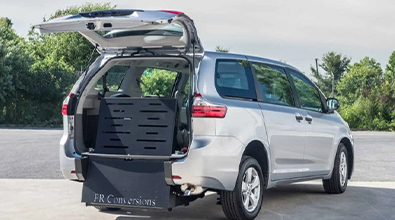
FR Conversions Rear-Entry Wheelchair Minivan
Compact ADA Platform | 1–2 W/C Positions
The FR Conversions rear-entry conversion is our most popular wheelchair minivan for organizational use. A fold-out ramp deploys from the rear hatch, providing straight-in wheelchair access without needing side clearance. The factory seating is reconfigured to accommodate one or two wheelchair positions with Q'Straint securement, while retaining ambulatory seating for up to four additional passengers. Built for daily use in senior living and church settings.
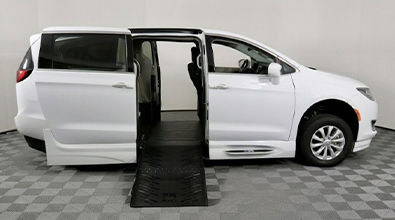
FR Conversions Side-Entry Wheelchair Minivan
Curbside Loading | Front-Position Access
The FR Conversions side-entry model features a lowered floor and a power or manual ramp at the sliding passenger door, allowing the wheelchair user to access the front passenger position. This configuration is ideal for programs that require curbside loading capability or need the wheelchair user seated at the front of the vehicle for easier communication with the driver.
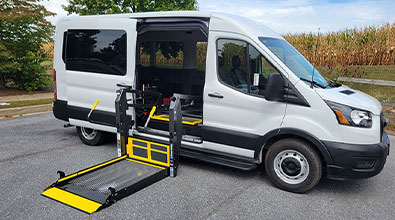
Need More Capacity? See Full-Size Wheelchair Vans
Ford Transit Platform | Up to 4 W/C + 8 Ambulatory
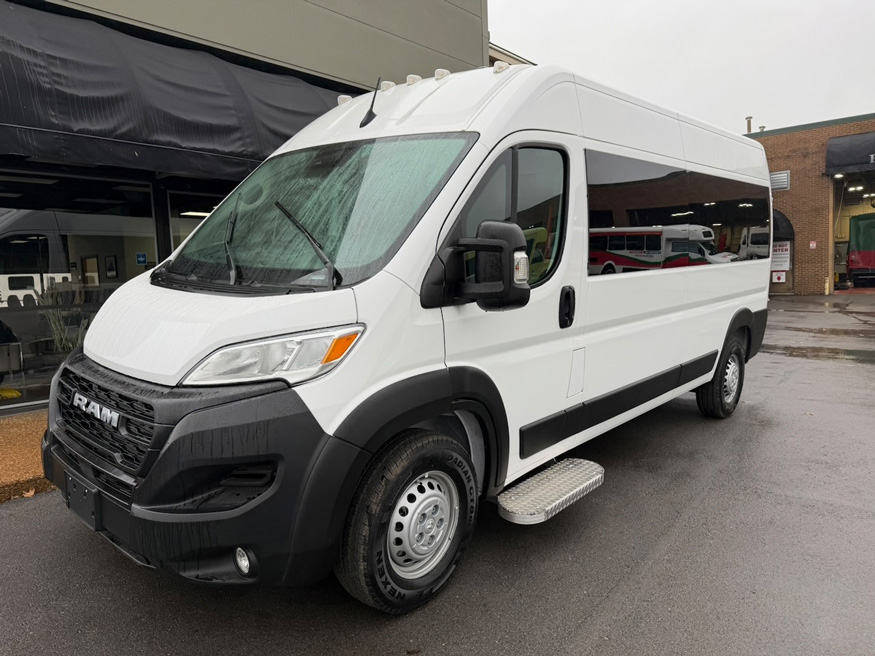
If your operation requires multiple wheelchair positions or higher total passenger counts, our full-size wheelchair vans on the Ford Transit chassis may be the better fit. With 2–4 wheelchair positions and up to 12 total passengers, models from Forest River, FR Conversions, and ADA Boy handle the daily group routes that a minivan can't cover alone.

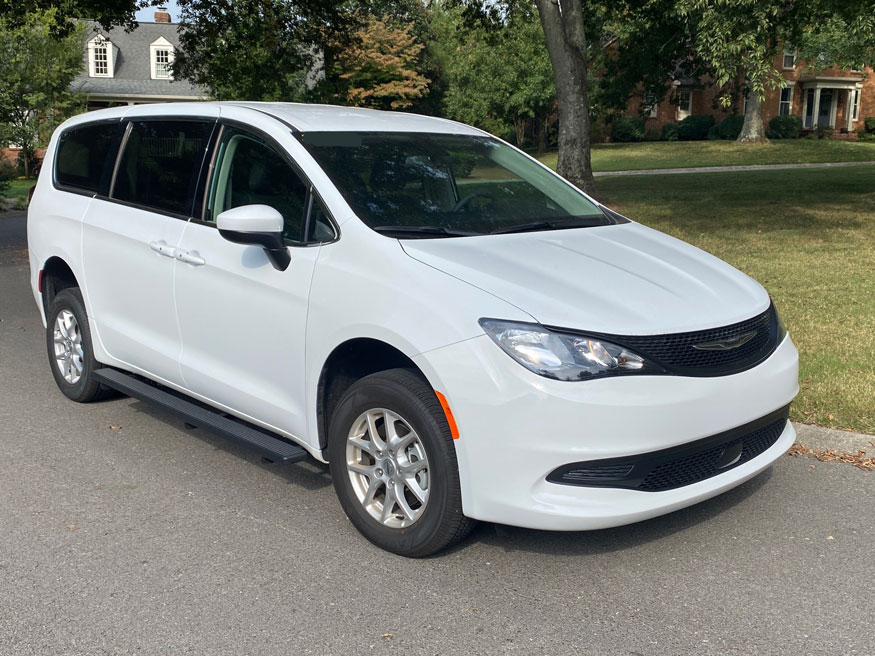
Wheelchair Minivans for Sale — Featured Inventory
Wheelchair Minivan vs. Full-Size Wheelchair Van Comparison
Typical Platforms
Wheelchair Positions
Total Passenger Capacity
Entry Configuration
CDL Required?
Best For
Parking & Maneuverability
| Feature | Wheelchair Minivan | Full-Size Wheelchair Van |
|---|---|---|
| Typical Platforms | Dodge Grand Caravan, Chrysler Pacifica, Toyota Sienna | Ford Transit (High Roof) |
| Wheelchair Positions | 1–2 | 2–4 |
| Total Passenger Capacity | 4–6 (including W/C) | 8–14 (including W/C) |
| Entry Configuration | Rear-entry ramp or side-entry ramp | Rear-entry lift or side-entry lift |
| CDL Required? | No | No |
| Best For | Individual appointments, 1-on-1 transport, supplemental fleet vehicle | Daily group routes, multi-passenger scheduled service |
| Parking & Maneuverability | Standard parking spaces, tight lots, residential driveways | Requires more clearance, better for dedicated loading zones |
Many organizations operate both a wheelchair minivan and a full-size wheelchair van. The minivan handles individual transport and overflow while the full-size van runs scheduled group routes. Contact our team to discuss the right mix for your operation.
Why Buy Your Wheelchair Minivan from Carpenter Bus ?
Commercial Expertise, Not Consumer Sales
Most wheelchair minivan dealers focus on personal-use sales to individual consumers and families. We focus on the organizations that operate these vehicles professionally — senior living communities running daily resident transport, churches picking up members every Sunday, and medical transport providers maintaining NEMT fleets. That means we understand fleet insurance requirements, ADA inspection standards, and the operational reality of putting a vehicle into daily commercial service. When you buy from Carpenter Bus, you get a dealer who speaks your language.
One Dealer for Your Entire Accessible Fleet
A wheelchair minivan is often just one piece of a larger transport operation. You might also need a full-size wheelchair van for group routes and a shuttle bus for high-capacity outings. Carpenter Bus Sales is the only dealer you need for all three. We help you plan the right vehicle mix, keep your fleet specifications consistent, and provide parts and service support for every vehicle — vans and buses — from a single relationship. That simplicity matters when you're managing transport for an entire organization.
Expert Answers to Common Wheelchair Minivan Questions
A certified manufacturer takes a factory minivan and performs several structural modifications: the floor is lowered by 10–14 inches (side-entry) or approximately 10 inches (rear-entry) to create the vertical clearance needed for a seated wheelchair user. A fold-out or in-floor ramp is installed at either the rear hatch or the sliding passenger door. The rear suspension is raised with upgraded springs to compensate for the lowered floor and additional passenger weight. Factory seats are removed or replaced with fold-away seats to create wheelchair positions, and Q'Straint or equivalent securement tie-downs are installed. The finished vehicle meets all applicable Federal Motor Vehicle Safety Standards (FMVSS) and ADA accessibility requirements.
Wheelchair securement in a minivan uses the same WTORS (Wheelchair Tiedown and Occupant Restraint Systems) required in any ADA-compliant vehicle. The standard setup includes four floor-mounted retractable tie-down straps that attach to the wheelchair frame — two at the front and two at the rear — plus a three-point occupant seatbelt for the wheelchair user. Our minivans use Q'Straint securement systems, which are the industry standard for commercial-grade wheelchair transport. The tie-down process takes about 60 seconds for a trained staff member.
It depends on the make, model, and year. Not every minivan can be converted — factors like floor height, door configuration, and structural integrity determine feasibility. The most commonly converted platforms are the Dodge Grand Caravan, Chrysler Pacifica, and Toyota Sienna. Conversion must be performed by a certified manufacturer (not a general mechanic) to meet FMVSS and ADA standards. In most cases, purchasing a pre-converted wheelchair minivan is more cost-effective and reliable than converting an existing vehicle. Contact our team to discuss your options.
Wheelchair minivans almost exclusively use ramps rather than lifts. A ramp is a flat surface (fold-out or in-floor) that creates a gradual incline for the wheelchair to roll up into the vehicle. Ramps are lighter, simpler to maintain, and appropriate for the lower entry height of a minivan. Wheelchair lifts — which mechanically raise the wheelchair from ground level to vehicle floor height — are typically found on full-size vans and buses where the floor is too high for a ramp. If your transport needs require a lift rather than a ramp, you likely need a full-size wheelchair van or bus rather than a minivan.
For organizational and commercial use, rear-entry is the most common choice. It's less expensive, works in any parking spot (no side clearance needed), and is designed for the typical scenario where a staff member drives while the wheelchair user rides as a passenger. Side-entry is better when the wheelchair user needs to sit in the front passenger position or drive independently — which is more common in personal-use situations. If your primary use is transporting residents, members, or patients, rear-entry is almost always the right configuration.

Download Your FREE Bus Buying Guide!
Expert tips to make your bus purchase simple and stress-free.