
New or Used Bus: What to Inspect Before You Buy
When a used bus is the smarter buy, when new is worth it, and the inspection, records, and warranty checks that protect your budget before you sign.
By Dominic Menard - National Director of Marketing & Technology
Published • Last updated
Carpenter Bus Sales recommends a new bus when your organization drives often or far and wants warranty protection from day one, and a used bus when budget is the deciding factor and the bus passes a thorough inspection backed by documented maintenance. A used bus costs less up front, but its factory warranty may have already run out on time or mileage, so repair costs and downtime shift to you.
This guide covers how to make the new or used decision, how warranty coverage differs, a system-by-system inspection checklist, how long a used bus lasts, and how trade-ins work at Carpenter Bus Sales.
Should you buy a new or used bus?
Buy a new bus if your organization runs it weekly or on long trips, needs a specific floor plan or wheelchair lift, and wants warranty coverage from the first mile. Buy a used bus if the budget is fixed, most trips are local, and you find a bus with complete service records that passes a thorough inspection.
"Buying used will sometimes save you money up front, but it will cost you the warranty and adds the possibility of some downtime for repair."
Rick Cassels, Regional Sales Manager, Carpenter Bus Sales
The table below compares new and used on the factors a committee has to weigh.
| Factor | New bus | Used bus |
|---|---|---|
| Upfront cost | Higher | Lower, which can stretch a fixed budget further |
| Warranty from Carpenter Bus Sales | Factory coverage plus SilverCare on every new bus and van, with PlatinumCare for churches, ministries, and senior care communities | No Carpenter Bus Sales warranty; optional service contracts on qualifying buses |
| Condition history | Starts at zero miles with no prior wear | Depends on the maintenance records and the inspection |
| Configuration | Ordered or selected to your floor plan, seating, lift, storage, and graphics | What already exists; changes after purchase can be limited or costly |
| Depreciation | Steepest in the first few years | The steepest drop has usually already happened |
| Availability | Choose from the buses in stock, or order a build when nothing in stock fits | Limited to the specific buses available at the time |
| Downtime risk | Lower in the early years | Higher, since repairs become more likely as components age |
| Best fit | Frequent or long-distance travel, long ownership, specific equipment needs | Fixed budgets, local or occasional use, shorter ownership plans |
When is a used bus the better buy?
A used bus is usually the better buy when the budget cannot stretch to new and the bus will carry a lighter workload. Used makes the most sense when:
- Your transportation budget is fixed or limited.
- Trips are short and mostly local, such as Sunday pickups or trips across town.
- The bus will be used a few times a week or less.
- Advanced amenities such as entertainment systems or extra luggage space are not required.
- You are unsure how much your group will grow and do not plan to keep the bus for many years.
Rick Cassels, Regional Sales Manager at Carpenter Bus Sales, says a pre-owned bus is often the right call when the budget is the limiting factor, and that a well-maintained bus at a good price is a real find.
Used inventory changes as buses arrive and sell, so check the current used buses for sale while you are deciding.
When is a new bus worth the higher price?
A new bus is worth the higher price when the bus will work hard for many years and unexpected repairs would disrupt your program. New usually wins when:
- You plan long-distance trips, tours, or year-round use.
- You expect to keep the bus for most of its service life.
- You need a specific seating layout, wheelchair lift, storage, or graphics package.
- Passenger comfort features matter for the trips you run.
- Your board wants predictable costs backed by warranty coverage.
Carpenter Bus Sales sells new buses for sale from manufacturer partners including Starcraft, Glaval, Collins, Forest River, L.A. West, and ADA Boy.
How does warranty coverage differ between a new and used bus from Carpenter Bus Sales?
Every new bus and van from Carpenter Bus Sales includes SilverCare coverage at no cost, and churches, ministries, and senior care communities receive the 8-year, unlimited-mile PlatinumCare program free. Carpenter Bus Sales does not provide a warranty on used buses, and Rick Cassels, Regional Sales Manager at Carpenter Bus Sales, says a pre-owned bus has typically timed out or miled out of its factory coverage by the time it is resold.
| Program | Term | What it covers | Who receives it | Cost |
|---|---|---|---|---|
| SilverCare | 5 years or 60,000 miles | Entire vehicle, bumper to bumper | Every new bus and van buyer | Free |
| GoldCare | 7 years or 70,000 miles | Entire vehicle, bumper to bumper | Any new bus buyer who upgrades | $800 one time |
| PlatinumCare | 8 years, unlimited miles | Entire vehicle, bumper to bumper | Churches, ministries, and senior care communities | Free |
The three programs differ on length, mileage, eligibility, and price, not on how much of the vehicle they cover. They also share the same terms:
- A $100 deductible per claim.
- Routine maintenance and consumables are excluded.
- Coverage begins on the date of purchase or the official in-service date and runs alongside the factory warranty.
- You contact the Carpenter Bus Sales Warranty Department before work begins, then use a qualified local repair shop of your choice.
- Carpenter Bus Sales pays the shop directly for approved labor and parts.
Adult day care organizations are not eligible for PlatinumCare. They receive SilverCare on a new bus and can choose the GoldCare upgrade. For the full details, read how Carpenter Bus Sales warranty programs work.
What coverage can you get on a used bus?
Carpenter Bus Sales offers optional service contracts on qualifying used buses. Some late-model used buses also keep part of their original manufacturer warranty, which is manufacturer coverage rather than Carpenter Bus Sales coverage. Ask your Carpenter Bus Sales representative whether a specific bus qualifies for a service contract and exactly what the contract covers.
"When you buy a pre-owned bus, typically it is not going to have warranty. ... It's likely that you may have either timed out or miled out when you purchase a pre-owned bus."
Rick Cassels, Regional Sales Manager, Carpenter Bus Sales
What should you inspect before buying a used bus?
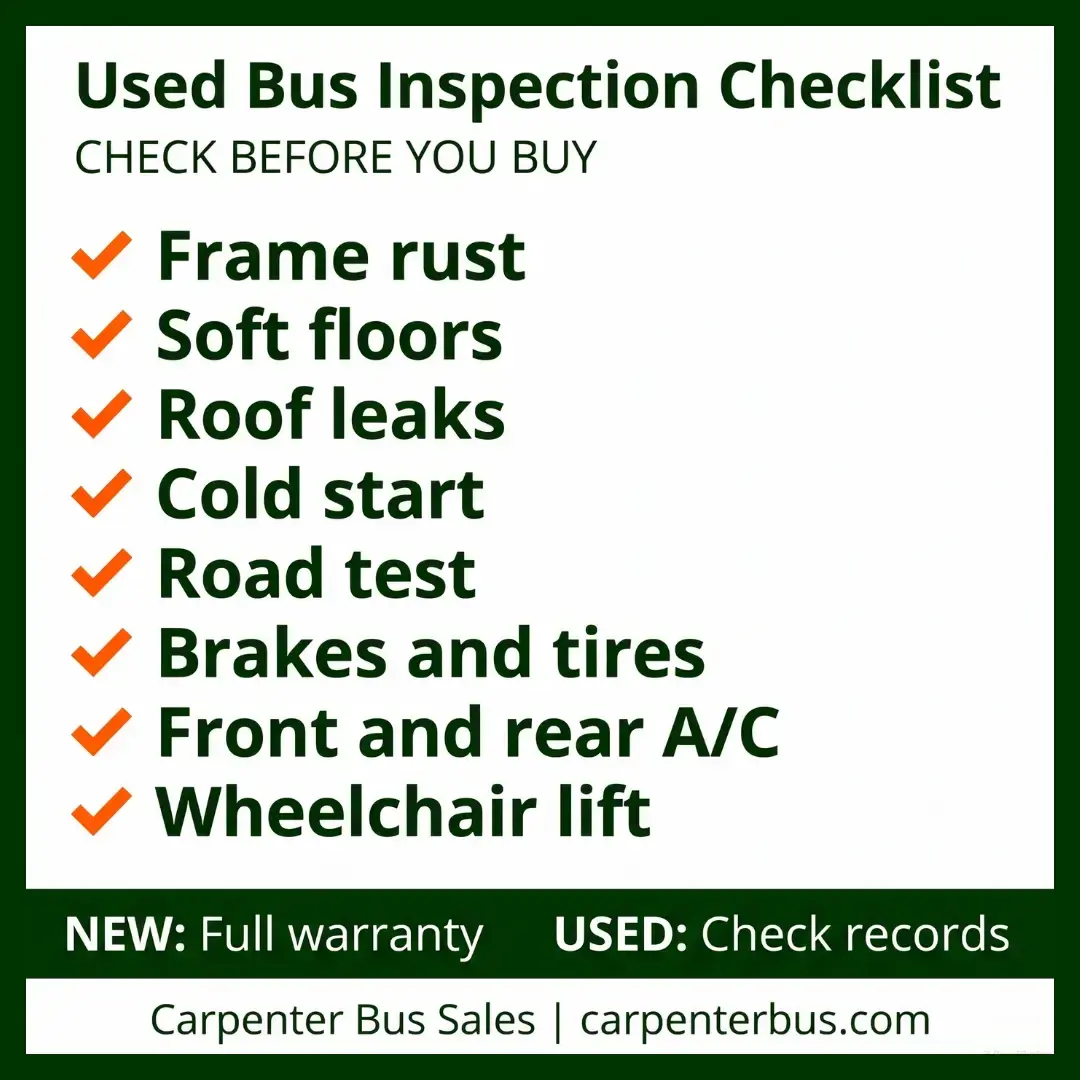
Inspect a used bus system by system: the frame and undercarriage for structural rust, the floor and roof for water damage, the engine and transmission on a cold start and road test, then brakes, tires, heating and air conditioning, seats and belts, and any wheelchair lift. Compare what you find against the maintenance records.
"We take great pains to ensure that when you buy a pre-owned bus at Carpenter Bus, we have gone over that bus top to bottom to make sure that you have a great experience. ... If you decide to go forward and look at a pre-owned bus, always check your AC, check your lift, check all the moving parts to make sure they're in great working order."
Rick Cassels, Regional Sales Manager, Carpenter Bus Sales
| System | What to check | Warning signs |
|---|---|---|
| Frame and undercarriage | Frame rails, crossmembers, body mounts, and wheel wells from underneath | Scaling or perforated rust, bent or patched rails |
| Floor and subfloor | Floor near the entry steps, rear wheel wells, and under seat tracks | Soft or spongy spots, water staining, lifting floor covering |
| Roof, windows, and seals | Roof seams, hatches, rooftop A/C mounts, window gaskets, headliner | Stains on the headliner, damp insulation, fresh sealant over seams |
| Engine | Cold start, idle quality, exhaust, fluid leaks | Hard starting, heavy smoke, knocking, low or dirty fluids |
| Transmission | Shifts during a road test at different speeds, fluid condition | Slipping, harsh or delayed shifts, burnt-smelling fluid |
| Brakes | Stopping feel, pad and rotor or drum wear; on air brakes, how pressure builds and holds | Pulling, grinding, audible air leaks, warning lights |
| Tires | Tread depth, wear pattern, matching sets, and the date code in the DOT number | Uneven wear, sidewall cracking, a date code much older than the bus's recent service |
| Steering and suspension | Play in the steering wheel, tracking at speed, shocks and springs | Wandering, clunks over bumps, leaking shocks |
| Heating and air conditioning | Front and rear systems tested separately | Weak airflow, warm air from the rear unit, noisy compressor |
| Electrical and doors | Lights, entry door operation, PA and audio or video equipment | Intermittent failures, slow or sticking door |
| Seats and belts | Seat count against the rated capacity, seat mounts, belts, recliners | Loose or damaged mounts, torn upholstery, seat count that does not match |
| Wheelchair lift and securement | Several full lift cycles, manual backup, securement tracks and straps | Slow or jerky operation, missing backup handle, worn straps |
Engines and transmissions can be repaired or replaced. Structural rust in the frame or subfloor often cannot be repaired at a reasonable cost, so check underneath first, especially on buses that operated where roads are salted in winter.
To read a tire's age, look for the DOT number on the sidewall. Under federal tire labeling rules, the last four digits show the week and year the tire was made, so "2219" means the 22nd week of 2019.
For diesel buses, also ask whether the emissions system has needed repairs, since those parts are expensive to replace.
How do you evaluate engine hours and maintenance records?
Maintenance history matters as much as the odometer reading. A bus with higher mileage and a complete maintenance record is often a safer buy than a low-mileage bus that sat for long periods without fluid changes. When you review the records, look for:
- Oil changes at regular, consistent intervals.
- Transmission service, brake work, and tire replacements with dates and mileage.
- Service history for the wheelchair lift, if the bus has one.
- Major repairs and the reason they were needed.
- Engine hours compared with mileage. A bus that idled for long periods, such as running the air conditioning while waiting for passengers, can show more engine wear than the odometer suggests.
- A VIN on the title that matches the VIN on the bus.
Enter the VIN at the National Highway Traffic Safety Administration recall lookup to check for open safety recalls on the chassis. Ask the seller separately about recalls from the body manufacturer.
Should you get an independent pre-purchase inspection?
An independent inspection is worth the cost when you are buying from a private seller, buying a bus you cannot see in person, or considering a bus with gaps in its records. Choose a mechanic who works on commercial vehicles and knows the specific engine and transmission in the bus, and give them the checklist above.
How many miles can a used bus last?
There is no single mileage limit for a used bus. The Federal Transit Administration sets minimum useful life benchmarks for grant-funded vehicles, such as 5 years or 150,000 miles for a light-duty bus built on a chassis, but those are the earliest points a transit agency may replace a vehicle, not the point where it wears out.
| Vehicle category (FTA Circular 5010.1E) | Minimum useful life |
|---|---|
| Heavy-duty and articulated transit buses, 35 to 40 feet | 12 years or 500,000 miles |
| Heavy-duty transit bus, about 30 feet | 10 years or 350,000 miles |
| Medium-duty transit bus, about 30 feet | 7 years or 200,000 miles |
| Light-duty transit bus built on a chassis, 25 to 35 feet | 5 years or 150,000 miles |
| Other vehicles, including small buses and vans | 4 years or 100,000 miles |
These figures come from the Federal Transit Administration's award management guidance on useful life, which draws its categories from FTA Circular 5010.1E. The agency notes that a heavy-duty bus is built as a bus, while a medium-duty bus is built on a truck chassis. These are minimums for federally funded transit service, not predictions for any one bus. A church or senior living bus that drives far fewer miles per year can reach its age limit long before its mileage limit, which is why the records and the inspection matter more than any single number.
What do engine type and brake type mean for a used bus?
Engine type and brake type affect who can service the bus and who can drive it. Gas and diesel engines each need a mechanic who knows that engine, and air brakes, which are common on larger buses, can add driver licensing and training requirements that vary by state and vehicle configuration.
The majority of buses Carpenter Bus Sales sells are gas powered, and Carpenter Bus Sales sells both gas and diesel buses. For a full comparison of fuel costs, maintenance, and duty cycles, see gas vs diesel engines for buses.
Hydraulic brakes work much like the brakes on a large pickup truck. Air brakes are common on heavier buses, and drivers need to know how to check the system before each trip. Driver licensing requirements, including any that relate to air brakes, vary by state and vehicle configuration, so confirm them with your state DMV or a Carpenter Bus Sales representative. Our guide to CDL requirements for shuttle buses explains how capacity and weight affect licensing.
How do you match a used bus to how you'll use it?
Match the bus to its main job before comparing prices. A bus bought for short local shuttles needs a different setup than one bought for long trips, and adding luggage racks, entertainment systems, or a wheelchair lift after purchase usually costs more than buying a bus that already has them.
Before you shortlist buses, answer these questions as a committee:
- How many passengers ride on a typical trip, and how many on the largest trip of the year?
- Are most trips across town, or do you travel out of state?
- Do any riders need a wheelchair lift or wheelchair positions?
- How much luggage or equipment travels with the group?
- Who will drive, and what license do they hold?
Service access matters as much as the bus itself. Before you buy, confirm that a local mechanic you trust can service the specific engine and transmission in that bus, since many general auto shops do not work on commercial vehicles. When your mechanic needs parts for a bus line Carpenter Bus represents, order them from CarpenterBusParts.com.
What costs beyond the purchase price should you budget for?
Budget for parts and repairs, preventive maintenance, insurance, fuel, titling and registration, and driver training or licensing if the bus requires it. These costs apply to new and used buses alike, but on a used bus without warranty coverage, repair costs fall entirely on your organization.
- Replacement parts and repairs, which weigh most heavily on a used bus past its factory coverage.
- Routine and preventive maintenance. See our breakdown of annual mini bus maintenance costs.
- Insurance. Get a quote on the specific bus before you commit, since coverage and premiums vary by insurer and vehicle.
- Fuel and operating expenses.
- Titling, registration, and any required inspections in your state.
- Driver training, and a commercial license if the bus you choose requires one.
Carpenter Bus Sales offers financing and leasing on both new and used inventory. Compare bus financing and leasing options to see how the purchase fits alongside these ongoing costs.
Can you trade in your old bus when you buy from Carpenter Bus Sales?
Yes. Carpenter Bus Sales accepts trade-ins and can apply your current bus or van's value toward a new or pre-owned vehicle. Carpenter Bus Sales currently buys buses and vans that seat 12 to 45 passengers, including the driver, are model year 2010 or newer, and have under 120,000 original miles, with or without wheelchair lifts.
"You don't have to sell it yourself. ... Usually the same day or next day, we'll get you a value for your bus. It's an easy process."
Rick Cassels, Regional Sales Manager, Carpenter Bus Sales
Here is how the process works:
- Fill out the online form to sell or trade in your bus with the vehicle year, mileage, seating capacity, chassis make, body manufacturer, and condition.
- Your Carpenter Bus Sales representative can also email a short evaluation form. Have the VIN, current miles, general condition, and dates of last service ready.
- Take photos of each of the four corners of the bus, the interior from front to back and from back to front, and the odometer.
- Carpenter Bus Sales evaluates the bus and gives you a value, usually the same day or the next day.
- Apply that value toward your next bus. Carpenter Bus Sales buys buses nationwide and handles the delivery or pickup logistics.
How do you buy a used bus, step by step?
Buying a used bus takes eight steps: define the bus's job, set a total budget, shortlist buses, review records and the VIN, inspect and road test, ask about coverage options, negotiate based on what you found, and plan titling, insurance, and delivery. Each step protects the budget from surprises after the sale.
- Define the job. Settle capacity, trip types, accessibility needs, and who will drive.
- Set a total budget. Include ownership costs, a repair reserve, and financing if you need it.
- Shortlist buses. Buying from a dealer gives you title verification, inspection, financing, and trade-in options in one place. Private sales can work, but you handle title checks, inspection, and transport yourself.
- Review the records and the VIN. Request service records, confirm the VIN matches the title, and check for open recalls.
- Inspect and road test. Work through the inspection table above, and bring a qualified mechanic if you can.
- Ask about coverage. Find out whether any factory coverage remains and whether the bus qualifies for an optional service contract.
- Negotiate based on findings. Use specific findings, such as tires near replacement or a lift that needs service, as the basis for price discussions or repair requests before delivery.
- Plan the handoff. Arrange insurance, titling, registration, and delivery before the bus arrives. Carpenter Bus Sales sells and delivers nationwide.
Frequently Asked Questions
Which used buses hold their value best?
Used buses with documented maintenance, a solid frame and floor, working air conditioning and lifts, and moderate mileage tend to hold their value best, because those are the same things the next buyer checks. Carpenter Bus Sales, for example, currently buys buses and vans seating 12 to 45 passengers that are model year 2010 or newer with under 120,000 original miles.
Is a used church bus reliable?
A used church bus can be reliable when its records show regular maintenance and an inspection finds no structural rust, floor damage, or drivetrain problems. Because any factory coverage may have already expired, set aside a repair budget and confirm that a qualified local mechanic can service the engine and transmission.
Can you finance a used bus?
Yes. Carpenter Bus Sales offers financing and leasing on both new and used inventory. For churches, Carpenter Bus Sales typically arranges the loan or lease directly with the church entity rather than requiring a personal guarantee from the pastor or board members. Terms depend on the vehicle and the organization's credit.
Does Carpenter Bus Sales inspect used buses before selling them?
Yes. Carpenter Bus Sales goes over each pre-owned bus top to bottom before sale, according to Regional Sales Manager Rick Cassels. Buyers should still review the service records, confirm the VIN matches the title, check for open recalls, and test the air conditioning, lift, and other moving parts themselves.
What should you do next?
Start by agreeing on how the bus will be used and what your organization can spend, then compare new and used options side by side. A Carpenter Bus Sales representative can show which buses fit your budget, whether a used bus qualifies for a service contract, and what your current bus is worth as a trade-in.
Carpenter Bus Sales has helped churches, senior living communities, schools, and shuttle operators choose buses since 1953. Browse current used buses for sale, or contact a representative to talk through the decision with your committee.
