
15 Passenger Van vs 15 Passenger Bus: How to Choose
Both vehicles seat 15 including the driver. A Carpenter Bus Sales sales manager on when the van is the smarter buy, and when the bus earns the difference.
By Dominic Menard - National Director of Marketing & Technology
Published • Last updated
A 15 passenger van and a 15 passenger bus both carry up to 15 people including the driver, and in most states neither one requires a commercial driver's license, so the real decision is how often you move people and who is riding. Carpenter Bus Sales sells both vehicles, and the honest answer is that each one wins in different conditions.
This comparison covers what separates the two, what current federal safety guidance actually says about 15 passenger vans, what changes if you carry students or riders who use wheelchairs, and which vehicle fits your situation. The buying judgment comes from Rick Cassels, Regional Sales Manager at Carpenter Bus Sales.
What is the difference between a 15 passenger van and a 15 passenger bus?
A 15 passenger van is a full size passenger van fitted with rows of seats. A 15 passenger bus is a purpose built bus body on a commercial cutaway chassis, with dual rear wheels, a center aisle, a dedicated entrance door, and a separate luggage area. Both seat 15 including the driver.
That difference in construction drives nearly everything else: how passengers get to their seats, where luggage rides, what accessibility equipment can be fitted, and how the vehicle feels to drive with a full load.
| Feature | 15 passenger van | 15 passenger bus |
|---|---|---|
| Capacity | Up to 15 including the driver | Up to 15 including the driver |
| Construction | Full size van body with seating installed | Purpose built bus body on a cutaway chassis |
| Rear wheels | Single or dual, depending on the model and chassis | Dual rear wheels |
| Getting to a seat | Side door with a step up, and a center aisle on high roof models | Dedicated stairwell with grab rails, center aisle |
| Seating | Bench seating or individual seats, depending on the model | Individual cushioned seats, reclining on many models |
| Luggage | Behind or beside passengers | Separate rear compartment, overhead racks on many models |
| Wheelchair access | Ramp based conversions | Lift, securement stations, fold away seating |
| Driving and parking | Easier to park, drives more like a car | Longer and wider at the rear, large mirrors standard |
| Licensing | No CDL in most states | No CDL in most states |
How do two real vehicles compare?
Categories only go so far, because Carpenter Bus Sales sells many models and configurations of each. The two vehicles below are a new van conversion and a new bus from Carpenter Bus inventory, listed to show what the differences look like on actual spec sheets rather than in the abstract.
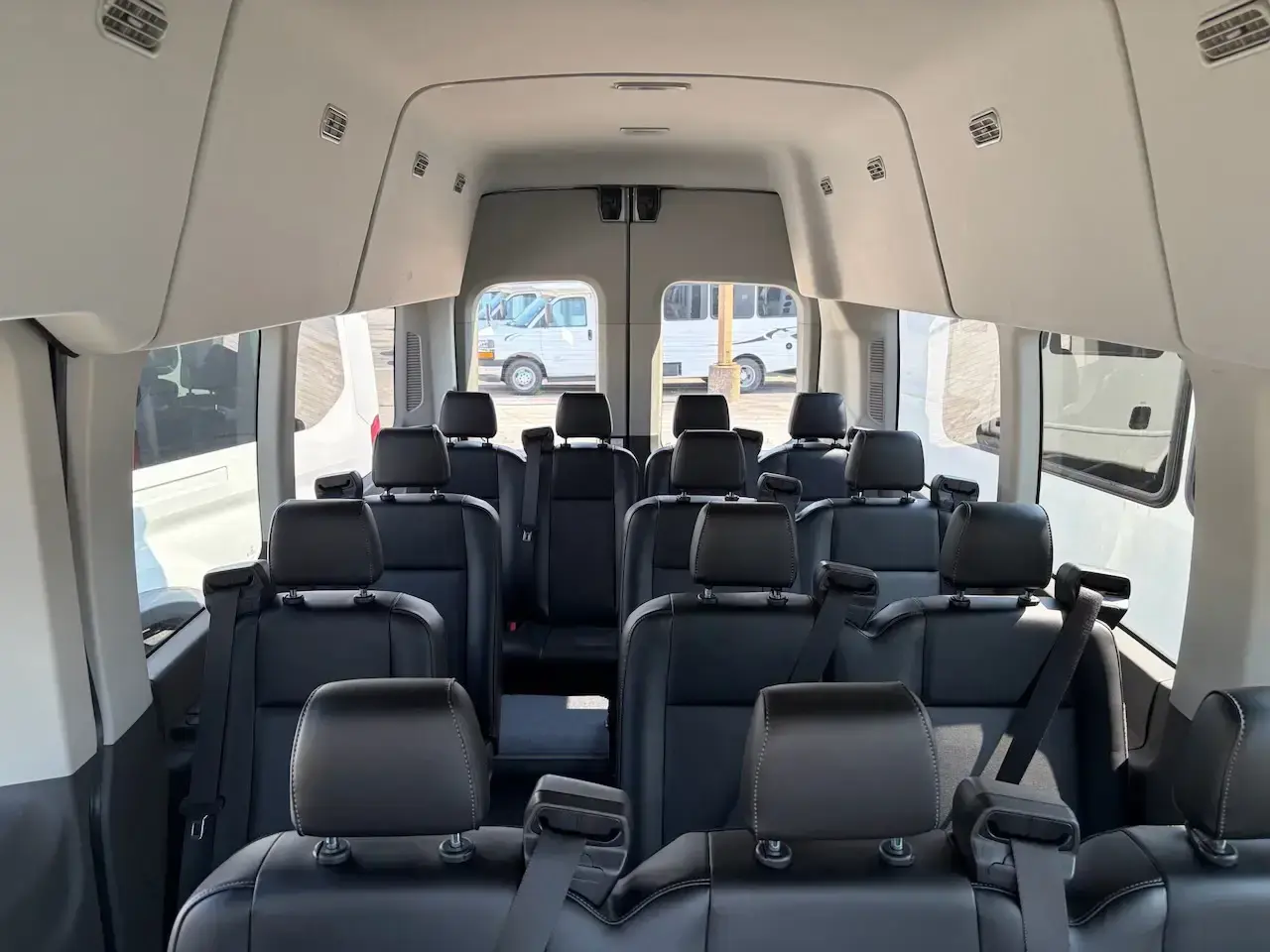
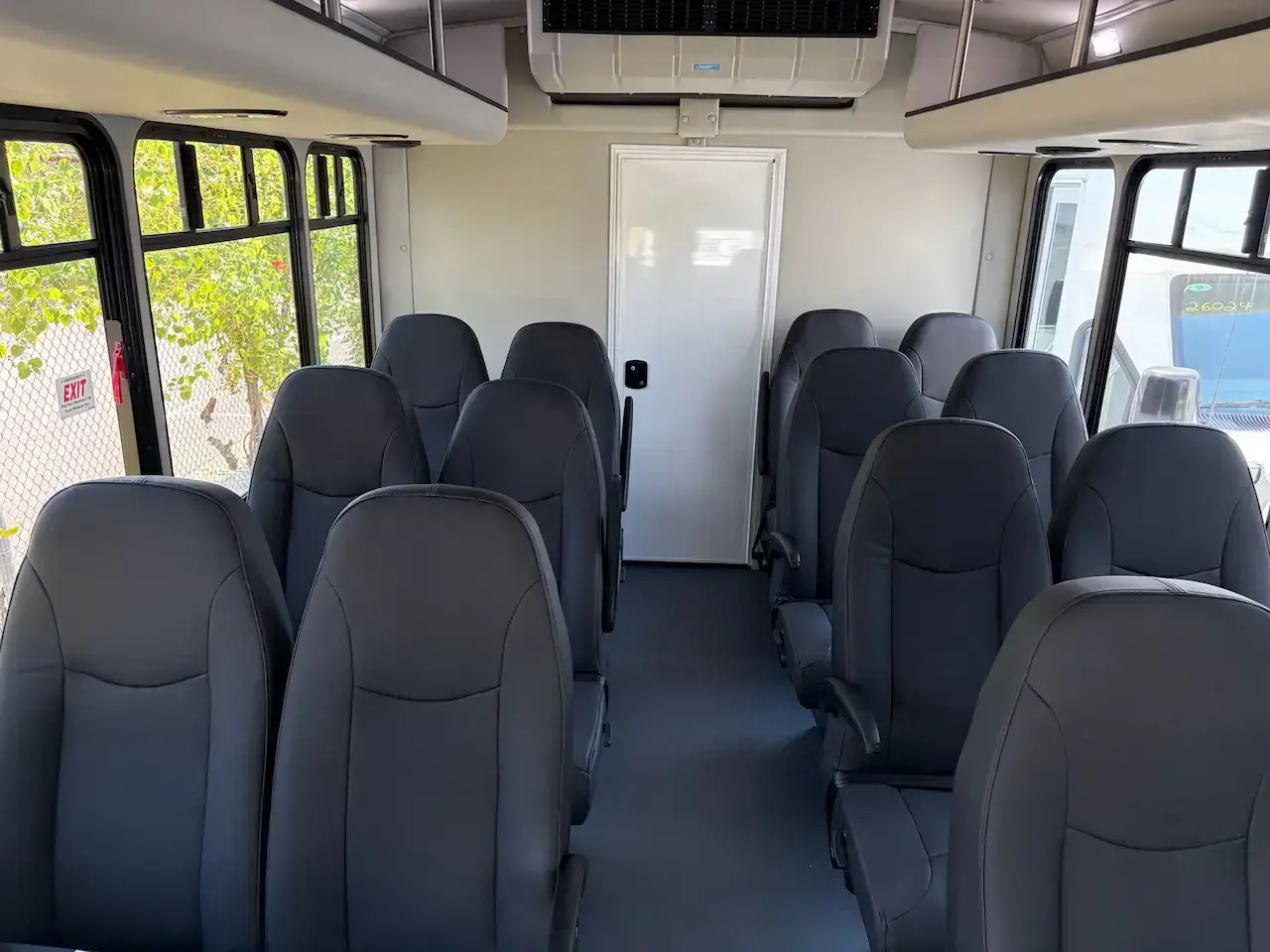
| Specification | 2026 Ford Transit U4X van conversion | 2026 Ford E450 Starcraft Allstar bus |
|---|---|---|
| Capacity | 15, including the driver | 15, including the driver |
| Length | 22 feet | 24 feet |
| Rear wheels | Dual | Dual |
| Entrance | Side entry with aluminum running boards and a right hand grab rail | Electric double leaf entrance door with a right hand grab rail, 12 inch first step |
| Seating | Mid back seats with three point shoulder harness belts | High back recliner seats with retractable belts and arm rests at the aisle |
| Interior height | 6 feet 5 inches | 6 feet 8 inches |
| Storage | 30 inch deep rear storage area | 34 inch deep rear luggage compartment plus full length overhead racks on both sides |
| Engine | 3.5L V-6 gas | 7.3L V-8 gas |
Both of these are current vehicles rather than category standards. Interior dimensions for the bus come from the manufacturer specifications for the 24 foot Starcraft Allstar on a Ford E450 chassis. Configurations, floor plans, and equipment change by model year and build, so confirm the specification of the exact vehicle you are considering with a Carpenter Bus Sales representative.
Are 15 passenger vans safe?
A current 15 passenger van is not the vehicle that earned the reputation two decades ago. The National Highway Traffic Safety Administration states that thanks to electronic stability control, rollover is no longer a danger for newer 15 passenger vans. The risk that remains sits mostly with older vans, loading, tires, and seat belt use.
That matters for how you read older advice. Much of what circulates online about 15 passenger vans dates from federal advisories issued in the early 2000s, before stability control became standard equipment. If your organization is choosing between a new van and a new bus today, rollover propensity is not the deciding factor it once was.
What still deserves attention in any 15 passenger van?
Seat belts and tires. In rollover crashes from 2010 through 2019, 235 occupants of 15 passenger vans were killed, and 57 percent of them were ejected. Across all crashes in that period, 69 percent of the van occupants killed were known not to be wearing a seat belt, according to NHTSA guidance on 15 passenger vans.
The other thing worth knowing is age. A used van bought cheaply may predate stability control entirely, and its spare tire may be older than the tread suggests. If you are buying used on either side of this comparison, the vehicle's year and its maintenance history matter more than the category it belongs to.
When is a 15 passenger van the better choice?
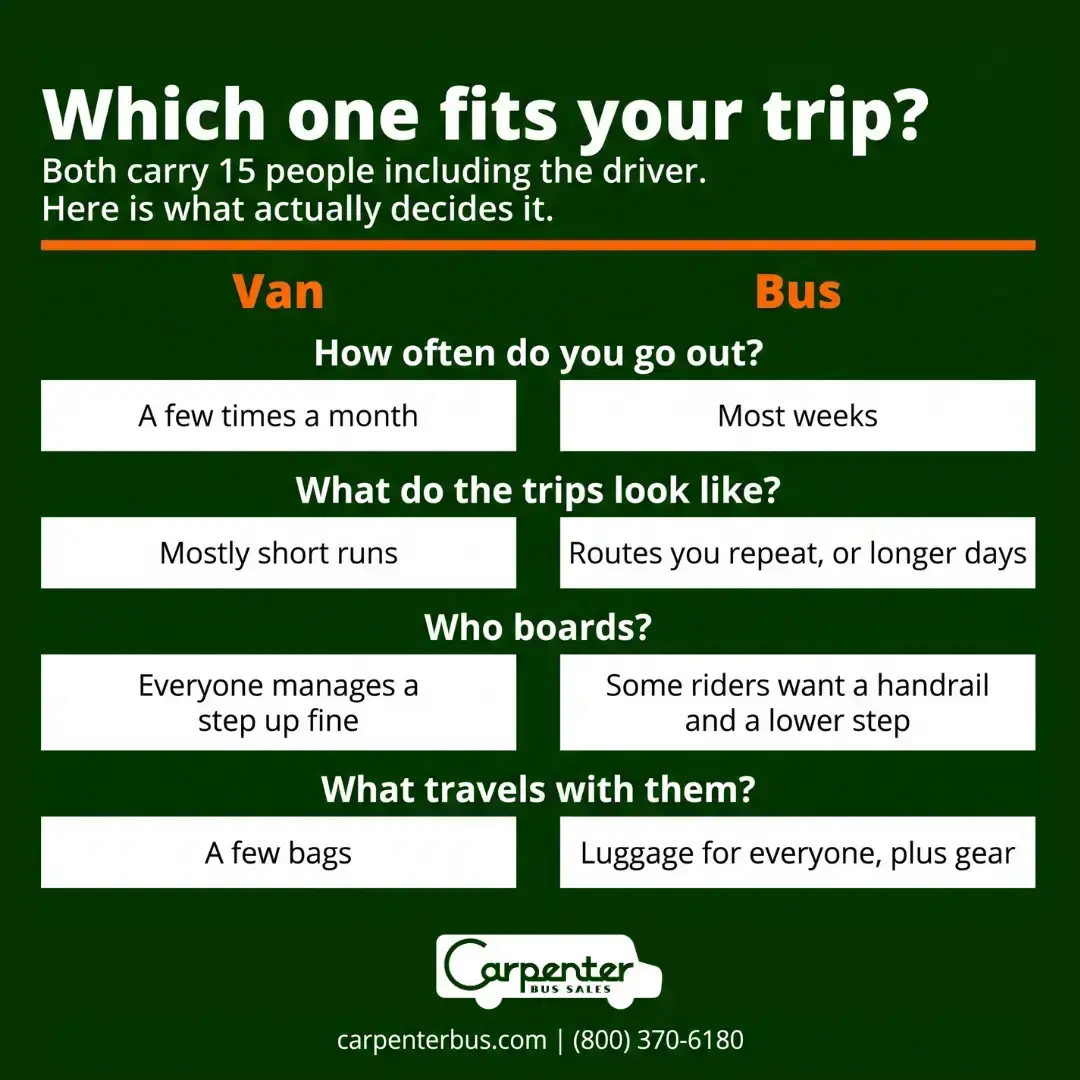
When the vehicle runs occasionally, makes short trips, or has to live in a normal parking space. Rick Cassels, Regional Sales Manager at Carpenter Bus Sales, points to the practical advantages of a van: it is easier to drive, easier to park, and the fuel costs are lower, and it drives much more like a car than a bus does.
He frames the choice around use rather than vehicle type. One or two riders on short or infrequent trips point toward a van. Scheduled group transportation points toward a bus. A hotel running an occasional airport run, or a day program with one short route, is often better served by the smaller vehicle.
Driver comfort belongs in that calculation too. Cassels tells buyers to ask the people who will actually drive the vehicle what they are comfortable handling, because a vehicle nobody wants to drive is the wrong vehicle whatever the spec sheet says. If your volunteer drivers are confident in a van and uneasy in anything larger, that is a real constraint.
Carpenter Bus Sales carries commercial grade passenger vans built for high cycle, multi passenger use, which is a different vehicle from a consumer van with seats added.
When is a 15 passenger bus the better choice?
When you move groups on a schedule. In Cassels's words, "If you're moving groups of people regularly, the bus is almost always going to be the superior choice." The reasons are boarding, seating, storage, and how the vehicle behaves over years of weekly use rather than any single safety specification.
He starts with how people get aboard: "When you come into a bus, you have a center aisle that you can step up into a dedicated stairwell with grab rails and walk down a wide aisle to take your seat." For a congregation with older members, or a community moving residents several times a week, that stairwell and aisle change the experience more than anything on a brochure.
From there the differences stack up:
- Seating. High back recliner seats with arm rests at the aisle on many buses. Van seating varies by model, from bench rows to individual high back seats, so compare the specific vehicle rather than the category.
- Room to move. The two vehicles above are closer than the categories suggest, at 6 feet 5 inches of interior height in the van against 6 feet 8 inches in the Starcraft Allstar. The bus adds a 93 inch interior width and a first step 12 inches off the ground, which is what makes boarding easier rather than the height itself.
- Storage. Cassels says the thing buyers regret skipping is storage. A van typically stores bags behind the last row, where the Starcraft Allstar above carries a 34 inch deep rear luggage compartment behind a rear wall, plus full length overhead racks down both sides.
- Driving with a full load. Extra weight and a longer wheelbase keep a bus more solidly planted, including in wind. Dual rear wheels help, though 15 passenger van conversions are commonly built on a dual rear wheel chassis as well, including the one above.
- Service life and resale. In Carpenter Bus Sales experience buses last longer through a commercial duty cycle, and Cassels says resale on a bus holds up considerably better than on a van.
Carpenter Bus Sales delivery records show that roughly two thirds of the vehicles delivered since January 2022, with records through July 2026, were small buses carrying 15 passengers or fewer. That is what Carpenter Bus customers chose, not a statement about the national market, and the organizations in it were mostly moving groups on a weekly schedule.
Cassels adds one more test for organizations that expect to grow. If your current vehicle fits and the group has stopped growing, staying put is a reasonable answer. If people or gear have stopped fitting, that is the signal to move up. Browse small buses for sale to see what the bus side of the comparison looks like in current inventory.
What changes if you carry riders who use wheelchairs?
The equipment differs by vehicle. A van conversion uses a ramp, while a bus uses a lift with securement stations and fold away seating. Cassels considers the lift the better solution for riders with accessibility needs, and the same use test applies: occasional short trips suit a van, scheduled group routes suit a bus.
Both are legitimate choices, and plenty of organizations run one of each, using the van for daily individual trips and the bus for group outings. Compare wheelchair accessible vans against wheelchair accessible buses before you commit, and have your rider count and route frequency ready when you do.
Can a school or daycare use a 15 passenger van?
Federal rules do not stop a school from using a van, but they restrict what can be sold to one. Any new vehicle designed to carry more than 10 people that is sold or leased for significant student transport has to meet federal school bus safety standards, so a conventional new 15 passenger van cannot be sold for that purpose.
The limit applies to new sales and leases rather than to operation. A school buying a used 15 passenger van, or renting one for a single special event, falls outside that requirement, per NHTSA school bus regulation guidance. NHTSA still recommends that vehicles carrying students meet school bus standards.
That is where the activity bus fits. A multifunction school activity bus, or MFSAB, is built to the same federal structural safety standards as a yellow school bus without the stop arms, flashing red lights, or yellow paint, and private organizations can buy one. It is not a yellow school bus and cannot stand in for one on home to school routes. Carpenter Bus Sales does not sell yellow school buses. State rules on student transport vary, so confirm yours before you buy.
Do you need a CDL for a 15 passenger van or a 15 passenger bus?
In most states, neither one requires a commercial driver's license, because both are designed for 15 people including the driver. The federal threshold is triggered by a gross vehicle weight rating of 26,001 pounds or more, a design capacity of 16 or more people including the driver, or placarded hazardous materials.
State requirements vary, and some states apply stricter rules to churches and nonprofits rather than looser ones. Seat count alone does not make any particular driver or vehicle exempt, so confirm the rules with your state licensing agency or a Carpenter Bus Sales representative before you assign drivers. The guide to shuttle buses and driver's licenses covers the licensing detail, and the 15 passenger bus buying guide covers configuring a bus that stays under the line.
How can you operate a 15 passenger van more safely?
Van handling rewards habits more than equipment. NHTSA recommends that 15 passenger vans be driven by experienced, licensed drivers who operate that type of vehicle regularly, that every occupant wear a seat belt, that tires be checked at least weekly, and that no load ever go on the roof.
The full set of federal recommendations is short and worth posting where your drivers will see it:
- Assign the van to experienced drivers who use it regularly rather than rotating whoever is available.
- Require seat belts for every occupant on every trip, and replace damaged belts or buckles.
- Check tire pressure before each use against the figure on the driver's side door pillar, not the tire sidewall.
- Watch the age of the spare, since tires weaken with age even unused, and a used van may carry a very old spare.
- Never carry more than 15 people, and fill seats from the front, forward of the rear axle, when the van is not full.
- Keep cargo forward of the rear axle and off the roof.
- Allow extra room for maneuvering and extra braking distance, and rely on the side mirrors for lane changes.
For the bus side of your fleet, the same discipline applies with a different vehicle underneath it, and your Carpenter Bus Sales service team can set up a maintenance schedule for either one.
Which vehicle fits your organization?
Match the vehicle to the trip you take most often, not the one you take twice a year. The table below sorts the common situations Carpenter Bus Sales sees, using the use based test Cassels applies with buyers: frequency of use, group size, who rides, and what has to travel with them.
| Your situation | Usually points to | Why |
|---|---|---|
| A few short trips a month | Van | Easier to drive and park, lower fuel cost, fits a standard space |
| Weekly scheduled group transportation | Bus | Boarding, seating, storage, and duty cycle built for repeated use |
| Older riders boarding several times a week | Bus | Dedicated stairwell with grab rails, lower step up, wide center aisle |
| One or two wheelchair riders, short or occasional trips | Van | Ramp conversion, lower cost, parks anywhere |
| Scheduled accessible routes | Bus | Lift, multiple securement stations, flexible floor plans |
| Overnight trips with luggage or gear | Bus | Separate luggage compartment keeps bags out of the cabin |
| Volunteer drivers uneasy with a larger vehicle | Van | Drives more like a car, and driver confidence is a real constraint |
| Student transport on a regular basis | Activity bus (MFSAB) | Federal rules restrict selling new vans for significant student transport |
Frequently Asked Questions
Is a 15 passenger van considered oversized?
Not in the permit sense. Oversize rules apply to vehicles past standard width, height, or length limits, and neither a 15 passenger van nor a 15 passenger bus approaches those in a standard configuration. The limits you will actually hit are parking garage clearance and the length of your parking spaces.
How long is a 15 passenger van compared with a 15 passenger bus?
They are closer than people expect. An extended length 15 passenger van conversion in Carpenter Bus Sales inventory measures 22 feet, against 24 feet for a 15 passenger bus on the lot. Lengths vary by chassis and floor plan, so measure your gate, garage clearance, and parking spaces before you decide.
Does a 15 passenger count include the driver?
Yes. Carpenter Bus Sales counts the driver in every passenger figure, so a 15 passenger vehicle carries 14 riders plus the person driving. This matters because the federal licensing threshold also counts the driver. A vehicle with 15 passenger seats plus a driver seat holds 16 people and crosses that line.
Is a 15 passenger bus harder to park than a van?
A bus is longer and taller, so it takes more room and more care backing in, though an extended length van conversion is closer in size than most buyers expect. Rick Cassels, Regional Sales Manager at Carpenter Bus Sales, names easier parking as one of the real advantages of a van.
Does insurance cost more for a van or a bus?
It depends on your carrier, your drivers, your state, and how the vehicle is used. Some insurers and institutions place conditions on 15 passenger van use that they do not place on buses. Carpenter Bus Sales does not quote insurance, so ask your carrier to price both vehicles before you decide.
What should your organization do next?
Write down the trip you take most often, the number of people on it, who among them needs help boarding, and what travels with them. Those four answers decide this comparison faster than any spec sheet, and they are the first things a Carpenter Bus Sales representative will ask you.
Then compare real vehicles against those answers. Browse van inventory if your trips are smaller and less frequent, or small bus inventory if you move groups on a schedule. If your organization is a congregation weighing both, the church bus page shows how other churches have configured theirs. Call (800) 370-6180 and a representative will work through the four answers with you.
