Buying Guide

15 Passenger Bus: The Complete Guide for Buyers

Everything on the non-CDL workhorse: how it differs from a van, MFSAB rules, safety features, models, pricing, insurance, financing, and upkeep.

By Admin User

Published

A 15 passenger bus is a purpose-built vehicle designed to carry up to 14 riders plus the driver — and in most states, it does not require a Commercial Driver's License (CDL) to operate. Sometimes called a shuttle bus, or minibus, or Multi-Function School Activity Bus (MFSAB), the 15 passenger bus has become the go-to choice for churches, schools, senior living communities, hotels, corporate campuses, and dozens of other organizations that need safe, comfortable group transportation.

This guide covers everything you need to know before buying a 15 passenger bus: what it is, how it compares to a 15-passenger van, CDL and licensing requirements, safety features, popular models and specs, cost factors, insurance, financing, and maintenance. Carpenter Bus Sales has been helping organizations find the right vehicle since 1953, and with over 200 new and used buses in stock, we're the largest small bus dealer in the United States. Whether you're buying your first bus or replacing an aging one, this page will give you the information you need to make a confident decision.

Want the short version? You can also download our free Bus Buying Guide using the form on this page — it's a quick, printable reference you can share with your team.

The Quick Version (TL;DR)

Short on time? Here are the key facts about 15 passenger buses:

  • What it is: A purpose-built bus on a commercial cutaway chassis (Ford or Chevy) that carries up to 14 riders plus the driver. It is NOT a converted cargo van.
  • CDL required? No. In most states, a standard driver's license is all you need. The bus carries 15 or fewer occupants and falls well below the 26,001-lb GVWR threshold. (California has stricter rules — check your state.)
  • Why not a van? The NHTSA issued rollover warnings for 15-passenger vans. The bus has dual rear wheels, a wider stance, a lower center of gravity, and purpose-built construction — making it dramatically safer and often cheaper to insure. Browse our mini bus alternatives to the 15-passenger van.
  • What's an MFSAB? Multi-Function School Activity Bus. It means the bus is built to federal school bus safety standards, even though it's also often used for churches, camps, hotels, and other non-school purposes.
  • Who buys them? Churches, schools, senior living communities, hotels, corporate campuses, daycares, camps, and government agencies.
  • Popular models: Starcraft Allstar, Starcraft Starlite, and Glaval Universal are among the most popular. Available on Ford and Chevy chassis platforms.
  • Cost: Varies widely by new vs. used, chassis, manufacturer, configuration, and options. Call Carpenter Bus Sales at 800-370-6180 for a current quote.
  • Financing: Available through Carpenter Bus Sales with competitive fixed rates for both new and used buses.
  • Rentals: If you only need a bus occasionally, Carpenter Bus Sales also has a rental department.
  • Warranty: Carpenter Bus Sales includes SilverCare free, a 5-year or 60,000-mile plan.

Read on for the full details, or call us at 800-370-6180 to talk to a bus specialist who can answer your specific questions right now.

What Is a 15 Passenger Bus?

A 15 passenger bus is a vehicle built on a commercial cutaway chassis — typically a Ford E-350, Ford E-450, Chevrolet 3500, or Chevrolet 4500 — with a purpose-built bus body mounted on the frame. The "15 passengers" includes the driver, so the bus carries up to 14 seated riders plus the person behind the wheel.

This is an important distinction from a 15-passenger van, which is a standard full-size van (like the Ford E-350 cargo van or Chevy Express 3500) that has been outfitted with seats. A 15 passenger bus is not a modified van. It is engineered from the ground up as a bus, with a wider body, dual rear wheels for stability, a dedicated passenger entrance door, an aisle between the seats, and a separate rear luggage compartment.

Typical dimensions for a 15 passenger bus are roughly 23 to 25 feet in length, about 8 feet in width, and 9 to 10 feet in overall height. The interior offers a flat floor, high-back individual seats, overhead storage in many configurations, and standing headroom in the aisle.

You may hear a 15 passenger bus referred to by several names: shuttle bus, minibus, activity bus, non-CDL bus, MFSAB (Multi-Function School Activity Bus), or small bus. These all describe the same general category of vehicle: a bus built for 15 or fewer occupants on a cutaway commercial chassis.

Organizations that commonly purchase 15 passenger buses include churches and religious organizations, private schools and universities, daycare and childcare centers, senior living and assisted living communities, hotels and resorts, corporate and employee shuttle operations, summer camps, youth organizations, and government agencies.

15 Passenger Van vs. 15 Passenger Bus — Primary Differences

For decades, organizations that needed to transport small groups relied on 15-passenger vans — vehicles like the Ford E-350 Econoline van and the Chevrolet Express 3500. They were affordable, widely available, and easy to drive. But they also came with some safety concerns.

In the early 2000s, the National Highway Traffic Safety Administration (NHTSA) issued warnings about 15-passenger vans, citing a significantly elevated risk of rollover accidents — especially when the vehicles were fully loaded with passengers and luggage. The problem was rooted in the van's design: a high center of gravity, single rear wheels, and a narrow track width made the vehicle increasingly unstable as weight was added to the rear. Several fatal rollover crashes involving universities, churches, and other organizations led to widespread attention, and many institutions — including dozens of universities — banned the use of 15-passenger vans altogether. While 15 passenger vans have made tremendous strides towards improved safety, people were looking for something different.

Insurance companies followed. Premiums for 15-passenger vans climbed sharply, and some insurers stopped covering them entirely for organizational use. The industry needed a better solution.

That solution was the 15 passenger bus.

Built on a commercial cutaway chassis with dual rear wheels, a wider body, and a lower center of gravity, the 15 passenger bus addressed every major safety shortcoming of the van. The vehicle was designed as a bus from the start — not a cargo van with seats added after the fact.

Here is how the two vehicles compare side by side:

Feature 15-Passenger Van 15-Passenger Bus
Rear wheels Single (less stable) Dual rear wheels (wider stance, greater stability)
Rollover risk Higher — NHTSA rollover warnings issued Significantly lower due to wider base and lower center of gravity
Construction Modified cargo van body Purpose-built bus body on cutaway chassis
CDL required? No (15 or fewer passengers including driver) No (15 or fewer passengers including driver)
Insurance cost Higher — many insurers restrict coverage Typically lower — better safety record
Cargo/luggage space Limited, often stored near passengers in rear Dedicated rear luggage compartment, separated from passengers
ADA/wheelchair options Very limited or unavailable Wheelchair lift or ramp, securement systems available
Seat design Low bench-style or van seats Higher, individual high-back reclining seats
Passenger entry Side or rear van door Dedicated electric entrance door with handrail and steps
Visibility for driver Standard van mirrors Large bus-style side mirrors, backup camera standard on most models

The bottom line: if your organization is still using a 15-passenger van, the 15 passenger bus is a safer, more comfortable, more insurable, and more practical replacement. In recent years, numerous improvements have been made towards safety in 15 passenger vans, but 15 passenger buses are still the most popular vehicle for transporting less than 15 people.

Do You Need a CDL to Drive a 15 Passenger Bus?

No. In most states, you do not need a Commercial Driver's License (CDL) to drive a 15 passenger bus.

Under federal law, the CDL requirement is triggered when a vehicle is designed to carry 16 or more passengers (including the driver) OR when the vehicle has a Gross Vehicle Weight Rating (GVWR) exceeding 26,001 pounds. A 15 passenger bus — which carries up to 14 riders plus 1 driver, for a total of 15 occupants — falls below both of those thresholds. The typical GVWR for a 15 passenger bus is between 10,000 and 14,500 pounds, well under the 26,001-pound CDL trigger.

This means your church volunteer, school administrator, hotel shuttle driver, camp counselor, or employee shuttle operator can drive a 15 passenger bus with nothing more than a standard, non-commercial driver's license.

There are a few important exceptions to be aware of. California requires a commercial license for any vehicle used to transport passengers for hire or compensation, regardless of size. A small number of other states have specific endorsement or permit requirements for certain types of organizational transport. It is always a good idea to check with your state's Department of Motor Vehicles to confirm the specific requirements that apply to your situation.

The practical takeaway: the 15 passenger bus offers the capacity and safety features of a commercial vehicle without the licensing burden of a CDL. That is one of the biggest reasons it has become the most popular vehicle class for churches, schools, and community organizations.

What Is an MFSAB? (Multi-Function School Activity Bus)

An MFSAB — Multi-Function School Activity Bus — is a bus that meets the same federal safety construction standards as a yellow school bus but is not used as a route bus for daily school transportation. MFSABs are typically white (or another non-yellow color) and are used by churches, private schools, camps, daycares, community organizations, and other groups for activity transportation: field trips, youth group outings, athletic events, shuttle service, and similar purposes.

The important thing to understand about an MFSAB is that it is built to Federal Motor Vehicle Safety Standards (FMVSS). That means it must meet strict requirements for structural integrity, emergency exits, seating anchorage, fuel system integrity, and occupant crash protection — the same standards that govern the yellow school buses that transport millions of children every day.

Most 15 passenger buses sold for organizational use are classified as MFSABs. When you purchase a 15 passenger bus from a reputable dealer, you are getting a vehicle that was engineered and tested to school-bus-level safety standards, even though it will never run a school bus route. Your passengers — whether they are church members, senior citizens, hotel guests, or campers — ride in a vehicle built to protect them the same way a school bus protects students.

If you see the terms "MFSAB," "activity bus," or "multi-function bus" used in bus listings, they all refer to this same category: a bus built to school bus safety standards for non-route use.

Safety Features of a 15 Passenger Bus

Safety is the primary reason organizations have shifted from 15-passenger vans to 15 passenger buses. Here are the key safety features that make the bus the superior choice.

Dual Rear Wheels (DRW). Every 15 passenger bus rides on dual rear wheels — four tires across the rear axle instead of two. This creates a significantly wider stance, which lowers the center of gravity and dramatically reduces the risk of rollover. The dual rear wheels are the single biggest safety advantage the bus has over a van.

Purpose-Built Bus Body. The body of a 15 passenger bus is not a modified van shell. It is a purpose-built structure with a steel cage frame, reinforced roof, and body panels designed to absorb and distribute impact forces. This body-on-frame construction provides a level of structural protection that a converted cargo van cannot match.

Emergency Exits. Federal standards require 15 passenger buses to have multiple emergency exits, including a rear emergency door, push-out emergency windows, and a roof hatch on most models. These exits ensure that passengers can evacuate quickly in an emergency, even if the primary entrance is blocked.

Lower Center of Gravity. Because the bus body sits on a cutaway chassis with a wider track width and dual rear wheels, the center of gravity is lower and more stable than a van — especially when the vehicle is fully loaded with passengers and luggage.

Backup Cameras. Most current 15 passenger bus models include a backup camera as standard equipment, giving the driver a clear view behind the vehicle when reversing.

Large Side Mirrors. Bus-style side mirrors are significantly larger than van mirrors, providing better visibility of traffic, pedestrians, and obstacles alongside the vehicle.

LED Marker Lights. Exterior marker lights and clearance lights improve the visibility of the bus to other drivers, particularly at night, in rain, and in low-visibility conditions.

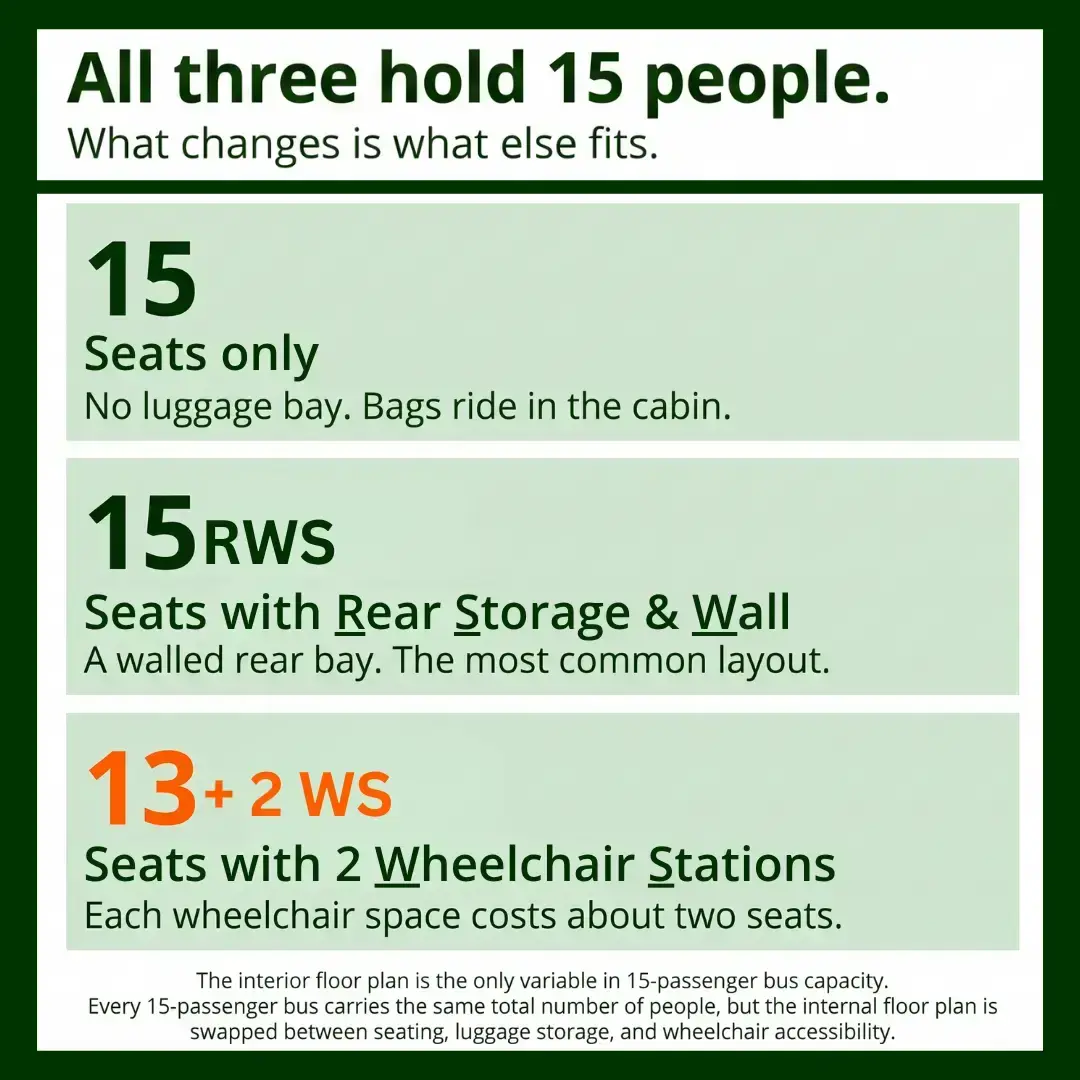
ADA Accessibility Options. Many 15 passenger bus models can be configured with a wheelchair ramp or lift, wheelchair securement stations, and kneeling suspension to make boarding easier for passengers with mobility challenges. ADA-accessible configurations are available in multiple passenger counts (for example, 13 passengers plus 2 wheelchair positions).

FMVSS Compliance. As noted in the MFSAB section, 15 passenger buses are built to Federal Motor Vehicle Safety Standards, including requirements for seating anchorage, fuel system integrity, and occupant crash protection.

Comfort and Interior Features

Beyond safety, a 15 passenger bus offers a noticeably more comfortable ride than a van for both passengers and drivers.

Individual High-Back Reclining Seats. Most 15 passenger buses come equipped with individual high-back seats — not the bench-style seats found in vans. Many models offer reclining seats with padded armrests, providing a comfortable ride for trips of any length.

Overhead Luggage Racks. Available on many configurations, overhead racks give passengers a convenient place to store bags, jackets, and personal items without taking up floor space or blocking the aisle.

Rear Luggage Compartment. One of the most practical advantages of a 15 passenger bus over a van is the dedicated rear luggage compartment. This is a separate, enclosed storage area behind the last row of seats — accessed from the outside through a rear cargo door. Luggage stays secure and separated from the passenger cabin, which eliminates the safety hazard of loose bags piled near the rear doors of a van.

Climate Control. Front and rear heating and air conditioning systems keep the entire cabin comfortable. Many models have a separate rear HVAC unit to ensure consistent temperatures throughout the bus.

Interior Lighting. Overhead dome lights and step-well lighting provide safe, well-lit boarding and travel, especially for early-morning or evening trips.

Aisle Width. The center aisle of a 15 passenger bus is wide enough for passengers to move comfortably to their seats, and for drivers or trip leaders to walk the aisle during stops.

Optional Upgrades. Depending on the model and manufacturer, available options may include USB charging ports, a PA system, tinted windows, vinyl or cloth seat upholstery, and powered entrance doors with exterior key switches.

Popular 15 Passenger Bus Models

Carpenter Bus Sales carries a range of 15 passenger bus models from top manufacturers. Here are some of the most popular options in our inventory.

Starcraft Allstar

The Starcraft Allstar is our best-selling 15 passenger bus and has been for several years running. Available on both Ford and Chevrolet chassis platforms, the Allstar combines durability, comfort, and value.

  • Chassis options: Ford E-350 / E-450 or Chevrolet 3500 / 4500
  • Passenger capacity: Up to 14 passengers + driver
  • Engine: Ford 7.3L V8 gas or Chevrolet 6.6L V8 gas (varies by chassis year)
  • Key features: Dual rear wheels, rear luggage compartment, overhead luggage racks, high-back reclining seats, electric entrance door with exterior key switch, 225-amp alternator (Ford) or 220-amp alternator (Chevy), backup camera
  • Fuel tank: 55-gallon (Ford) or 57-gallon (Chevy)
  • Best for: Churches, schools, camps, corporate shuttles, senior living communities

The Chevrolet 3500 Allstar with rear storage is especially popular for organizations that take overnight trips — the dedicated luggage bay means you never have to sacrifice passenger seating for cargo space.

Starcraft Starlite

The Starcraft Starlite is a narrower-body bus with a smaller turning radius, making it easier for drivers to handle in tight spaces. Its wide entry door and deep steps make boarding and exiting simple for passengers. The Starlite is an excellent option for organizations looking for a smaller shuttle bus or an alternative to a raised roof van.

  • Chassis: Ford E-350
  • Passenger capacity: Up to 14 passengers + driver
  • Bus length: 20' – 22'
  • Key features: One-piece fiberglass front and rear caps, LED interior and exterior lighting, electric entry door, rear egress window, high-back seats, optional rear luggage compartment, optional overhead luggage racks
  • Best for: Organizations that need a compact, maneuverable shuttle bus for shorter routes or tighter environments

Glaval Universal

The Glaval Universal is built around safety and durability. The passenger compartment is surrounded by a fully welded aluminized steel structure, with standard 5/8" marine grade plywood flooring, stainless steel exterior screws, and a fully undercoated chassis to withstand extreme conditions. Laminated straight sidewalls and one-piece fiberglass front and rear caps give it a clean, professional appearance.

  • Chassis: Ford E-350 / E-450
  • Passenger capacity: From 15 passengers up to 25 passengers + driver
  • Bus length: 20' – 25'
  • Key features: Fully welded aluminized steel passenger structure, Rosco backup camera, 36" x 36" tempered safety glass windows, LED interior and exterior lighting, electric entry door, optional rear luggage compartment, optional overhead luggage racks, wheelchair-accessible configurations available
  • Best for: Hotels, corporate campuses, senior living communities, and organizations that prioritize durability and a polished shuttle appearance

Wheelchair-Accessible Configurations

For organizations that need ADA-accessible transportation, several of our 15 passenger bus models are available in wheelchair-accessible configurations. A common setup is 13 ambulatory passengers plus 2 wheelchair positions, with a wheelchair ramp or lift and securement systems. The Starcraft Allstar is one of the most popular platforms for wheelchair-accessible builds.

Other Manufacturers

In addition to Starcraft and Glaval, you may encounter 15 passenger buses from other manufacturers, including ElDorado (Aerotech, Advantage), Collins (MFSAB models), Champion (Crusader, Challenger, Defender), Ameritrans, and Diamond Coach. Carpenter Bus Sales can help you compare these options and determine which model is the best fit for your specific needs.

How Much Does a 15 Passenger Bus Cost?

The cost of a 15 passenger bus varies widely based on several factors, and because prices change frequently with chassis availability, manufacturer pricing, and market conditions, we recommend contacting a dealer directly for current quotes rather than relying on published price ranges that may be outdated.

That said, here are the key factors that influence what you will pay:

New vs. Used. A new 15 passenger bus will cost significantly more than a pre-owned one. Carpenter Bus Sales carries a large inventory of both new and quality pre-owned buses, and every used bus we sell is inspected and reconditioned before delivery. For many organizations — especially those buying their first bus — a well-maintained used bus can be an excellent value.

Chassis Platform. The underlying chassis (Ford E-350, Ford E-450, Chevrolet 3500, Chevrolet 4500) affects cost. Larger chassis with higher GVWRs and more powerful engines will be priced higher than lighter-duty platforms.

Body Manufacturer. Different bus body manufacturers (Starcraft, ElDorado, Collins, Champion, Glaval, Ameritrans) price their products differently based on build quality, standard features, and warranty coverage.

Passenger Configuration. A standard 14+1 seating layout will typically cost less than a wheelchair-accessible configuration that includes a ramp or lift and securement systems.

Interior Options. Upgraded seating (reclining seats with armrests), overhead luggage racks, rear luggage compartments, USB charging ports, premium HVAC systems, and custom graphics or lettering all add to the total cost.

Fuel Type. Gas, diesel, and propane-powered options are available, each at different price points.

Financing is available. Carpenter Bus Sales offers competitive financing with fixed rates and flexible terms for both new and used buses. We work with organizations of all sizes — from small churches to large corporate fleets — to find a payment plan that fits your budget. Contact us to discuss your financing options.

For a current quote on any bus in our inventory, call us at 800-370-6180 or browse our online inventory.

Who Buys a 15 Passenger Bus?

The 15 passenger bus is one of the most versatile vehicles on the road. Here are some of the most common buyers and how they use it.

Churches and Religious Organizations. The 15 passenger bus is the most popular vehicle in America for church transportation. It carries enough people for Sunday services, midweek programs, youth group outings, mission trips, and community outreach — and because no CDL is required, volunteer drivers can operate it. Carpenter Bus Sales is America's #1 church bus dealer and the exclusive bus provider for Cokesbury, Gospel Advocate, and My Healthy Church.

Schools and Universities. Private schools, universities, and school districts use 15 passenger buses for student activity transportation: athletic events, field trips, debate tournaments, band competitions, and more. Because these buses are built to MFSAB safety standards, students ride in a vehicle designed to the same structural safety requirements as a yellow school bus.

Senior Living and Healthcare. Assisted living facilities, nursing homes, and healthcare providers use 15 passenger buses to transport residents to medical appointments, shopping trips, social outings, and community activities. ADA-accessible configurations with wheelchair ramps and securement systems are available for residents with mobility needs.

Hotels and Hospitality. Hotels, resorts, and conference centers use 15 passenger buses as airport shuttles, guest transport vehicles, and excursion buses. The professional appearance, comfortable seating, and luggage compartment make them ideal for hospitality applications.

Corporate and Employee Shuttles. Companies use 15 passenger buses for campus transportation, offsite meeting shuttles, employee commuting programs, and client transport. The vehicle's comfort and capacity make it a cost-effective alternative to multiple sedans or SUVs.

Camps and Youth Organizations. Summer camps, YMCA/YWCA programs, Boy Scouts, Girl Scouts, and other youth organizations rely on 15 passenger buses to transport participants to activities, field trips, and events safely.

Daycare and Childcare Centers. Childcare operators use 15 passenger buses — often in MFSAB configurations — to transport children to and from programs with the safety features required by state licensing regulations.

Government and Municipalities. City and county agencies, parks departments, and transit authorities use 15 passenger buses for community shuttle routes, park-and-ride programs, and specialized transportation services.

Renting vs. Buying a 15 Passenger Bus

Not every organization needs to own a bus. If you only need a 15 passenger bus a few times a year — for an annual retreat, a one-time event, or a seasonal program — renting can be a smart option. Carpenter Bus Sales has a bus rental department that offers 15 passenger bus rentals for organizations that need short-term transportation without the commitment of ownership. Contact our rental team to check availability and rates.

However, if you use a bus regularly — weekly church services, daily hotel shuttles, recurring school activities, ongoing employee transport — buying is almost always the better financial decision. You avoid per-trip rental fees, you have the bus available whenever you need it on your own schedule, and you can customize it to your exact specifications: seating layout, custom graphics, ADA features, and luggage configuration. Over the life of the vehicle, ownership is significantly more cost-effective than repeated rentals.

Carpenter Bus Sales offers both new and used buses to fit every budget, along with financing to spread out the cost. If you are not sure whether renting or buying is right for your situation, give us a call at 800-370-6180 and we can help you evaluate your options.

Insurance for a 15 Passenger Bus

One of the lesser-known advantages of a 15 passenger bus over a 15-passenger van is insurance cost. Because the bus has a significantly better safety record — thanks to dual rear wheels, a lower center of gravity, and purpose-built construction — many insurance companies offer more favorable rates for buses than for vans.

After the NHTSA rollover warnings in the early 2000s, several insurance carriers restricted coverage for 15-passenger vans or raised premiums substantially. Organizations that switched from vans to buses often found that their insurance costs actually decreased, even though the bus itself was a more expensive vehicle to purchase.

Insurance premiums for a 15 passenger bus will vary depending on how the vehicle is used (church, commercial, school), the number of drivers, driver records, the state where the vehicle is registered, and the coverage limits you select. We recommend getting quotes from multiple insurance providers, including carriers that specialize in commercial or organizational vehicle coverage.

If you need help finding an insurer, Carpenter Bus Sales can point you toward carriers that our customers have had positive experiences with. Just ask.

Financing Your 15 Passenger Bus

Carpenter Bus Sales offers competitive financing programs for both new and used 15 passenger buses. We understand that a bus is a significant investment, and we work with each customer to find a financing plan that fits their budget and timeline.

Our financing options include traditional purchase financing with fixed interest rates, lease programs, and lease-to-own arrangements. We work with churches, nonprofits, schools, corporations, and government agencies — each with different financial structures and approval processes. Our team has decades of experience navigating the financing needs of every type of organization.

The approval process is straightforward. Contact our sales team with the vehicle you are interested in, and we will walk you through the available financing options, help you complete the application, and work to get you approved quickly so your bus can be delivered on schedule.

To discuss financing, call us at 800-370-6180 or fill out a quote request on our website.

Maintenance and Service for Your 15 Passenger Bus

Buying a bus from a dealer that also services buses is a major advantage. At Carpenter Bus Sales, our relationship with you does not end at delivery — we are here for the life of the vehicle.

Our service team offers preventive maintenance plans customized to your bus and usage patterns, routine inspections and oil changes, brake service, HVAC repair, electrical diagnostics, body and paint work, and warranty repairs. We carry a large inventory of OEM and aftermarket parts, available online 24/7 through our parts store, with fast shipping nationwide.

A well-maintained 15 passenger bus can provide years of reliable service. Most organizations get 10 to 15 years or more out of their bus with regular maintenance. Having a preventive maintenance plan in place — rather than waiting for something to break — keeps your bus on the road, reduces unexpected repair costs, and protects the value of your investment.

If you already own a bus that needs service, contact our parts and service team. We support all major bus brands and chassis platforms.

Frequently Asked Questions About 15 Passenger Buses

Do I need a CDL for a 15 passenger bus?

No. Under federal law, a vehicle designed to carry 15 or fewer passengers (including the driver) does not require a Commercial Driver's License. The typical 15 passenger bus also falls well below the 26,001-pound GVWR threshold that triggers a CDL requirement. However, California has stricter rules — check with your state DMV to confirm your specific requirements.

What is an MFSAB?

MFSAB stands for Multi-Function School Activity Bus. It is a bus built to federal school bus safety standards (FMVSS) but used for non-route purposes such as church outings, field trips, corporate shuttles, and community transport. Most 15 passenger buses sold for organizational use are classified as MFSABs.

Is insurance cheaper for a bus than a van?

In many cases, yes. The 15 passenger bus has a better safety record than the 15-passenger van, and many insurance companies offer more favorable rates for buses. Some insurers have restricted or increased premiums for 15-passenger vans following NHTSA rollover warnings. Switching from a van to a bus has resulted in lower insurance costs for many organizations.

How much does a 15 passenger bus cost?

The cost of a 15 passenger bus depends on whether you are buying new or used, the chassis platform, the body manufacturer, passenger configuration, ADA features, and interior options. Prices fluctuate with market conditions, so we recommend contacting Carpenter Bus Sales directly at 800-370-6180 for a current quote on the specific bus you are interested in. We carry over 200 new and used buses in stock and can provide pricing on any vehicle in our inventory.

What is the difference between a 15-passenger van and a 15-passenger bus?

A 15-passenger van is a standard full-size van (like a Ford E-350 or Chevy Express 3500) with seats installed. A 15-passenger bus is a purpose-built vehicle on a commercial cutaway chassis with dual rear wheels, a wider body, bus-style seating, an aisle, a dedicated entrance door, and a separate luggage compartment. The bus is significantly safer, more stable, and more comfortable than the van.

Can a 15 passenger bus tow a trailer?

Yes. Many 15 passenger buses are built on chassis platforms rated for towing. The Ford E-450 chassis, for example, has a towing capacity that can accommodate a small to mid-size trailer. Check the specific towing capacity of your bus model and ensure your hitch and trailer are properly rated and installed.

Does the bus have luggage space?

Yes. Most 15 passenger buses include a dedicated rear luggage compartment that is separate from the passenger cabin. This is one of the key practical advantages over a van, where luggage is typically stored near passengers and can create safety hazards in a sudden stop or collision.

What chassis options are available for 15 passenger buses?

The most common chassis platforms for 15 passenger buses are the Ford E-350, Ford E-450, Chevrolet 3500, and Chevrolet 4500. Each offers different engine, fuel tank, and GVWR options. Your Carpenter Bus Sales associate can help you determine which chassis is the best fit for your application.

Can a 15 passenger bus be made wheelchair accessible?

Yes. Many 15 passenger bus models are available in ADA-accessible configurations with a wheelchair ramp or lift, wheelchair securement stations, and adjustable seating layouts. A common configuration is 13 ambulatory passengers plus 2 wheelchair positions.

How many miles does a 15 passenger bus last?

With regular preventive maintenance, a 15 passenger bus can easily exceed 150,000 to 200,000 miles. Many organizations get 10 to 15 years of service from their bus. The longevity of the vehicle depends on usage patterns, maintenance schedule, driving conditions, and climate.

What manufacturers make 15 passenger buses?

Major manufacturers of 15 passenger buses include Starcraft Bus, ElDorado National, Collins Bus, Champion Bus, Glaval Bus, Ameritrans, Diamond Coach, and others. Carpenter Bus Sales carries models from top manufacturers and can help you compare options.

Should I rent or buy a 15 passenger bus?

If you need a bus only a few times a year, renting may be the right choice — and Carpenter Bus Sales has a rental department that can help. But if you use a bus weekly or daily — for church services, school activities, hotel shuttles, or employee transport — buying is almost always more cost-effective over time. Carpenter Bus Sales offers both sales and rentals, along with financing to make ownership affordable. Call us at 800-370-6180 to discuss which option makes the most sense for your organization.

Why Buy from Carpenter Bus Sales?

Carpenter Bus Sales was founded in 1953, and for over 70 years we have been helping organizations find the right bus for their needs. We are the largest small bus dealer in the United States and Canada, with over 200 new and used buses in stock at our locations in Franklin, Tennessee, and Waco, Texas.

We are America's #1 church bus dealer and the exclusive bus provider for Cokesbury, Gospel Advocate, and My Healthy Church. But we serve far more than churches — our customers include schools, hotels, corporations, senior living communities, camps, government agencies, and any organization that needs reliable group transportation.

Every new bus we sell includes SilverCare free, a 5-year or 60,000-mile plan. We offer competitive financing with fixed rates. Our in-house delivery team delivers buses to your door anywhere in the United States. And our parts and service team is available after the sale to keep your bus running for years to come.

When you call Carpenter Bus Sales, you talk to a real person who knows buses. Our sales associates have decades of experience matching organizations with the right vehicle, and we take pride in going the extra mile for every customer.

Call us today at 800-370-6180, browse our inventory online, or download our free Bus Buying Guide to get started.

Download Our Free Bus Buying Guide

You may have already noticed the Bus Buying Guide form in the sidebar of this page. If you haven't grabbed your copy yet, now is a great time. Our comprehensive Bus Buying Guide walks you through everything you need to consider when purchasing a bus: vehicle size, seating configurations, chassis options, new vs. used, financing, insurance, and more. It is the most complete buying resource in the industry, and it is yours free — just fill out the form on this page.

The guide is printable and easy to share with your board, committee, or decision-making team. Many of our customers use it to compare options and build a shortlist before they call us.

About the Carpenter Bus Sales Editorial Team

This guide was written and reviewed by the Carpenter Bus Sales editorial team. Our team brings together decades of hands-on experience in bus sales, service, financing, and fleet management. We are committed to providing accurate, helpful information that empowers buyers to make the best transportation decision for their organization. Carpenter Bus Sales has been a family-owned business since 1953, and we believe that educating our customers is just as important as selling them a bus.

If you have a question that is not answered in this guide, call us at 800-370-6180 or send us an email. We are happy to help.

Bus

Download Your Free BUS BUYING GUIDE

Expert tips to make your bus purchase simple and stress-free.