
25 Passenger Bus: Cost Per Seat, CDL Rules, and Specs
Size for the trip you take most often, not the biggest trip of the year. What 24 seats plus a driver really costs per seat, and when a smaller bus wins.
By Dominic Menard - National Director of Marketing & Technology
Published • Last updated
A 25 passenger bus seats 25 people (24 passengers plus the driver). Federal rules require a commercial driver's license (CDL) for any vehicle designed to carry 16 or more people including the driver, so a 25 passenger bus is well over that threshold. Anyone driving it needs a CDL with a passenger (P) endorsement. There are only a few narrow exceptions, such as active duty military personnel driving for military purposes. A 20 passenger bus and a 25 passenger bus are often built on the same chassis with the same body. The 20 passenger version just has five fewer seats. Both sizes require a driver with a CDL, so stepping down to 20 doesn't make the driver situation any easier. That's why the 25 passenger gives you more seats for close to the same money and a lower cost per seat. Rick Cassels, Regional Sales Manager at Carpenter Bus Sales, points this out to every buyer comparing the two. Carpenter Bus Sales sells this size to churches, schools, senior care communities, hotels, and shuttle operators.
Whether it is the right size for you is a different question, and the answer from the sales floor is blunt. Cassels tells buyers: "Don't size for your largest trip of the year. Size for the trip that you take most often."
What is a 25 passenger bus?
A 25 passenger bus is a commercial bus body seating 25 people including the driver, which means 24 riders and one driver. Passenger counts at Carpenter Bus Sales always include the driver, so a group of 24 plus a driver fills the bus exactly.
That seat count is a layout, not a body length. The same 24 riders plus driver configuration is built on more than one chassis and more than one body, so two buses advertised as 25 passenger vehicles can sit several feet apart in length and carry different weight ratings. What they share is the seat count and the licensing that comes with it.
You will also see neighboring counts on listings and model pages, such as 24, 25, and 26 passengers, because each one is a different floor plan rather than a different class of bus. Match the listing to the number of people you actually carry, driver included. The same body can be built at more than one count, and Starcraft bodies such as the MVP and the Allstar XL are examples of models that can be configured around this size.
Listings describe the layout as well as the count. A listing reading 25 RSW means 25 people including the driver with rear wall storage, so the bus keeps a place for bags without giving up seats. Other layouts trade seats for interior luggage, extra legroom, or wheelchair positions. Manufacturers also note that capacities are subject to a final weight analysis, because every option you add draws on the same weight rating.
You will see this size called a 25 seater or a shuttle bus. Under the Carpenter Bus size bands it is a medium bus, which covers 16 to 30 passengers.
Is a 25 passenger bus a better value than a 20 passenger bus?
On cost per seat, yes. Rick Cassels, Regional Sales Manager at Carpenter Bus Sales, puts the step up from a small bus to the medium class at roughly 10 percent more money for about 40 percent more bus, which is why cost per seat drops sharply. The catch is the driver. Cassels is direct that a medium bus requires a pool of drivers holding a commercial license, and that keeping one is a real challenge for many organizations as licensing costs rise.
The license is the dividing line, not the five extra seats. Once a bus is designed for 16 or more people including the driver, the licensing requirement is the same at 20 seats as at 25. So the seats between those two points come without a new licensing problem attached.
How do the 20 and 25 passenger layouts compare?
| Factor | 20 passenger bus | 25 passenger bus |
|---|---|---|
| Riders plus driver | 19 riders plus the driver | 24 riders plus the driver |
| CDL with passenger endorsement | Required | Required |
| Cost per seat | Higher | Lowest in the medium class |
| Dedicated luggage | Common on this layout | Depends on the layout. Rear wall storage keeps the seat count |
| Typical fit | Groups of 15 to 19 most weeks | Groups of 20 to 24 most weeks |
| Chassis, length, weight rating | Vary by model and body. Confirm on the unit you are quoted | |
How do you work out cost per seat on your own quote?
Ask for both layouts on one quote, divide each price by its seat count, then divide again by the years you expect to own the bus. Henry Headden, President and Owner of Carpenter Bus Sales, says a well-maintained commercial bus typically lasts 10 to 15 years, or 150,000 to 250,000 miles, and that regular preventive maintenance is the biggest factor in which end of that range a bus reaches.
Run that math with your own numbers rather than an industry average. Two quotes, the seat counts beside them, and a service life you can defend to a board is a calculation a committee can follow in a single meeting.
One cost the math misses is the driver. Crossing into this class means recruiting and keeping licensed drivers. If your pool is one volunteer who might move away next year, the cheaper seat is not actually cheaper.
When is the smaller bus the better buy?
When your usual trip fits inside it. Cassels applies the same rule to the small bus: if you are carrying 15 people or fewer in a typical week, that is probably the size you need. A once or twice a year event can be handled another way, and sizing the whole purchase around it is how organizations end up with seats they rarely fill.
Carpenter Bus Sales delivery records show that roughly two thirds of the buses Carpenter Bus delivered since January 2022, with records through July 2026, were small buses carrying 15 passengers or fewer. Most organizations land below this class. That describes what Carpenter Bus delivers rather than the national market, but it is a useful check before a committee talks itself into a bigger bus.
Luggage is the other reason to look smaller. If your layout does not include rear wall storage or an interior luggage area, bags ride overhead or on laps.
How many buses does your group actually need?
Count the riders on a typical trip, add the driver, then match that number to one vehicle. Two buses means two drivers, two insurance lines, and two maintenance schedules, so the step that removes the second vehicle is usually the step worth paying for.
| Riders on a typical trip | Fits in | What that means |
|---|---|---|
| Up to 14 | A 15 passenger bus | Stays below the federal passenger threshold in most states |
| 15 to 19 | A 20 passenger bus | Crosses into CDL territory |
| 20 to 24 | A 25 passenger bus | Lowest cost per seat in the medium class |
| 25 to 29 | A 30 passenger bus | Usually a heavier chassis with available diesel |
| 30 or more | A large bus, or two vehicles | Compare one large bus against two buses and two drivers |
Read the table against your usual trip rather than your biggest one. A group of 24 that travels weekly justifies this bus. A group of 24 that gathers once a year does not.
Which options on a 25 passenger bus are worth the money?
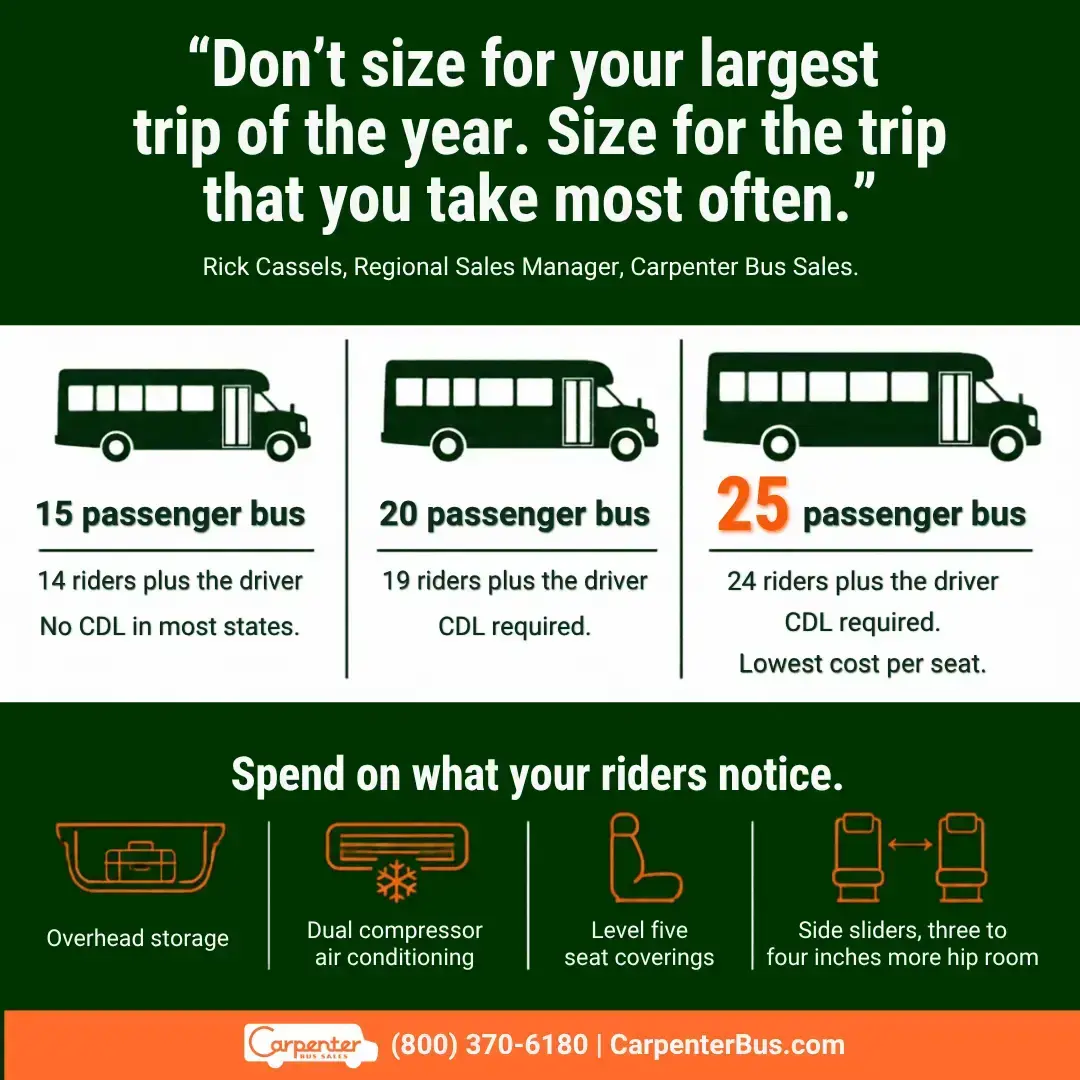
Four options repay their cost on a bus this size: overhead storage, dual compressor air conditioning, level five seat coverings, and side sliders. Rick Cassels, Regional Sales Manager at Carpenter Bus Sales, sums up the rule behind that list: "Spend money on what your riders notice and cut what they don't."
- Overhead storage. Cassels calls it "worth its weight in gold" and tells every customer so. He also says inadequate storage is the regret he hears most often from customers after a purchase, which makes this an inexpensive way to avoid the regret he names most.
- Dual compressor air conditioning. In his words, "Don't buy a bus with a single compressor unless you live at the North Pole." A single compressor cools slowly, and on a full bus in July that is the first thing riders notice.
- Level five seat coverings. The top seat covering grade lasts longer and looks better across a long ownership cycle, for a small addition to the price.
- Side sliders. Aisle seats slide three to four inches into the aisle for more hip room. It is one of the least expensive comfort options available.
Reclining seats, video systems, and Wi-Fi are situational. They earn their place on long trips with adult riders and go unused on a short shuttle route. As Cassels puts it, "seniors notice comfort, junior high boys, not so much."
Can Carpenter Bus Sales get you a 25 passenger bus?
Yes. Carpenter Bus Sales sells 25 passenger buses, generally keeps 200 or more new and used buses in stock across Franklin, Tennessee and Elm Mott, Texas, and can order one built to your configuration when the exact layout you want is not on the lot.
That matters because the layout decisions in this guide are real choices rather than a search for whatever happens to be parked somewhere. Seat count, rear wall storage, wheelchair positions, seat grade, air conditioning, and graphics are all specified before a bus is built.
Inventory changes constantly, and build timing depends on chassis availability from the manufacturer, so rather than hunting listings, tell a Carpenter Bus specialist your rider count, your luggage needs, and who will drive, and ask where current timing stands. New buses are delivered nationwide by an in-house delivery team, and every used bus is inspected and reconditioned before delivery.
Do you need a CDL to drive a 25 passenger bus?
Yes. A bus seating 24 riders plus a driver is designed to carry 16 or more people including the driver, which triggers the federal commercial driver's license requirement with a passenger endorsement. The federal thresholds are a gross vehicle weight rating of 26,001 pounds or more, a design capacity of 16 or more people including the driver, or placarded hazardous materials.
Requirements vary by state and by vehicle configuration, and some states apply stricter rules to churches and nonprofits rather than looser ones. Confirm with your state licensing agency before committing to a size, because licensing, not the bus, is the real obstacle for most organizations.
The rule follows design capacity rather than how many people are aboard, so leaving seats empty changes nothing. If licensing is the sticking point, a 15 passenger bus stays under the federal passenger threshold, and the 20 passenger guide covers whether crossing that line is worth it at all.
How big is a 25 passenger bus to park and store?
Plan on a vehicle roughly 25 to 28 feet long and about 8 feet wide, with height varying by model. Because this seat count is built on more than one chassis and body, length and weight rating differ between two buses that both carry 24 riders plus a driver.
Three measurements decide whether a bus fits your property. Overall length against your parking run, overall height against any canopy or garage entry you use, and turning room at the gates and driveways you enter weekly. Ask for the exact figures on the unit you are quoted rather than working from a general range, and measure your own entrances before you sign.
On fuel, the Carpenter Bus model pages put the Ford E-450 chassis at roughly 8 to 12 miles per gallon depending on load and driving conditions. Gross vehicle weight rating is not the empty weight of the bus. It is the maximum the vehicle is rated to carry fully loaded, which is why manufacturers tie seat counts to a final weight analysis.
Can a 25 passenger bus carry luggage or wheelchairs?
Luggage yes, with the right layout. Wheelchairs yes, at a lower seat count. Both are decisions made before the bus is built rather than additions afterward.
For luggage, a rear wall storage layout keeps the seat count and adds a storage area along the back wall. Other layouts give up seats for an interior luggage area, and the maximum seat version relies on overhead racks. Groups running airport routes and overnight trips usually take the storage.
For accessibility, the same bodies can be built with a wheelchair lift, foldaway seats, and securement systems, which reduces the number of seated riders. Carpenter Bus can walk you through shuttle bus configurations and which floor plans suit mixed mobility needs.
Should you buy, rent, or charter a 25 passenger bus?
Buy when you run on a schedule, rent when the need is occasional, and charter when you want someone else to drive. Carpenter Bus Sales rents in Tennessee and Texas, including 25 passenger buses, and those rentals are self-drive, so your organization supplies the driver and the insurance. Carpenter Bus does not provide drivers or charter service.
That distinction answers the once a year trip. A group that fills a 25 passenger bus one weekend each spring and carries 12 people the rest of the year is better off renting for the weekend than owning for the year.
Rental availability, insurance requirements, and terms change, so confirm current details with the rental team before planning around them.
How do organizations usually pay for a 25 passenger bus?
Most either finance the purchase over a term or lease, and Carpenter Bus Sales works with churches, schools, nonprofits, companies, and government buyers through a network of lenders. Loans, leases, and lease to own arrangements are all available.
Financing usually sits with the organization rather than with individual board members. Rates, terms, and approval depend on your circumstances, so ask for current numbers rather than planning around a figure you read anywhere. The bus financing page covers the options in more detail.
What warranty comes with a new 25 passenger bus?
Every new bus from Carpenter Bus Sales includes SilverCare at no charge, covering the entire vehicle bumper to bumper for 5 years or 60,000 miles. Two other tiers are available, and they differ on duration, mileage, eligibility, and price rather than on how much of the bus is covered.
| Program | Coverage | Term | Who gets it | Price |
|---|---|---|---|---|
| SilverCare | Entire vehicle, bumper to bumper | 5 years or 60,000 miles | Every new bus buyer | Included |
| GoldCare | Entire vehicle, bumper to bumper | 7 years or 70,000 miles | Any new bus buyer who upgrades | $800 one time |
| PlatinumCare | Entire vehicle, bumper to bumper | 8 years, unlimited miles | Churches, ministries, and senior care communities | Included |
Carpenter Bus Sales offers the only 8-year unlimited mile warranty in the industry for churches, ministries, and senior care communities. All three programs carry a $100 deductible per claim, exclude routine maintenance and consumables, and begin on the purchase or in-service date. Contact the warranty department before work begins, then use a qualified local shop, and Carpenter Bus pays that shop directly for approved parts and labor.
Used buses do not carry a Carpenter Bus warranty. Some retain remaining manufacturer coverage, and an optional service contract can be purchased separately.
Frequently Asked Questions
Is there a 25 passenger van?
No. Passenger vans top out around 15 people including the driver. A vehicle carrying 24 riders plus a driver is a bus body built on a commercial cutaway chassis, with a center aisle, standing headroom, dual rear wheels, and a separate passenger entry door. If a listing calls a 25 passenger vehicle a van, it is a bus.
How much does a 25 passenger bus cost?
Price depends on new or used, the chassis and body, the seating layout, wheelchair equipment, seat grade, air conditioning, and graphics. Chassis pricing and availability also move through the year. Call Carpenter Bus Sales at (800) 370-6180 for current pricing, and ask for the 20 and 24 seat layouts on the same quote so you can compare cost per seat.
What does RSW mean on a bus listing?
RSW means rear wall storage. A listing reading 25 RSW describes a bus that seats 25 people including the driver and carries a storage area along the rear wall. It tells you the bus keeps a place for bags without giving up the seat count, which matters for airport runs, retreats, and overnight trips.
What is the next size up from a 25 passenger bus?
The 30 passenger class, which usually means a heavier Ford F-550 chassis with a higher gross vehicle weight rating and available diesel power. It is a larger vehicle to park, store, and maintain, so the step is worth it only when your usual load genuinely exceeds 24 riders.
Is a 25 passenger bus gas or diesel?
Usually gas. Ford E-450 chassis under this seat count use a 7.3L gas V8, and most buses Carpenter Bus Sales sells are gas powered. Diesel becomes an option when the same seat count is built on a heavier F-550 chassis. For church and shuttle duty cycles, gas usually keeps acquisition and routine maintenance costs lower, and the gas versus diesel guide walks through the tradeoff.
What should you do next if a 25 passenger bus looks right?
Count the riders on your most common trip, confirm you can field licensed drivers, then ask for the 20 and 25 passenger layouts on one quote. Seeing both prices beside both seat counts settles the cost per seat question in about five minutes.
Bring three things to that conversation: your typical rider count, whether you need rear wall storage or wheelchair positions, and who will drive. Then compare medium buses for sale, 16 to 30 passengers, or call (800) 370-6180 and tell a specialist what you need. If the configuration is not on the lot, it can be ordered and built the way you want it.
