
Gas vs Diesel Bus Engines: Pros, Cons, and Which One Fits Your Organization
Gas costs less to buy and maintain. Diesel goes farther per gallon and pulls harder. Annual mileage, terrain, and service access decide which one fits.
By Dominic Menard - National Director of Marketing & Technology
Published • Last updated
For most churches, schools, hotels, and senior living communities, a gas bus is the more economical choice, and the majority of buses Carpenter Bus Sales sells today are gas powered. A diesel bus earns its higher purchase price mainly with about 25,000 or more highway miles a year, steep terrain, and heavy loads, where diesel's roughly 20% to 35% better fuel economy and stronger low-end torque pay off.
This guide compares the pros and cons of gasoline vs diesel shuttle buses, shows when diesel is worth the extra cost, and covers what to check on a used bus of either type.
What are the pros and cons of gasoline vs diesel shuttle buses?
Gasoline shuttle buses cost less to buy, are simpler to maintain, and can be serviced by most local repair shops. Diesel shuttle buses travel about 20% to 35% farther per gallon, according to the U.S. Department of Energy, and deliver more low-end torque, but they cost significantly more upfront and need emissions system maintenance gas buses do not.
| Factor | Gas shuttle bus | Diesel shuttle bus |
|---|---|---|
| Purchase price | Lower | Significantly higher; ask a Carpenter Bus Sales representative for a current quote |
| Fuel economy | Lower miles per gallon | About 20% to 35% farther per gallon |
| Fuel price per gallon | Regular gasoline, available almost everywhere | Often higher than gasoline; varies by region |
| Low-end torque | Adequate for most local routes | Stronger for steep grades and heavy loads |
| Emissions maintenance | No diesel exhaust fluid or particulate filter | Requires diesel exhaust fluid (DEF) and diesel particulate filter (DPF) upkeep |
| Service access | Most auto and fleet repair shops | Often needs a commercial diesel technician |
| Ride noise | Generally quieter and smoother | Quieter than older diesels, usually louder than gas |
| Best fit | Local routes, short loops, and moderate annual mileage | About 25,000 or more highway miles a year, steep terrain, and heavy loads |
The table is the short version. The rest of this guide explains how to decide which column describes your organization, because the right answer depends on how the bus will actually be used, not on which engine is better in general.
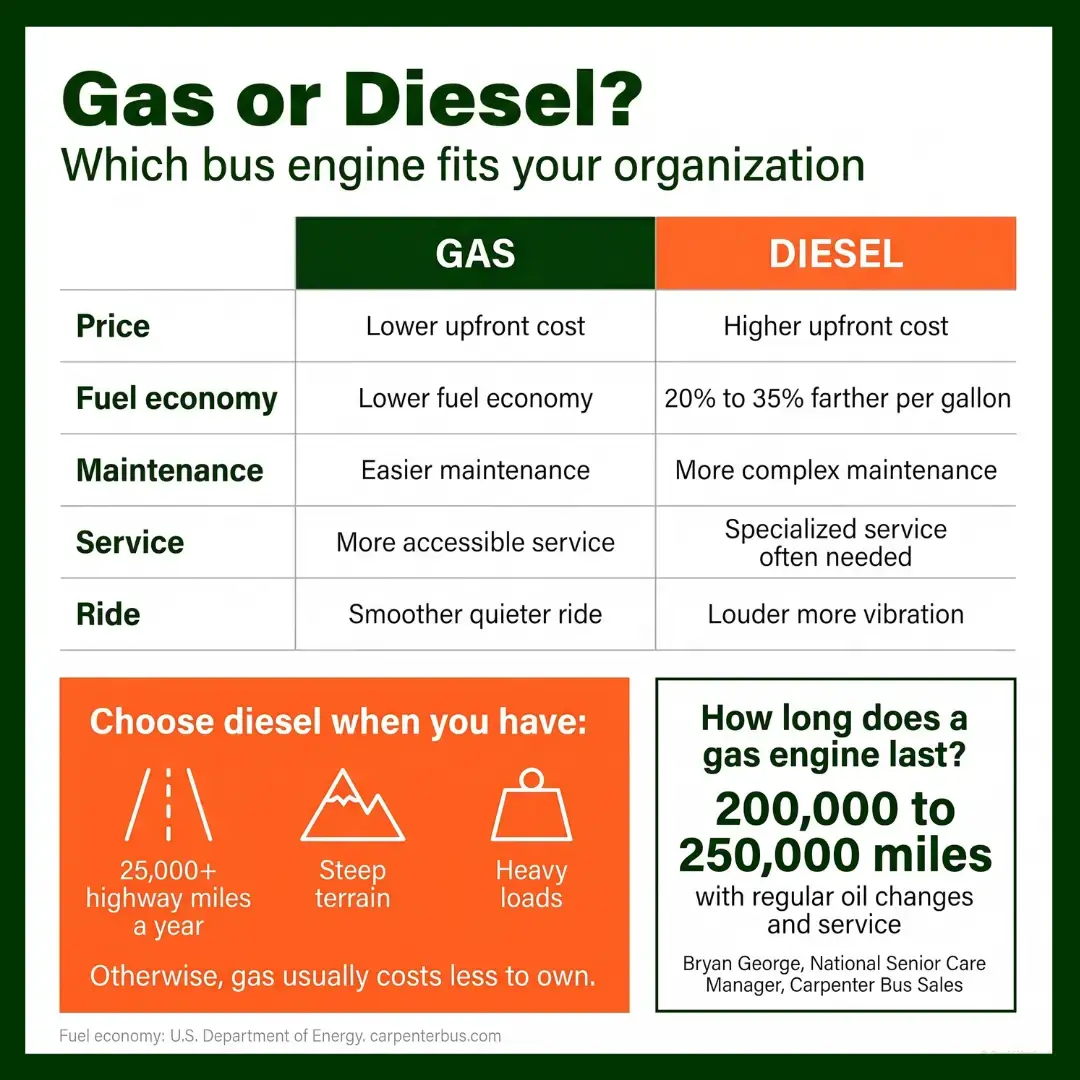
When is a diesel bus worth the higher upfront cost?
A diesel bus is usually worth its higher upfront cost only at about 25,000 highway miles a year or more, the break-even point Carpenter Bus Sales National Senior Care Manager Bryan George uses, or with regular steep grades and heavy loads. Below that mileage, diesel savings rarely recover the extra price, so a gas bus costs less to own.
Bryan George, National Senior Care Manager at Carpenter Bus Sales, starts every diesel conversation with the same question: how many miles a year do you drive? The answer settles most of the decision before engine specs come up.
One customer asked Bryan for a diesel Ford F-650, a chassis Carpenter Bus Sales offers with either a gas or diesel engine. The organization drove its bus about 2,000 miles a year. Bryan steered them to gas, because the diesel's higher purchase price and fuel cost would never pay back at that mileage, and the bus would rarely run long enough on the highway to keep a modern diesel emissions system healthy.
"If someone is going to drive it 25,000 miles a year and it's going to be highway miles, diesel is worth considering. But in senior care, that's a rarity."
Bryan George, National Senior Care Manager, Carpenter Bus Sales
The math works like this. The diesel premium is paid on day one. The savings arrive a little at a time, with every mile driven. Fewer miles each year means a longer wait to earn the premium back, and diesel fuel that costs more per gallon narrows the savings on every fill-up.
How does annual mileage change the answer?
Annual mileage is the biggest single factor, and Bryan George's rule of thumb is about 25,000 miles a year, mostly on the highway. A bus that runs long highway trips week after week builds up miles quickly, and diesel's fuel economy has time to pay for itself. The kind of miles matters too: highway miles suit a modern diesel, while short stop-and-go loops do not. A bus used for Sunday services, midweek programs, and occasional trips usually does not reach that point.
Do hills and heavy loads favor diesel?
Steep grades and heavy loads favor diesel. Diesel engines produce more low-end torque than similar-sized gas engines, which helps a fully loaded bus climb and pull without working as hard. On flat or rolling terrain with typical passenger loads, a gas engine handles the work comfortably.
Why does local diesel service matter?
A diesel bus is only as practical as the repair shop that can work on it. If the nearest qualified diesel technician is hours away, every repair costs more time and money. Organizations in rural areas, or those relying on a local general repair shop, usually find a gas bus easier to keep on the road.
| Your situation | Better fit |
|---|---|
| Under about 25,000 miles a year on local routes, such as services, programs, and local shuttles | Gas |
| Short, low-speed loops that rarely reach the highway, even if the bus runs all day | Gas |
| About 25,000 miles a year or more, mostly sustained highway driving | Diesel is worth pricing |
| Regular climbs on steep grades with full passenger loads | Diesel is worth pricing |
| Flat or rolling terrain with typical loads | Gas |
| No qualified diesel technician nearby | Gas |
| Board priority is the lowest purchase price | Gas |
| Fleet with in-house diesel technicians and high utilization | Diesel is practical |
Gas is the right choice for most churches, senior living communities, hotels, and local shuttle operators, and it is the smarter buy whenever the bus runs under about 25,000 miles a year. Diesel is the right choice for long-distance and highway-heavy routes that pile up miles every year, and for buses that regularly climb steep grades with full loads.
If your group also needs more seats than a standard cutaway bus carries, the 30 passenger bus guide covers the move to a heavier chassis and its gas and diesel options.
Is diesel better than gas for fuel mileage?
Diesel is better than gas for miles per gallon. The U.S. Department of Energy reports that diesel fuel holds roughly 10% to 15% more energy than gasoline, so diesel vehicles often travel about 20% to 35% farther on a gallon. Fuel cost per mile is a separate question, because diesel often costs more per gallon.
To compare the two fairly, look at cost per mile instead of miles per gallon:
- Divide the current price per gallon by the bus's miles per gallon for each engine.
- Multiply each cost per mile by the miles the bus will drive in a year.
- Add the cost of diesel exhaust fluid to the diesel total.
- Compare the yearly difference against the extra purchase price of the diesel bus.
Current regional prices are published every week in the U.S. Energy Information Administration gasoline and diesel fuel update. Use the prices for your region, since the gap between gasoline and diesel changes over time.
Do diesel engines require more maintenance than gas engines?
Diesel engines require more specialized maintenance than gas engines. Modern diesel buses need diesel exhaust fluid refilled regularly and diesel particulate filter upkeep, and diesel repairs often call for a technician trained on commercial diesel systems. Most gas buses can be maintained by a capable local auto or fleet shop.
Diesel technicians have historically charged higher hourly labor rates than general automotive technicians, and in rural areas they can be hard to find. Those two facts matter more to a church or senior living community than to a large fleet with its own shop, because every repair trip takes the bus out of service.
Why do short routes cause problems for modern diesel engines?
Modern diesel emissions systems need sustained high operating temperatures to clean themselves, and short, low-speed routes often never get the engine hot enough. Bryan George contrasts that with the diesels many buyers remember:
"Old-school diesel engines were a much more effective engine if you were running a route and you were going to keep the engine on all day long, because it would just go and go and go."
Bryan George, National Senior Care Manager, Carpenter Bus Sales
Today, he stresses, a diesel has to run hot for a sustained stretch, not just run all day:
"Nowadays, without taking a diesel engine up to temperature, and what I'm talking about is getting on the highway and driving it for 30 or 40 miles, where it's running at a high temperature, then it's not worth it."
Bryan George, National Senior Care Manager, Carpenter Bus Sales

Here is why that highway time matters. As a modern diesel runs, its diesel particulate filter (DPF) traps soot from the exhaust. Extended highway driving keeps exhaust temperatures high enough, long enough, for the filter to burn that soot off, a process called regeneration. Short trips and stop-and-go driving often never reach those sustained temperatures, so soot keeps building up in the filter.
Diesel exhaust fluid (DEF) works differently. DEF is sprayed into the exhaust to reduce nitrogen oxide emissions and is used up in the process, which is why the DEF tank has to be refilled regularly. It does not burn off, and running on the highway does not replace it.
Without regular runs like that, Bryan explains, a diesel on a small circular route is not worth it, and the emissions system can build up enough trouble to take the bus out of service. For routes like that, a gas engine is the better option.
Gas buses skip the diesel emissions equipment entirely. Routine service follows a familiar pattern of oil changes, filters, brakes, and inspections that most shops already handle.
The Carpenter Bus Sales service department has qualified technicians and full-service bays at its Franklin, Tennessee and Elm Mott, Texas locations. Replacement parts for both engine types are available through CarpenterBusParts.com.
How long does a gas bus engine last?
A well-maintained modern gas bus engine lasts about 200,000 to 250,000 miles with regular oil changes and service, according to Carpenter Bus Sales National Senior Care Manager Bryan George. That is about as long as older diesel engines lasted before they needed major rebuild work, so the old belief that diesel always outlasts gas no longer holds.
Bryan George hears the durability argument most often from committee members who drove diesel trucks or buses years ago. As he puts it, the diesel advocate is usually the old truck guy or a retired bus driver who hasn't kept up with all the changes. His answer to them:
"A gas engine is going to last 200,000 or 250,000 miles as long as you're changing the oil and doing the service to it."
Bryan George, National Senior Care Manager, Carpenter Bus Sales
Asked whether any customer has come back a year or two later saying they chose the wrong engine, his answer was short: "Not with the gas engine."
For a church or shuttle operator driving moderate miles each year, engine life is rarely what ends a bus's service. Body condition, changing capacity needs, and accessibility requirements usually decide replacement timing first.
What protects engine life most, gas or diesel, is maintenance on schedule. Keep records of every service visit. Those records also protect resale value when the organization eventually sells or trades in the bus.
Does bus size decide whether you get gas or diesel?
Bus size decides the engine only on the largest buses. Carpenter Bus Sales offers the Ford F-550 and F-650 chassis with either a gas or diesel engine, so most sizes still come with a choice. Larger buses built on a Freightliner chassis come with diesel only. For every other bus, annual highway mileage matters more than passenger count.
A bigger bus does not change the temperature problem. A large diesel bus that never runs long highway stretches faces the same emissions system issues as a smaller one, so the mileage test applies at every size. If your group is choosing between chassis, the 30 passenger bus guide linked above covers the F-550 in detail.
Which diesel or gasoline used buses have lower operating costs?
For most buyers, a used gas bus has lower operating costs than a used diesel bus, for the same reasons as new: cheaper fuel per gallon in most markets, no diesel exhaust fluid, and wider service access. A used diesel bus can still make sense with high annual mileage, but its emissions system history matters.
Before buying a used bus of either type, check:
- Service records. Regular oil changes and scheduled maintenance matter more than the odometer reading alone.
- Transmission service history. Transmission work is one of the costlier repairs on any used bus, gas or diesel.
- Diesel emissions system history. On a diesel bus, ask for records of diesel particulate filter service and diesel exhaust fluid system repairs, and check for emissions warning lights.
- An independent inspection. A qualified mechanic familiar with the engine type should inspect the bus before purchase.
The guide to what to look for when purchasing a used bus walks through the full inspection, beyond the engine.
Can Carpenter Bus Sales build a propane bus or a CNG bus?
Carpenter Bus Sales can build propane and compressed natural gas (CNG) buses as special order vehicles, but does not keep either in stock. Most buyers choose from gas or diesel inventory, and propane buses are less common today than they once were. If your organization needs a propane or CNG bus, a Carpenter Bus Sales bus specialist will gladly help.
A propane or CNG bus makes the most sense when an organization already has reliable fueling for that fuel along its routes, or a specific reason to run on an alternative fuel. Because it is built to order rather than pulled from inventory, ask a Carpenter Bus Sales representative about configuration options and timing before planning around one.
Fueling access is the first thing to research. The U.S. Department of Energy Alternative Fuels Data Center station locator shows public propane and CNG stations nationwide. For most organizations, a gas bus delivers the same practical benefits of lower purchase cost and simple maintenance, with fuel available almost everywhere.
Which engine fits your organization?
Gas fits most churches, senior living communities, hotels, and local shuttle operators, because they run moderate miles on local routes. Diesel fits long-distance and highway-heavy routes that build up about 25,000 miles a year or more. Annual mileage, terrain, passenger load, and diesel service access decide the answer for everyone else.
Answer these five questions before the committee meets:
- How far will the bus travel each day, and each year?
- How heavy are typical passenger and equipment loads?
- Is diesel fuel and a qualified diesel technician available nearby?
- What is the budget for fuel and maintenance, not just the purchase?
- Are there local rules that affect which fuel type you can operate?
Most church buses fall clearly on the gas side of that list. Senior care buyers lean even further toward gas: Bryan George says nearly every senior care customer he works with chooses a gas bus. Operators whose shuttle buses run long highway routes are the group most likely to find diesel worth pricing.
Frequently Asked Questions
Do buses run on gas or diesel?
Buses run on both. Small and mid-size church, shuttle, and senior living buses built on cutaway chassis commonly run on gasoline, while large motorcoaches most commonly run on diesel. The majority of buses Carpenter Bus Sales sells today are gas powered, with diesel available on some configurations for high-mileage and heavy-duty use.
What is DEF, and do gas buses need it?
DEF stands for diesel exhaust fluid, a liquid that modern diesel engines use to reduce emissions. Diesel buses need DEF refilled regularly as part of normal operation. Gas buses do not use DEF at all, which is one reason gas buses are simpler and usually less expensive to maintain over their service life.
Are gas buses quieter than diesel buses?
Gas buses generally run quieter and smoother than diesel buses, which many riders notice on longer trips. Modern diesel engines are much quieter than older diesels thanks to newer engine designs and noise-damping technology, but a gas engine is still usually the quieter choice for passenger comfort in a church, senior living, or hotel shuttle bus.
Can a regular mechanic service a gas bus?
Most capable local auto or fleet repair shops can service a gas bus, because gas engines on cutaway bus chassis share much of their design with commercial trucks those shops already see. Diesel buses often need a technician trained on commercial diesel engines and emissions systems, which can be harder to find in rural areas.
Is diesel fuel always more expensive than gasoline?
Diesel fuel is not always more expensive than gasoline, but it often costs more per gallon in the United States. Prices vary by region and change week to week. Before comparing fuel costs for a gas or diesel bus, check current regional prices in the U.S. Energy Information Administration weekly gasoline and diesel fuel update.
What is the next step in choosing between gas and diesel?
The next step is to estimate your bus's annual mileage, terrain, and typical load, then talk with a Carpenter Bus Sales representative about configurations that match. A representative can quote gas and diesel options side by side so the committee compares real numbers instead of assumptions.
Find your Carpenter Bus Sales representative or call (800) 370-6180. Carpenter Bus Sales has served churches, schools, senior living communities, and shuttle operators since 1953, and sells and delivers nationwide.
