
20 Passenger Bus Buyer's Guide: Do You Really Need One?
The step up from 15 passengers: what a CDL now requires, how it compares to a 25 on the same chassis, and which configuration fits your group.
By Dominic Menard - National Director of Marketing & Technology
Published • Last updated
A 20 passenger bus is the right step up from a 15 passenger bus when your group regularly tops 15 people and you have CDL drivers, because the federal rule requires a CDL for any bus designed for 16 or more people, driver included. Carpenter Bus Sales counts the driver in every capacity it lists, so a 20 passenger bus carries 19 riders plus the driver. If your drivers hold standard licenses, a 15 passenger bus is usually the better buy.
This guide walks through what the 20 passenger class is, how the CDL line works, what you can do about it, and which floor plans exist, so your committee can make the call with the facts in front of it.
What is a 20 passenger bus?
A 20 passenger bus is a purpose-built bus on a commercial cutaway chassis, designed to carry 20 people including the driver. It is the middle ground between a 15 passenger bus and our mid-size 25 passenger buses. Carpenter Bus Sales publishes floor plans in this class from 25 to 27 feet long, depending on the layout.
Organizations usually start looking at this size when they outgrow a 15 passenger van or minibus but are not ready for a large coach. Stepping up to a 20 passenger bus gets you a longer body, a center aisle, and room to choose how the interior is used.
That choice is the heart of the class. The same body length can be set up two ways:
- Max capacity: fill the floor with seats and carry the most people the floor plan allows.
- Max comfort: spread the seats out for more legroom, or give up a row for rear luggage storage. The legroom option is often preferred by college and university sports teams.
The body rides on the same kind of heavy-duty cutaway platform used for larger buses in this size range. The Glaval Universal's 25-foot, 26 passenger configuration, for example, is built on the Ford E-450 chassis. Confirm the chassis for any specific bus with your rep, since it varies by manufacturer and floor plan.
Do you really need a 20 passenger bus, or will a 15 passenger bus work?
You need a 20 passenger bus only if you regularly fill more than 15 seats and can put a CDL driver behind the wheel for every trip. If your biggest trips happen a few times a year, or your drivers hold standard licenses, a 15 passenger bus from Carpenter Bus Sales usually serves you better.
Start with your drivers, not the brochure. Capacity is the easiest number to shop on and the least useful one to start with, because the licensing line, not the price, decides who can operate the bus. Three questions settle it for most committees:
- Who will drive it, and what are they comfortable driving? Count the people who hold a CDL with a Passenger endorsement today, or who will commit to getting one. If that number is one, the bus sits whenever that person is unavailable. Then ask those drivers what size they are willing to handle, because a bus nobody wants to drive is the wrong bus no matter how well it fits the group.
- How often do you fill the seats? Look at your last year of trips and size the bus for the trip you take most often, not the one big trip you take once or twice a year. There are usually other ways to cover the rare trip, including renting or running a second vehicle.
- Where will you park it? Every 20 passenger layout Carpenter Bus Sales publishes is longer than every 15 passenger layout: 25 to 27 feet against 20 to 24. Measure the space before you shop.
Rick Cassels, Regional Sales Manager at Carpenter Bus Sales, starts committees in the same place:
Let's start with the trip you take most often. Not the trip that's the really large one that you may only take once or twice a year. There are other ways to work around that trip. But a fifteen passenger bus, if that's what you're taking most of the time, is going to be the best solution for you in most cases.
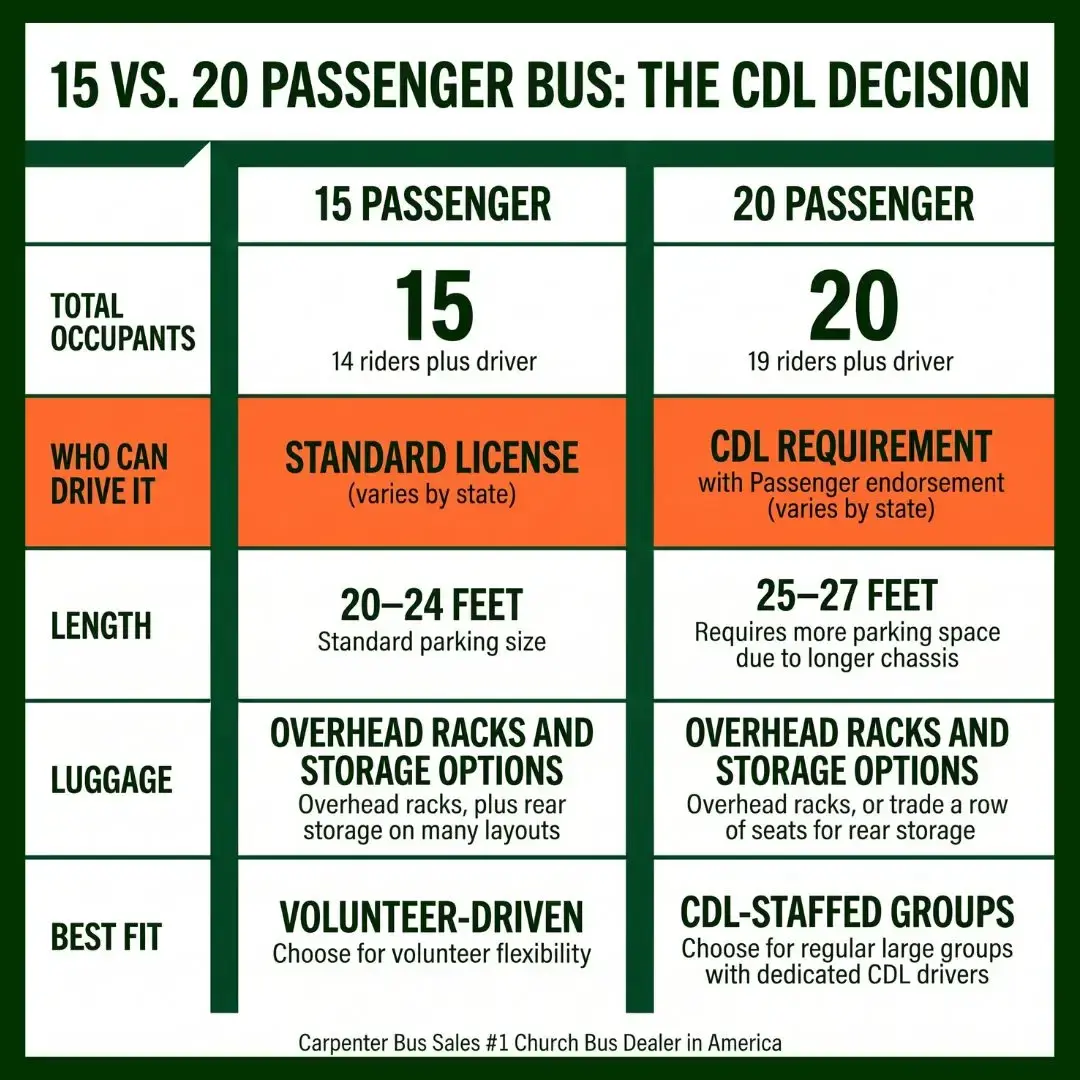
| Decision point | 15 passenger bus | 20 passenger bus |
|---|---|---|
| Total occupants, driver included | 15 (14 riders plus the driver) | 20 (19 riders plus the driver) |
| Federal CDL rule | Under the 16-occupant line; a standard license covers it in most states | Over the line; CDL with a Passenger (P) endorsement required |
| Who can drive it | Most licensed staff and volunteers, subject to state rules | Only drivers who hold a CDL with a P endorsement |
| Length on Carpenter Bus Sales floor plans | 20 to 24 feet | 25 to 27 feet |
| Luggage and storage | Overhead racks or rear storage on many layouts | Overhead racks, or trade a row of seats for rear storage |
| Best fit | Volunteer-driven churches, senior activity trips, groups that rarely exceed 15 | Groups that regularly exceed 15, teams carrying gear, operations with dedicated CDL drivers |
The smaller bus is often the better buy. If your group fills 12 to 15 seats most weeks and your drivers are volunteers, the smaller bus keeps every licensed adult on your roster eligible to drive. Our 15 passenger bus buyer's guide covers that class in full.
What do buyers wish they had planned for?
Storage and air conditioning are the two things buyers most often wish they had planned for, along with asking the people who will actually ride the bus what matters to them. Rick Cassels, Regional Sales Manager at Carpenter Bus Sales, raises all three with committees before capacity, because a bus with enough storage and enough cooling keeps almost everyone satisfied.
You will really rue the day that you didn't plan for enough storage in that bus. Talk to your seniors. Talk to the people that will be using the bus. Find out what's important to them. It's a great thing to have buy-in from a lot of different parties. So in closing, if you get enough storage and if you get enough AC, you're probably not going to make anybody mad.
Rick Cassels, Regional Sales Manager, Carpenter Bus Sales
- Plan for more storage than you think you need. Storage is the decision buyers regret most. On a 20 passenger bus that usually means giving back a row of seats, which is easier to accept before the purchase than after it.
- Do not treat air conditioning as an afterthought. Ask what cooling the floor plan includes, especially toward the rear of a longer body.
- Talk to the people who will ride. Seniors, youth leaders, and coaches each know something the committee does not. Buy-in across several groups is worth the extra conversations.
When is a 20 passenger bus the wrong choice?
A 20 passenger bus is the wrong choice when your group rarely exceeds 15 riders or your drivers hold standard licenses, because the licensing requirement applies to every trip regardless of how many seats are filled. Carpenter Bus Sales would rather sell your organization a 15 passenger bus it can operate every week.
Stay with a 15 passenger bus if:
- You rarely carry more than 15 people, driver included.
- Your drivers are volunteers or staff without a CDL, and nobody is committing to earn one.
- Your drivers are licensed but not comfortable handling a vehicle this size.
- Your parking or covered storage cannot take a 25 to 27 foot vehicle.
- You need the extra capacity only a few times a year, when renting or taking a second vehicle covers it.
Step up to a 20 passenger bus if:
- You routinely exceed 15 riders, or turn people away.
- You have more than one CDL driver with a Passenger endorsement, or a plan to certify them.
- Keeping the whole group together in one vehicle matters to the trip.
- You need luggage room or legroom that a fuller floor plan cannot give you.
- You are replacing two or more smaller vehicles running the same route.
What does stepping up to a 20 passenger bus get you?
You get comfort, capacity, and a group that travels together:
- A more comfortable ride. The center aisle and longer body mean passengers are not packed in the way they are in a crowded van, which matters on longer trips.
- One vehicle instead of a convoy. Moving the whole group in a single bus saves fuel over a line of cars and keeps everyone on the same schedule.
- Time back for passengers. Riders can read, work, or fellowship on the way instead of driving.
- Room to grow. If your group is close to 15 today and growing, the extra seats buy you time before the next purchase.
What does stepping up cost your organization?
The primary hurdle is the driver's license, not the purchase price. Once a bus crosses the 16-occupant line, volunteers with standard licenses cannot drive it, so you need a roster of CDL-certified drivers available for every trip.
A bus sized to the group but not to the driver roster sits in the parking lot. If one person holds the license, the bus runs only when that person is free. Carpenter Bus Sales can quote a 15 passenger bus and a 20 passenger bus side by side so your committee weighs the price difference against the driver question, not after it.
Do you need a CDL to drive a 20 passenger bus?
Yes, under the federal rule. A Commercial Driver's License with a Passenger (P) endorsement is required for any vehicle designed to carry 16 or more people, including the driver. A 20 passenger bus is designed for 20, so it crosses that line. Some states add stricter rules, so verify requirements with your state licensing agency.
The federal rule. The standard set out in the commercial motor vehicle definition at 49 CFR 383.5 has two triggers for passenger vehicles:
- The vehicle is designed to carry 16 or more people, including the driver.
- The vehicle has a gross vehicle weight rating (GVWR) of 26,001 pounds or more.
What counts is design capacity, not how many people ride that day. A 20 passenger bus carrying eight people on a Tuesday still requires a CDL driver, because the rule looks at what the bus was built to carry.
What this means in practice. Federal rules set the floor, your state can raise it, and neither one bends for how many seats are filled. Carpenter Bus Sales will tell you which category a specific bus falls into, but your state licensing agency is the authority on what your drivers need.
Your state comes next, and it can be stricter. Requirements vary by state. Some states set lower thresholds or add endorsements for churches, nonprofits, or paid drivers, even on smaller buses. Before you buy, check our state-by-state guide to CDL requirements for buses, confirm with your state DMV, or ask your Carpenter Bus Sales rep.
How hard is it to get a CDL with a Passenger endorsement?
A CDL with a Passenger endorsement requires passing a written knowledge test and a driving skills test in a representative vehicle. Since February 7, 2022, anyone getting a Passenger endorsement for the first time must also complete entry-level driver training through an FMCSA-registered provider before testing.
It takes study and practice, but many churches and organizations successfully sponsor staff members or volunteers to get certified. Your state DMV sets the testing locations and schedule, and training costs vary by provider, so get local quotes.
Can a 20 passenger bus be converted to a non-CDL bus?
It can be, but not by removing seats yourself. A bus's capacity comes from its original design, so pulling seats on your own does not change how the bus is classified. Carpenter Bus Sales handles manufacturer-approved reclassification, which ends with updated capacity labels from the manufacturer installed at our Franklin, Tennessee or Elm Mott, Texas (Waco Area) location.
The process on the Carpenter Bus Sales CDL to non-CDL conversion page runs in this order:
- You submit your organization and vehicle details.
- Our team confirms eligibility. The manufacturer, the bus's age, and its condition all matter, because some manufacturers support reclassification and some do not.
- Your organization provides a short letter, and our team takes before-and-after photos of the seats removed.
- Once approved, the manufacturer issues updated capacity labels.
- Carpenter Bus Sales installs the new labels in-house before the bus leaves our facility.
Requirements vary by state, so reclassification needs can look different depending on where you operate. Confirm with your state licensing agency and your insurance carrier how they will treat the reclassified bus before work begins. For current pricing and eligibility, use the conversion page form.
If you are buying new and already know your drivers will not hold a CDL, starting with a 15 passenger bus is the simpler path.
How is a 20 passenger bus different from a 25 passenger bus?
The difference is mostly the floor plan, not the vehicle class. Carpenter Bus Sales publishes 25-foot layouts that seat 25 or 26 people at full capacity, or 21 or 22 when the rear rows become a storage area. Both sizes require a CDL under the federal rule, so the choice comes down to seats versus cargo room.
That makes the 20 passenger decision easier than it looks. Once you have committed to CDL drivers, you are shopping a range of lengths and layouts rather than a single fixed size. A group that needs every seat for Sunday shuttles might choose the full 25 or 26 seats. A group that takes overnight trips might choose 21 or 22 seats with rear storage on the same body length.
If your headcount is closer to 25, our 25 passenger bus buyer's guide covers the larger layouts.
Which 20 passenger floor plans can you buy?
Carpenter Bus Sales publishes Starcraft Allstar floor plans in this range at 25 and 27 feet, carrying 21 or 22 people with rear storage, or 25 to 26 people when the storage area is given back to seating. Wheelchair layouts are available too, such as a 25-foot Allstar with 17 seats and two wheelchair stations.
| Floor plan | Length | Capacity, driver included | Storage or accessibility |
|---|---|---|---|
| Starcraft Allstar | 25 feet | 21 (or 25 without storage) | Rear storage |
| Starcraft Allstar | 25 feet | 22 (or 26 without storage) | Rear storage |
| Starcraft Allstar | 27 feet | 22 | Rear storage with wall |
| Starcraft Allstar | 25 feet | 17 plus 2 wheelchair stations | Versions with a rear door, jump seat, or fold-away seats |
These layouts come from the Carpenter Bus Sales bus floor plans library, which lists floor plans for models we have stocked. Chassis, model year, and options change by build, so confirm exact specifications for the specific bus you are considering with your rep.
Can a 20 passenger bus be wheelchair accessible?
Yes. Wheelchair layouts in this size range replace some seats with securement stations and add a lift. The 25-foot Starcraft Allstar floor plan with 17 seats and two wheelchair stations, for example, lets one bus serve riders who walk on and riders who use wheelchairs. Ask your rep which lift and securement setup fits your passengers.
What safety features should a 20 passenger bus have?
Look for a fully welded steel cage body, compliance with Federal Motor Vehicle Safety Standards (FMVSS), a rear emergency exit, and strong driver visibility. The Starcraft Allstar and Glaval Universal buses Carpenter Bus Sales carries both use fully welded steel structures, and Carpenter Bus Sales lists the Allstar as FMVSS compliant.
Features Carpenter Bus Sales lists for the two most common bodies in this class:
- Starcraft Allstar: fully welded steel cage structure, Altro safety flooring, LED interior and exterior lighting, and a 3,000-pound seat pull test. A rear emergency door with windows is a popular option.
- Glaval Universal: fully welded aluminized steel structure, 5/8-inch marine grade plywood flooring, a fully undercoated chassis, a Rosco rear vision backup camera, and tempered safety glass windows.
Standard and optional equipment changes by model year and build, so review the spec sheet for the exact bus with your rep before you sign.
Which organizations buy 20 passenger buses?
Churches, senior living communities, private schools and athletic programs, hotels, and corporate campuses commonly buy 20 passenger buses from Carpenter Bus Sales. What these buyers share is a group that regularly exceeds 15 riders and an operation that can keep CDL-licensed drivers available for every trip.
- Churches: retreats, mission trips, and youth activities that outgrow a 15 passenger bus. Churches buying in this size often designate one or two staff members or volunteers to earn a Passenger endorsement. See our church buses for options built for ministry use.
- Senior living communities: outings, appointments, and events, often with a wheelchair-accessible layout.
- Private schools and athletic programs: team travel where legroom and gear storage matter.
- Hotels and resorts: airport and guest shuttles where rear luggage storage is essential.
- Corporate campuses, camps, and government agencies: employee shuttles and community routes where one larger bus replaces two smaller vehicles.
What warranty comes with a new 20 passenger bus from Carpenter Bus Sales?
Every new bus and van from Carpenter Bus Sales includes SilverCare at no cost, covering the entire vehicle, bumper to bumper, for 5 years or 60,000 miles. Churches and senior care communities buying new also qualify for PlatinumCare: the 8-Year Unlimited Mile Warranty, bumper to bumper, at no extra cost.
| Plan | Coverage term | What it covers | Who it is for |
|---|---|---|---|
| SilverCare (included) | 5 years or 60,000 miles | Entire vehicle, bumper to bumper | Every new bus and van customer |
| GoldCare (optional upgrade) | 7 years or 70,000 miles | Entire vehicle, bumper to bumper | Any new-vehicle customer who wants to upgrade |
| PlatinumCare (included) | 8 years, unlimited miles | Entire vehicle, bumper to bumper | Churches and senior care communities |
For a church or senior living community, that makes a new 20 passenger bus unusually well protected. These plans apply to new vehicles. If you are buying used, ask your rep what coverage applies to that specific bus. Full terms are on the Carpenter Bus Sales warranty page.
What affects the cost of a 20 passenger bus?
Price depends on new versus used, manufacturer, floor plan, chassis, and options such as rear air conditioning, overhead luggage racks, and wheelchair lifts. Because configurations vary so widely, Carpenter Bus Sales quotes specific buses rather than a single price for the class, and a rep can compare options from more than 200 buses in stock.
Beyond the purchase, plan for these running costs:
- Insurance. Premiums depend on how the bus is used, how many drivers you have, their records, your state, and the limits you choose. Because a 20 passenger bus requires a CDL, some carriers classify it differently than a smaller bus, so get quotes from carriers that write commercial or organizational vehicle coverage.
- Fuel. Carpenter Bus Sales lists the Ford E-450 chassis at 8 to 12 miles per gallon, depending on driving conditions and load.
- Drivers. Budget for training and testing if you are sponsoring new CDL drivers.
- Financing. Carpenter Bus Sales offers financing on new and used buses, so you can match payments to your budget cycle.
If you only need 20 seats a few times a year, renting may make more sense than owning. Carpenter Bus Sales rents buses in Tennessee and Texas, and rentals of buses larger than 15 passengers require $5 million in liability coverage.
Frequently Asked Questions
What chassis is a 20 passenger bus built on?
A 20 passenger bus is typically built on a heavy-duty Ford or Chevrolet cutaway chassis with dual rear wheels. The Glaval Universal's 25-foot configuration, for example, rides on the Ford E-450. Chassis choices vary by manufacturer, floor plan, and model year, so confirm the chassis for the specific bus with your Carpenter Bus Sales rep.
Does a 20 passenger bus have luggage space?
It depends on the floor plan. A layout that uses the whole floor for seats has overhead racks at most. If you need both seats and storage, look at 25-foot Starcraft Allstar layouts that trade the rear rows for a storage area, carrying 21 or 22 people including the driver.
How long is a 20 passenger bus, and will it fit our parking?
Floor plans Carpenter Bus Sales publishes in the 20 passenger range run 25 to 27 feet long, compared with 20 to 24 feet for 15 passenger layouts. Measure your parking or storage space, including any covered area, before you shop, and ask your rep for the overall length and height of the exact bus.
What fuel economy does a 20 passenger bus get?
Carpenter Bus Sales lists the Ford E-450 chassis, a common platform in this size range, at 8 to 12 miles per gallon. Actual results depend on driving conditions, terrain, and passenger load, so budget from the low end of that range until you have a few months of your own fuel records.
Is a 16 passenger bus a CDL vehicle?
Under the federal rule, yes. A bus designed for 16 people, including the driver, meets the threshold for a CDL with a Passenger endorsement. That is why non-CDL buses are built for 14 riders plus the driver. Check how a seller counts capacity, and read the capacity label on the bus itself.
What should your organization do next?
Start with your drivers, not the brochure. Before you talk to anyone, write down three numbers: how many CDL drivers you have or will sponsor, how many people ride on a typical week, and how many feet of parking you have. Those three answers point clearly to a 15 or a 20.
If the numbers point to a 20, browse our midsize buses for sale, or call Carpenter Bus Sales at (800) 370-6180. Founded in 1953 and the number one church bus dealer in America, Carpenter Bus Sales delivers nationwide, and a rep can walk your committee through floor plans, licensing, and warranty coverage for the exact bus you are considering.
