
30 Passenger Bus: The Complete Guide for Buyers
A 30 passenger bus is 27 to 32 feet long on a Ford E-450 or F-550 chassis, and drivers need a CDL. Compare floor plans, engines, luggage space, and warranty.
By Dominic Menard - National Director of Marketing & Technology
Published • Last updated
A 30 passenger bus seats 30 people, including the driver, and Carpenter Bus Sales offers this size on two platforms: the 27-foot Starcraft MVP on a Ford E-450, or a Ford F-550 bus from 28 to 32 feet with gas or diesel power. Because it is designed for 16 or more people, drivers need a CDL with a passenger endorsement under the federal standard, and some states add stricter rules.
What is a 30 passenger bus?
A 30 passenger bus, also called a 30 seater or 30 person bus, is a bus body with a center aisle, standing headroom, and a powered entry door, built on a commercial cutaway chassis. Carpenter Bus Sales sells this size on the Ford E-450 and Ford F-550, with Starcraft bodies built around a fully welded steel cage.
One detail catches committees off guard: the driver counts as one of the 30. If you need seats for 30 riders, you need 31 in total, which points to the 32-foot F-550.
How long is a 30 passenger bus?
A 30 passenger bus runs 27 to 32 feet long. The Starcraft MVP on the Ford E-450 is 27 feet, and Ford F-550 buses come in 28, 30, and 32 foot lengths according to 2025 manufacturer specifications. Capacity grows with length, from 25 to 33 people including the driver.
| Length | Chassis | Engine | People, including driver |
|---|---|---|---|
| 27 feet | Ford E-450 (Starcraft MVP) | 7.3L V8 gas | 29 |
| 28 feet | Ford F-550 | 7.3L gas or 6.7L diesel | 25 |
| 30 feet | Ford F-550 | 7.3L gas or 6.7L diesel | 29 |
| 32 feet | Ford F-550 | 7.3L gas or 6.7L diesel | 33 |
The F-550 bodies are 96 inches wide and 123 inches tall, about 10 feet 3 inches. Measure your parking space, carport, and any garage door before choosing a length, and confirm exact dimensions for the specific bus, since specifications change by model year.
Should you stay on the E-450 or move up to the F-550?
Stay on the Ford E-450 if 29 total occupants covers your group, because the Starcraft MVP delivers that capacity in a 27-foot gas bus. Move up to the Ford F-550 when you need up to 33 occupants, rear luggage without dropping below 28 riders, two wheelchair positions with 24 seats, or diesel power.
When is the Starcraft MVP the better buy?
The MVP is the natural step up from a 25 passenger bus. It stays on the same Ford E-450 platform, adds 2 feet, and adds three seats, which is often all a growing group needs. At 27 feet it is also easier to park in a church lot, campus drive, or hotel loop than a 32-foot bus.
The trade-off is flexibility. Adding rear luggage drops the MVP to 24 passengers plus the driver, and there is no diesel option. See the Starcraft MVP floor plans and specs, or the 25 passenger bus buying guide if your group may fit one size down.
When is the F-550 worth it?
The F-550 is a heavier-duty chassis with a 19,500 lb GVWR. It earns its place when you need more than 29 seats, luggage space without giving up four riders, two wheelchair positions, or the 6.7L diesel. If you need more than 33 seats, or luggage and wheelchair space together, see the 35 passenger bus buying guide.
| Decision factor | 25 passenger bus (E-450) | Starcraft MVP (E-450) | F-550 bus |
|---|---|---|---|
| People, including driver | 26 | 29 | Up to 33 |
| Length | 25 feet | 27 feet | 28 to 32 feet |
| Engine | Gas | Gas | Gas or diesel |
| With rear luggage | Fewer seats | 24 passengers plus driver | 28 or 24 passengers plus driver |
| Wheelchair layouts | Available | Available | 24 passengers plus 2 wheelchairs plus driver |
| Best fit | Groups of 26 or fewer | Groups up to 29 that want a shorter bus | Larger groups, luggage trips, wheelchair riders, diesel buyers |
Ask for quotes on both builds with the options you actually need. Dividing each price by its seat count gives your board a clear cost-per-seat comparison.
How many seats do you give up for luggage or wheelchairs?
A rear luggage area costs four to eight seats, and two wheelchair positions cost eight. On the Ford F-550, seating drops from 32 passengers plus the driver to 28 or 24 with rear luggage, or 24 with two wheelchair positions. The Starcraft MVP drops from 28 to 24 passengers plus the driver with rear luggage.
| Chassis | Layout | Typical use |
|---|---|---|
| F-550 | 32 passengers plus driver | Maximum seating for short trips and campus routes |
| F-550 | 29 passengers plus driver | Full seating on a 30-foot body |
| F-550 | 28 passengers with rear luggage plus driver | Retreats, day trips, and airport runs |
| F-550 | 24 passengers with rear luggage plus driver | Overnight trips and teams with gear |
| F-550 | 24 passengers plus 2 wheelchairs plus driver | Senior living and mixed-mobility groups |
| E-450 (MVP) | 28 passengers plus driver | Maximum seating on a Ford cutaway |
| E-450 (MVP) | 24 passengers with rear luggage plus driver | Hotel and airport transfers |
Wheelchair layouts use either foldaway or flip seats in the wheelchair area, and every capacity is subject to the manufacturer's final weight analysis for your build.
Can you get a 30 passenger bus with a diesel engine?
Yes, but only on the Ford F-550 chassis, which is offered with a 7.3L gas V8 or a 6.7L diesel. Ford builds the 2026 E-450 around its 7.3L V8 gas engine, so the Starcraft MVP route is gas. Most buses Carpenter Bus Sales sells are gas powered, though it sells both gas and diesel.
Diesel costs more up front and adds emissions maintenance such as diesel exhaust fluid and particulate filter service. The gas vs diesel bus engine comparison explains when that trade makes sense. Carpenter Bus Sales can also build propane buses to order.
Do you need a CDL to drive a 30 passenger bus?
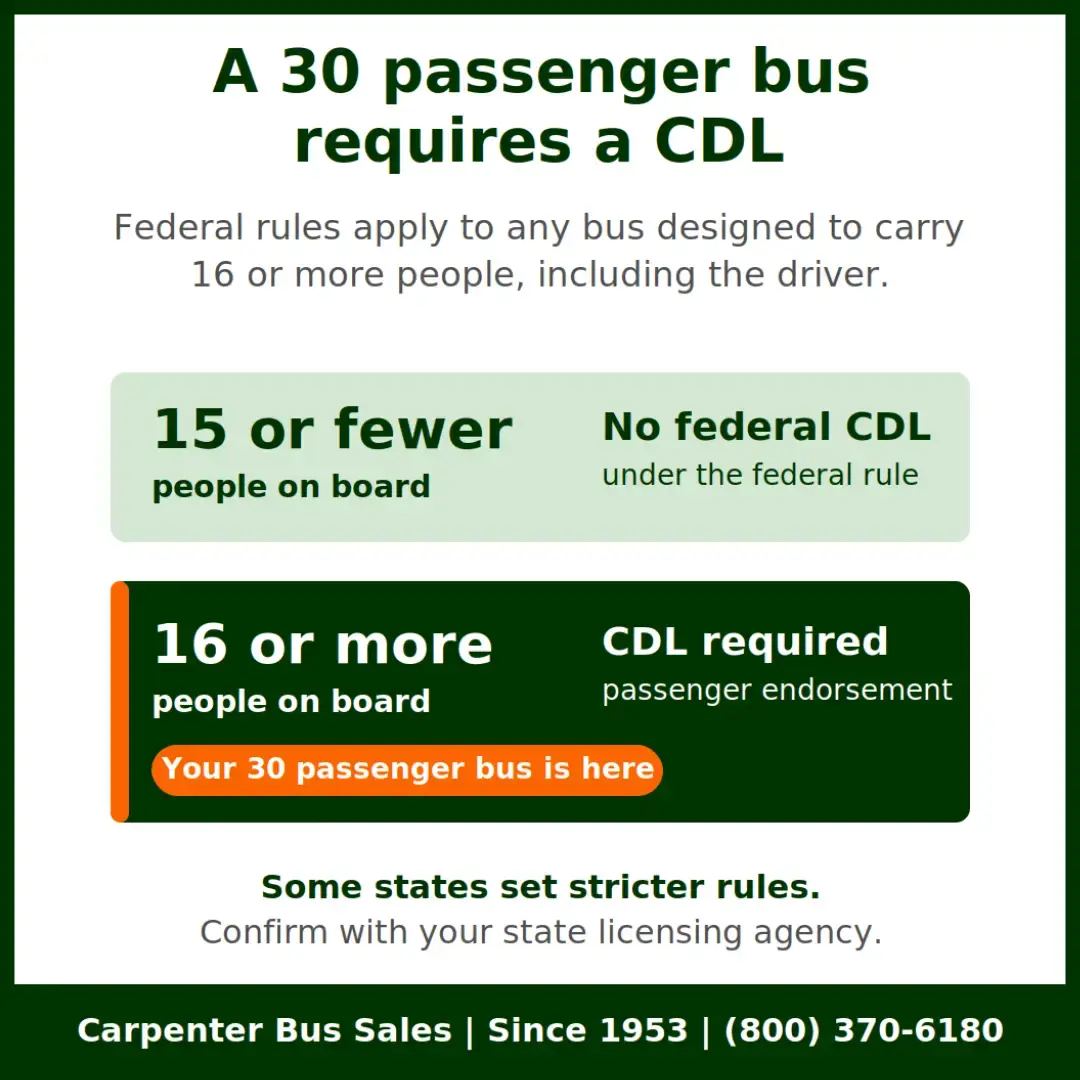
Yes. The federal CDL standard in 49 CFR 383.5 covers any vehicle designed to transport 16 or more people including the driver, so a driver needs a CDL with a passenger endorsement for every 30 passenger bus. Some states add stricter rules on top of that standard, so confirm with your state licensing agency or a Carpenter Bus Sales representative.
Under the federal commercial motor vehicle definition, passenger count is what puts this bus in Group C; the F-550's 19,500 lb GVWR is well under the 26,001 lb heavy-vehicle line. Two details trip up buyers:
- Removing seats does not change the rule. Licensing follows the bus's design capacity, not the seats currently installed.
- Towing can change the license group. A combination rated at 26,001 lb or more, with a trailer rated over 10,000 lb, falls under Group A.
For stricter state rules, including those for church and nonprofit drivers, see the state-by-state CDL requirements guide.
Who usually buys a 30 passenger bus?
Churches, private schools, senior living communities, and hotel or campus shuttle operators buy 30 passenger buses when a 25 passenger bus runs full or when two smaller vehicles keep making the same trip. Carpenter Bus Sales matches each group to a layout, from maximum seating to wheelchair positions.
- Churches use luggage layouts for retreats and mission trips. Carpenter Bus Sales is the number one church bus dealer in America; see all church buses.
- Private schools move a full team and gear. See the MFSAB question in the FAQ below.
- Senior living communities choose wheelchair layouts so outings do not split into two trips.
- Hotels and campus shuttles choose luggage layouts for airport runs and maximum seating for short loops.
What warranty comes with a new 30 passenger bus?
Every new bus from Carpenter Bus Sales includes SilverCare free, covering powertrain and chassis for 5 years or 60,000 miles. Churches, ministries, and senior care communities receive PlatinumCare free: 8 years, unlimited miles, bumper to bumper. Other new bus buyers can upgrade to GoldCare, 7 years or 70,000 miles on the entire vehicle, for $800.
| Program | Term | Coverage | Who it is for | Cost |
|---|---|---|---|---|
| SilverCare | 5 years or 60,000 miles | Powertrain and chassis; body stays under the manufacturer warranty | Every new bus and van buyer | Free |
| GoldCare | 7 years or 70,000 miles | Entire vehicle, bumper to bumper | Any new bus buyer who upgrades | $800 one time |
| PlatinumCare | 8 years, unlimited miles | Entire vehicle, bumper to bumper | Churches, ministries, and senior care communities | Free |
All three carry a $100 deductible per claim and exclude routine maintenance. Contact the Carpenter Bus Sales Warranty Department before work begins, then use a qualified local shop; Carpenter Bus Sales pays the shop directly for approved repairs. Starcraft separately backs its bodies with a 5-year, 100,000-mile structural warranty. Full terms are on the Carpenter Bus Sales warranty programs page.
Used buses do not carry a CBS-backed warranty, but Carpenter Bus Sales offers optional service contracts on qualifying used buses. Ask your representative whether a specific bus qualifies.
How much does a 30 passenger bus cost?
The price of a 30 passenger bus depends on the chassis, engine, length, floor plan, wheelchair equipment, options, and whether it is new or used, so Carpenter Bus Sales quotes each bus individually rather than publishing one figure. Comparing an E-450 quote with an F-550 quote shows your true cost per seat.
The biggest swings come from the diesel option, a wheelchair lift, and comfort options such as rear heat and air, overhead racks, and high-back seating. Carpenter Bus Sales also posts monthly pricing specials on its website.
Should you rent or buy a 30 passenger bus?
Rent if you need a bus this size only a few times a year, and buy if it will run weekly routes or regular trips. Carpenter Bus Sales rents buses in Tennessee and Texas, including buses in and around the 30 passenger range. Rentals Supervisor Amanda Crawford can check what is available for your dates.
Contact Amanda at (615) 376-2287, ext. 213 or [email protected]. Rentals of buses this size require $5 million in liability coverage, a Carpenter Bus Sales requirement, and rates are quoted per request.
Frequently Asked Questions
Is a 30 passenger bus the same as a 30 passenger van?
No. Passenger vans generally top out at 15 passengers, so a vehicle built for 30 people is a bus: a separate bus body with a center aisle mounted on a commercial cutaway chassis such as the Ford E-450 or F-550. Carpenter Bus Sales sells passenger vans up to 15 passengers and buses above that size.
Can a 30 passenger bus tow a trailer?
Some can, but towing depends on the chassis rating and the loaded weight of the bus. Under the federal CDL standard, a combination rated at 26,001 pounds or more, with a trailer rated over 10,000 pounds, moves into a higher license group. Carpenter Bus Sales can confirm the ratings for a specific bus.
Is a 30 passenger bus a school bus?
No. Carpenter Bus Sales does not sell yellow school buses. Schools, camps, and youth programs can look at MFSAB activity buses, which are built to federal school bus structural standards for field trips and athletics rather than roadside route pickups. Carpenter Bus Sales offers activity buses from 14 passenger non-CDL models up to 34 passengers.
What should you do next?
Count every occupant, including the driver and any wheelchair users, and decide how much luggage space your trips need. With those two numbers, a Carpenter Bus Sales representative can tell you whether the Starcraft MVP or an F-550 bus fits and quote both side by side.
- Confirm driver licensing with your state licensing agency.
- Browse the 30 passenger bus inventory for new and used buses in this range.
- Call Carpenter Bus Sales at (800) 370-6180 for quotes.
Carpenter Bus Sales has sold buses since 1953 from Franklin, Tennessee, and Elm Mott, Texas (Waco Area), and delivers nationwide.
