
Annual Bus Maintenance Costs: A Line-by-Line Breakdown from a Dealer Service Shop
What a 15 passenger gas bus and a 38 passenger diesel cost to maintain each year, from a dealer service shop, plus what changes your own number.
By Dominic Menard - National Director of Marketing & Technology
Published • Last updated
A year of routine maintenance on a church, senior care, or shuttle bus comes down to a handful of line items, and this guide breaks down what each one costs at the Carpenter Bus Sales service shop. In 2026, the shop typically charges about $2,245* a year to maintain a 15 passenger gas bus. For a larger bus, the guide uses a Freightliner 38 passenger diesel, which runs about $3,825* a year. Randy Sadler, Fixed Operations Manager at Carpenter Bus Sales, who oversees the Carpenter Bus service shop in Tennessee, confirmed both prices. Brakes are the largest single line on both buses, tires cost extra, and your own total will move with how your bus is used.
This guide is for church bus owners, senior care communities, shuttle operators, and other organizations running one bus to a handful of buses, not a district fleet of 100. It starts with the line-by-line prices, then covers what your warranty does and does not pay for, what pushes your bill up or down, and how to plan maintenance so a bus stays on the road.
How much does it cost to maintain a bus for a year?
Randy Sadler, Fixed Operations Manager at Carpenter Bus Sales, confirms typical shop pricing of about $2,245* a year for a 15 passenger gas bus and $3,825* for a Freightliner 38 passenger diesel, at roughly 12,000 miles per year. Tires are extra. Your own total depends on use, region, and labor rates.
Why start with a 15 passenger bus? Carpenter Bus Sales delivery records show that roughly two-thirds of the buses delivered since January 2022 were small buses, meaning 15 passengers or fewer (the records run through July 2026). Small buses are the size Carpenter Bus delivers most, so the table starts with a 15 passenger bus. The records cover Carpenter Bus deliveries only, not the whole bus market, so treat them as a starting point and not an industry average.
For the larger bus, Randy confirmed that the Freightliner 38 passenger diesel is a good example of a large bus (31 passengers or more) that the shop services often. Other large buses will differ, and passenger counts in this article include the driver. Randy joined Carpenter Bus in January 2011, after working for a Ford dealer and running his own shop for more than 10 years.
The table shows routine service for one year at about 12,000 miles. The four yearly oil changes on the gas bus are based on that mileage. Randy notes that OEM gas recommendations are about 5,000 miles between oil changes, and that four visits a year also bring the bus in for a quarterly inspection. The diesel runs two oil changes a year, but each one costs more: $300 per change on the diesel, compared with $90 on the gas bus.
| Service item | 15 passenger gas bus | Freightliner 38 passenger diesel bus |
|---|---|---|
| Oil changes | $360 (4 per year) | $600 (2 per year) |
| Safety inspection | $200 (1 per year) | $200 (1 per year) |
| Air filter | $40 (1 per year) | $125 (1 per year) |
| Fuel filter | Not a scheduled annual item | $400 (1 per year) |
| Tire rotations | $400 ($200 x 2) | $700 ($350 x 2) |
| A/C filter service | $95 (1 per year) | $100 (1 per year) |
| Brakes (inspection and pad replacement) | $950 | $1,500 |
| Miscellaneous | $200 | $200 |
| Total per year | $2,245 | $3,825 |
*2026 pricing. These are current typical shop prices, not quotes, and they can change over time. Confirm with the Carpenter Bus service department for the most up-to-date pricing on your bus.
Why are brakes the biggest line?
Brakes are the largest single line on both buses: $950 on the gas bus, about 42 percent of its total, and $1,500 on the diesel. Randy confirms the $950 figure and adds that some churches that put few miles on a bus may go three to five years before brakes are needed. Treat the brake line as a yearly planning figure, not a bill you will necessarily pay every year.
What does a set of tires cost?
Tires are not in the yearly total. Randy estimates a set for the 38 passenger diesel at roughly $2,000 to $4,000, depending on the application. Tread life on a church bus can run longer, while heavy commercial use wears tires out sooner. For a 15 passenger bus, tire cost and life depend on the tire size and how the bus is used, so ask your shop to quote your exact tires.
What does your warranty cover, and what is still your cost?
Carpenter Bus Sales new-bus warranties cover the entire vehicle, bumper to bumper, but not routine maintenance. SilverCare is free for 5 years or 60,000 miles, GoldCare extends coverage to 7 years or 70,000 miles for $800, and PlatinumCare gives churches, ministries, and senior care communities 8 years with unlimited miles.
The three programs differ in length, mileage, eligibility, and price, not in what they cover. This table compares them.
| Program | Price | Who gets it | Length | What it covers |
|---|---|---|---|---|
| SilverCare | Free | Every new bus and van buyer | 5 years or 60,000 miles | Entire vehicle, bumper to bumper |
| GoldCare | $800 one time | Any new bus buyer who upgrades | 7 years or 70,000 miles | Entire vehicle, bumper to bumper |
| PlatinumCare | Free | Churches, ministries, and senior care communities | 8 years, unlimited miles | Entire vehicle, bumper to bumper |

Coverage ends at whichever limit you reach first. Carpenter Bus Sales offers the only 8-year unlimited mile warranty in the industry for churches, ministries, and senior care communities.
None of these programs pay for the items in the cost table above. Routine maintenance and consumables, such as wiper blades, filters, and fluids, are not covered. Check wear items such as brake pads and tires against your warranty contract. For budgeting, the practical difference between the tiers is how many years pass before major repairs, as opposed to routine service, become your cost.
All three programs carry a $100 deductible per claim. Contact the Carpenter Bus Sales Warranty Department before any work begins. You can then use a qualified local shop, and Carpenter Bus pays the shop directly for approved parts and labor.
Used buses do not include a Carpenter Bus Sales warranty program. Any remaining factory warranty still applies, and an optional service contract is available on qualifying used buses, so ask your Carpenter Bus Sales representative whether a specific bus qualifies.
What makes your maintenance bill go up or down?
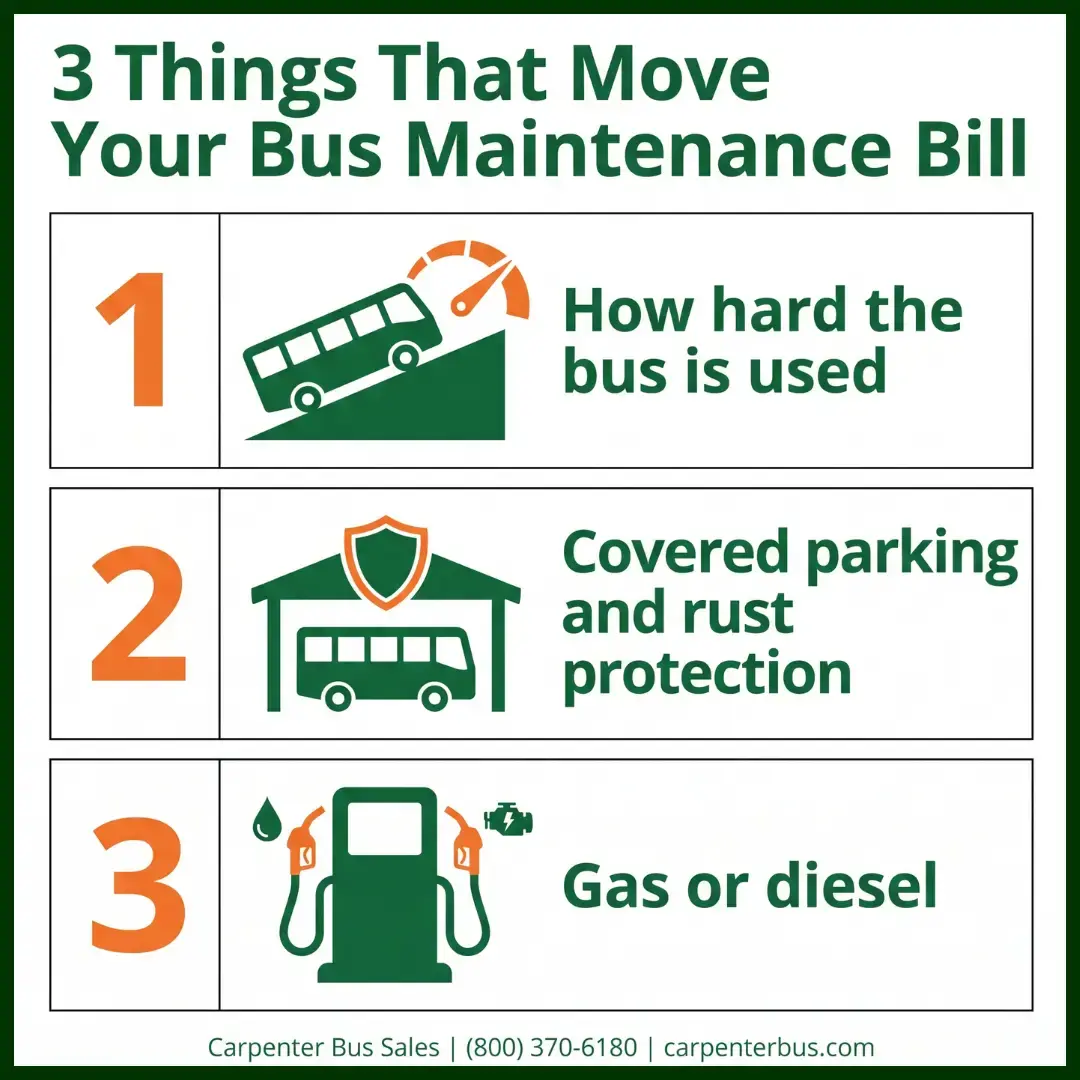
Three things move your maintenance bill most: how hard the bus is used, where and how it is parked, and what it runs on. Randy Sadler of Carpenter Bus Sales says heavy commercial use is harder on tires than church use, covered parking helps protect a bus, and northern or coastal climates call for more undercoating.
How does the way you use the bus change the bill?
Use changes which parts wear out first. Randy says the church buses his shop sees come in for tires, lights, leaks, and body damage, while commercial buses add brakes and air conditioning to that list. Tread life on a church bus can run longer, and heavy commercial use wears tires out sooner. He also says some churches that put few miles on a bus go three to five years between brake jobs.
Mileage matters too. The table assumes about 12,000 miles a year, and oil changes and tire rotations follow miles, not the calendar. A bus that drives much more than that will need more of both, and a bus that drives much less will need fewer. Randy adds that stretched or extended chassis carrying varied loads can wear tires unevenly, which is one reason to rotate on schedule.
Do rust protection and covered parking matter?
Yes. Randy says covered parking definitely helps prolong bus longevity by protecting the interior and exterior and by keeping tires from dry rotting. He adds that most buses have some undercoating and that he would probably recommend more in northern or coastal climates, where road salt and salt air speed up corrosion on the underside. If your bus is parked outside in one of those climates, ask your shop about undercoating before the underside shows damage.
Does gas or diesel change the budget?
Yes, though the table compares two different sizes as well as two engine types. By the numbers above, the 38 passenger diesel costs about 70 percent more per year to maintain than the 15 passenger gas bus. Brakes account for $550 of the $1,580 difference, the diesel's fuel filter adds $400, tire rotations add $300, and the two diesel oil changes cost $240 more than the gas bus's four. Some of that comes from the bigger bus, not only the diesel engine. Carpenter Bus Sales sells both gas and diesel buses, and our guide to gas vs diesel bus engines covers that decision in full.
Do prices change by shop or region?
Yes. Labor rates differ from shop to shop and region to region, and how and where the bus is driven, how heavily it is loaded, and the condition it arrives in all change a price. Treat the table as a planning baseline, and ask your service provider for a firmer number on your specific bus.
What should a bus preventative maintenance plan include?
Randy Sadler, Fixed Operations Manager at Carpenter Bus Sales, recommends pre-trip and post-trip inspections on every outing and tire rotation every 5,000 to 7,000 miles, depending on use. Henry Headden, President and Owner of Carpenter Bus Sales, ties a bus's service life directly to this kind of preventative care.
Use this list as a starting schedule, then adjust it to your bus and your manufacturer's manual.
- Walk around the bus before and after every trip. Check tire condition and pressure, exterior lights and mirrors, wipers, and the ground under the bus for fluid leaks. Test the wheelchair lift if your bus has one.
- Have drivers report problems right away. New noises, vibrations, warning lights, fluid leaks, and unusual odors are all worth a report.
- Rotate tires every 5,000 to 7,000 miles. Randy notes that Ford and GM recommend 5,000 miles and that most Carpenter Bus chassis have been stretched or extended and carry varied loads, which affects tire wear.
- Change oil and service filters at your manufacturer's intervals. Use the oil the manual specifies, and check belts and hoses for wear. Have the battery and electrical system checked, along with suspension and steering, so small problems do not turn into a no-start or a rough ride.
- Check for loose parts. Have a mechanic tighten loose fasteners to the proper torque for your bus, because overtightening can damage bolts.
- Wash the bus regularly. Washing the exterior helps prevent rust and corrosion. Cleaning the interior and the air filters helps the climate control keep working well.
- Adjust for the season. In winter, check the battery, heater, and tire tread. In summer, inspect the A/C system and coolant level. Before a long trip, review the brakes, fluids, and tires.
- Use OEM or dealer-recommended parts. Parts made for your bus keep it operating as designed, and cheaper substitutes can wear out sooner.
- Inspect emergency exits every 90 days. Federal rules call for pushout windows, emergency doors, and emergency door marking lights on buses to be inspected at least every 90 days.
- Schedule the annual inspection. Federal rules call for a periodic inspection of covered commercial vehicles at least every 12 months.
- Keep a record of every service. A dated log helps you stay on schedule and shows a buyer how the bus was cared for.
Those two federal rules appear in the Federal Motor Carrier Safety Administration's Part 396 guidance for motor carriers of passengers. They apply to motor carriers and vehicles that meet the federal definitions, and states add their own requirements, so confirm with your state agency whether your bus is covered.
Henry Headden has been with Carpenter Bus Sales since 1973 and has been President since 1982. He says a well-maintained commercial bus typically lasts 10 to 15 years, or 150,000 to 250,000 miles, and that regular preventative maintenance is the biggest factor in where a bus lands in that range. That is a general range under good maintenance, not a promise for any one bus.
What causes downtime in a bus or shuttle fleet, and how do you cut it?
Randy Sadler says the causes of bus downtime that the Carpenter Bus service shop sees depend on how the bus is used. On church buses it is tires, lights, leaks, and body damage. On commercial buses it is brakes, tires, air conditioning, lights, body damage, and leaks. A pre-trip walk-around looks at tires, lights, and leaks directly.
| How the bus is used | What the shop sees |
|---|---|
| Church use | Tires, lights, leaks, body damage. Randy says tires and lights are probably the most specific items he sees on church buses. |
| Commercial use | Brakes, tires, air conditioning, lights, body damage, leaks |
Three habits keep a small number of buses on the road:
- Track service in one place. A spreadsheet or fleet program that records service dates and mileage for each bus shows what is due before it becomes a breakdown.
- Keep common wear items on hand. Belts, hoses, bulbs, and fuses are easier to swap when they are already in your cabinet. CarpenterBusParts.com carries parts for the bus lines Carpenter Bus Sales represents.
- Use a shop that knows commercial buses. The Carpenter Bus service department works on buses no matter where they were bought.
When is refurbishing a bus worth it?
Randy Sadler says it depends on the bus's condition and how it is used, and that the odds of a worthwhile refurbishment usually diminish once a bus is more than 10 to 15 years old. Carpenter Bus Sales service handles major engine work and full reconditioning, and the Elm Mott, Texas location has a 60-foot paint and body booth.
A useful way to decide is to ask which part of the bus has worn out. If the body and frame are sound but the engine has high mileage, mechanical work may make sense. If the mechanical parts are healthy but the interior is worn or the paint is tired, cosmetic work may be the better fit. If both are worn on an older bus, replacement deserves a hard look. Start with a call to the Carpenter Bus service department and an inspection of your bus.
If your refurbishment includes paint or body work, the Elm Mott location is built for it. Carpenter Bus has a paint and body shop at its Elm Mott, Texas location, just north of Waco. Its 60-foot paint and body booth gives the team full-size paint and body repair capability for buses and large vehicles, and the location has six full-service bays. Ask the service department how paint and body work fits into your project.
Frequently Asked Questions
How often should I rotate bus tires?
Randy Sadler of Carpenter Bus Sales says to rotate tires every 5,000 to 7,000 miles, depending on how the bus is used. He notes that Ford and GM recommend 5,000 miles, and that stretched or extended chassis carrying varied loads can wear tires unevenly. At about 12,000 miles per year, the table above budgets two rotations.
Do I need to replace bus brakes every year?
Not always. Randy Sadler says some churches that put few miles on a bus may go three to five years before brakes are needed, while heavy commercial use calls for attention sooner. The brake line in the table covers inspection and pad replacement, so treat it as a yearly planning figure rather than a guaranteed yearly bill.
How much do bus repairs cost compared with routine maintenance?
The table covers routine service, not repairs. Randy Sadler of Carpenter Bus Sales says replacing the floor of a used bus can run roughly $2,000 to $8,000 depending on the damage, and in the buses his team sees, failed or weak roof seams are a usual source of the water intrusion behind it. An inspection sets the real price.
What are the maintenance costs for transit vans?
The table above prices buses, not vans, so use it only as a reference point. Carpenter Bus Sales service works on buses and vans, and the service department can quote your specific van after an inspection. Costs depend on the van's chassis, mileage, and how it is used. To get a quote, call (800) 370-6180 or contact the Carpenter Bus service department.
Does Carpenter Bus repair church buses?
Yes. The Carpenter Bus Sales service department works on buses no matter where they were bought, and it supports all major bus brands and chassis platforms. Both the Franklin, Tennessee and Elm Mott, Texas locations service buses, so call (800) 370-6180 to tell us about your bus and schedule an inspection.
Ready to get a firmer number for your bus?
Ask the Carpenter Bus service department for an inspection and a quote on your specific bus, because the table above is a planning baseline and not a quote. The service team works on buses wherever they were bought and can set up a maintenance schedule for yours.
Schedule service with the Carpenter Bus service department or call (800) 370-6180.
Sources
- Federal Motor Carrier Safety Administration, Inspection, Repair, and Maintenance for Motor Carriers of Passengers (Part 396). Accessed October 6, 2026.
- Carpenter Bus Sales service shop pricing and shop observations, confirmed by Randy Sadler, Fixed Operations Manager. 2026 prices. Accessed October 6, 2026.
- Carpenter Bus Sales delivery records, January 2022 through July 2026. Accessed October 6, 2026.
- Bus service-life range, Henry Headden, President and Owner of Carpenter Bus Sales. Accessed October 6, 2026.
- Carpenter Bus Sales warranty programs. Terms as reviewed September 2026. Accessed October 6, 2026.
