
Bus Interior Options: Storage, Seats, Fabric, and Flooring to Decide Before You Order
Storage, seat style, fabric, and flooring all compete for the same floor space. Here is what to decide before you order a bus.
By Dominic Menard - National Director of Marketing & Technology
Published • Last updated
Carpenter Bus Sales recommends settling five interior choices before you order a bus: storage, seats, fabric, flooring, and add-on features. Rick Cassels, Regional Sales Manager at Carpenter Bus Sales, says inadequate storage is the regret he hears most often from customers. Storage and seats compete for the same floor space, so your floor plan decides how that trade works out.
Key takeaways
- On Carpenter Bus Sales floor plans, rear storage takes away about four seats on larger buses, such as a 25 passenger plan that becomes 21.
- Carpenter Bus Sales floor plans run from two wheelchair stations to eight, and fold-away seats create space for wheelchairs or luggage.
- Carpenter Bus Sales offers seat fabric from entry level to top-of-the-line, and the standard floor differs by manufacturer, so check what comes on your model.
- Carpenter Bus Sales says custom factory orders take 60 days to 9 months (depending on chassis availability), plus a couple of weeks for transport and any graphics.
This guide is for committees ordering a new church bus, senior care bus, or shuttle bus. One heads-up: passenger counts here include the driver, the same way Carpenter Bus Sales counts them on its floor plans. Some manufacturer brochures list the driver separately (for example, "24 passenger + driver"), so add one seat when you compare a brochure with one of our floor plans.
What storage options can you get on a bus?
Buses offer several ways to carry luggage: rear storage compartments with or without a wall, overhead storage racks, and interior luggage racks. Which ones you can get depends on the model and floor plan, and some Starcraft XL buses also offer skirt-mounted storage pods.
When you browse Carpenter Bus Sales listings, you'll see rear storage shown as RS and rear storage with a wall shown as RSW, so you can spot your storage setup at a glance.
| Option | What it is | Good to know |
|---|---|---|
| Rear storage (RS) | A storage area at the back of the bus with no wall | Takes seats away on larger plans |
| Rear storage with a wall (RSW) | The same rear storage, separated from riders by a wall | Keeps bags apart from the passenger area |
| Luggage rack on the plan | A rack listed on the floor plan itself | Appears on select floor plans |
| Overhead storage racks | Racks above the seats | An option, and they can sometimes include reading lights, so decide before you order |
| Interior luggage racks | Racks inside the passenger area | Layout varies by model |
| Skirt-mounted storage pods | Pods mounted on the bus skirt | Available on some Starcraft XL buses, such as the XL F650 |
| Battery or storage compartment | An optional compartment for batteries or storage | Offered on the Collins Magellan activity bus |
Storage size changes from plan to plan, and depth and width depend on the exact model, so confirm the numbers for your bus with your Carpenter Bus Sales representative.
How many seats do you give up for storage?
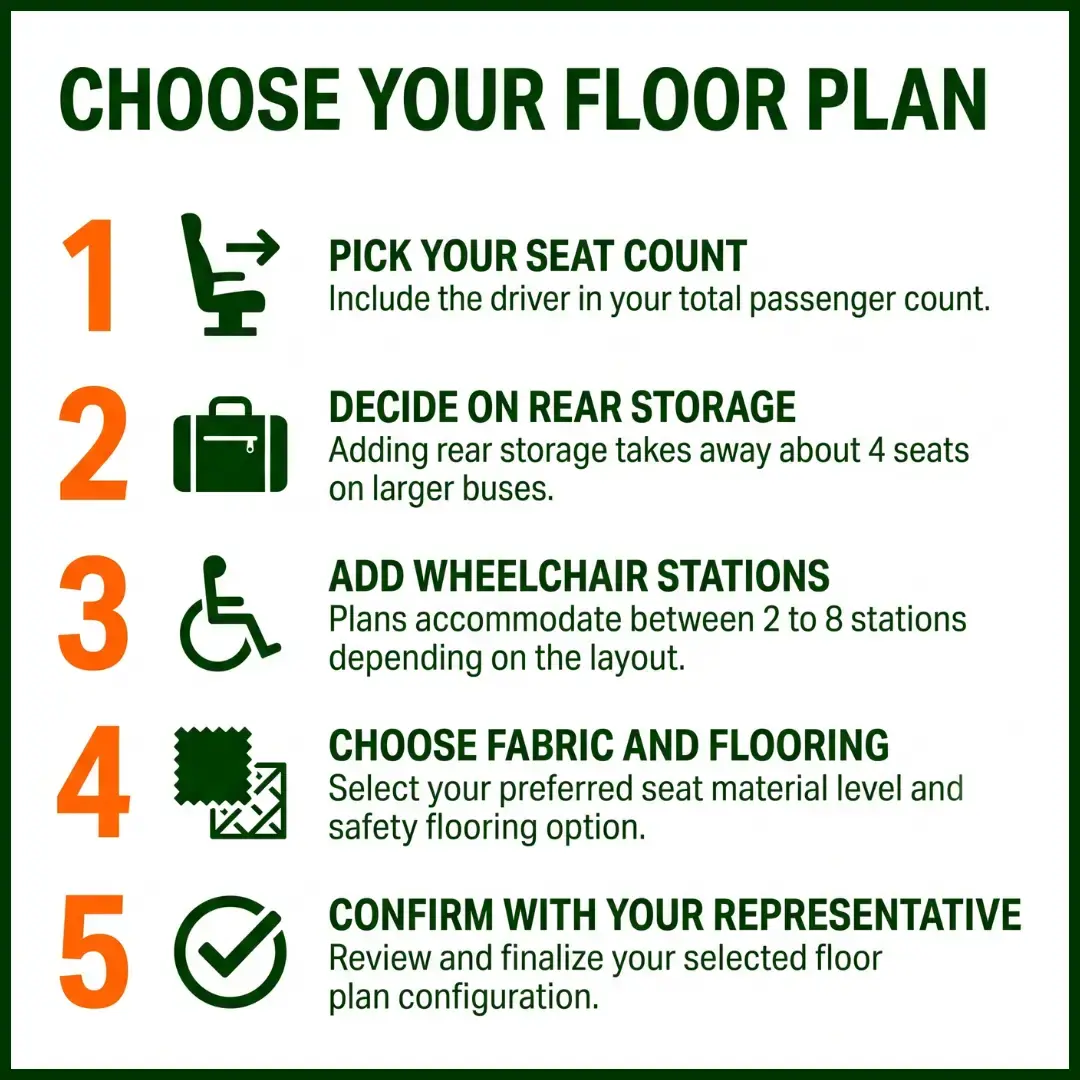
On the floor plans Carpenter Bus Sales publishes, adding rear storage takes away about four seats on the larger buses. The Bus Floor Plans page lists a 25-foot Starcraft Allstar, for example, as 25 passengers, or 21 with rear storage, driver included.
Every plan the page lists both ways shows that same four-seat difference, across Starcraft and Glaval buses from 25 to 40 feet. The 15 passenger buses with rear storage are listed as their own plans, so the seat count there depends on the plan you pick.
Here's a simple way to work through it:
- Count the riders on a typical trip, driver included. If you land near 15, the 15 passenger bus guide covers the licensing line.
- Count the bags and gear on your longest trip.
- Compare the same bus with and without rear storage, and count the seats in each.
- Decide on overhead racks before you order, since adding them to a finished bus is difficult.
How do wheelchair stations change your floor plan?
Each wheelchair station takes floor space that would otherwise hold seats or luggage, so settle your wheelchair needs before you choose a floor plan. Most Carpenter Bus Sales buses can be configured with a rear or side wheelchair lift, and the standard commercial lifts from Braun and Ricon are rated for 800 pounds.
The Bus Floor Plans page shows how many wheelchair stations a floor plan can hold, from two to eight. Some plans use a fold-a-way seat, fold downs, or jump seats, and some have a removable rear row. Manufacturer brochures show a few examples. The Starcraft XL brochures list two-wheelchair layouts with flip seats or foldaway seats, Glaval brochures list side access along with ADA and FMVSS compliant lifts and securement systems, and Collins lists wheelchair availability on only some models.
Fold-away seats are worth knowing about, because they create space for wheelchairs or luggage when you need it.
A few things to work out as you compare plans:
- Which models at your length offer a lift, and whether it is rear or side access.
- How many wheelchair stations the plan holds, and how many seats remain.
- Which rows fold away or come out, and what they open up.
- Where luggage goes once the lift and the stations are in place.
Not every bus can take a lift, so your representative can confirm what works on the exact model.
What are bus seats made of?
Bus seats are a frame and padded cushion covered in cloth or vinyl. Carpenter Bus Sales offers seat fabric from entry level to top-of-the-line, as its seating options page shows, and works with CMI Enterprises for bus seating. Style and fabric are separate choices, so decide them one at a time.
| Decision | Options | What to think about |
|---|---|---|
| Seat height | Vinyl mid-back seats through high-back luxury seats for higher-end buses | Trip length and who rides |
| Seat style | Berkshire, Featherweight, Featherweight mid-back, and Featherweight flip-down seats | How each style looks in the fabric you want |
| Material | Cloth or vinyl | Your riders and your cleaning routine |
| Fabric level | Entry level to top-of-the-line, with Level 1 shown in vinyl and fabric, Level 4 in vinyl, and Level 5 in fabric | How the same seat looks in two levels |

Should you choose high-back or mid-back seats?
Your options run from vinyl mid-back seats to high-back luxury seats on higher-end buses, and Glaval lists both as options. High-back seats are the luxury choice, so they make sense if comfort and a more upscale look matter most. Mid-back seats are where the range starts, so they make sense if you want a simpler seat and a lower starting point.
Should you choose fabric or vinyl?
Carpenter Bus Sales offers both. Vinyl is easier to clean than fabric, which helps if your riders eat or drink on board or several groups share the bus. Weigh who rides your bus and how much time you want to spend cleaning it.
Which fabric level should you pick?
The seating options page shows Level 1 in both vinyl and fabric, Level 4 in vinyl, and Level 5 in fabric, across Berkshire, Featherweight, and Featherweight flip-down seats. The page describes the choices as running from entry level to top-of-the-line, so the easiest way to compare is to look at the same seat in two levels.
Which flooring should you choose?
Flooring depends on the manufacturer, so find out what is standard on your model. The Starcraft Allstar brochure lists a black slip-resistant floor covering over 5/8-inch plywood, the Glaval Universal brochure lists Gerflor, and Carpenter Bus Sales offers Gerflor and Altro safety flooring upgrades.
| Bus or option | Flooring listed |
|---|---|
| Starcraft Allstar | Black slip-resistant floor covering over 5/8-inch exterior-grade plywood as standard, with stainless steel wheel inserts as an option |
| Starcraft XL F550 | Black slip-resistant floor covering over 5/8-inch exterior-grade plywood as standard, with complete rubber flooring as an option |
| Glaval Universal | Black slip-resistant Gerflor floor covering over 5/8-inch marine tech plywood as standard |
| Collins activity bus | One-piece 1/2-inch marine-grade plywood as standard, with colored rubber flooring and track flooring as options |
| Gerflor or Altro safety flooring upgrade | Gerflor in gray, black, and Yellowstone. Altro in black, gray, and wood-look oak patterns, with an integrated bacteriostat, an easy-clean surface, and heat-welded seams that make the floor waterproof |
The flooring options page shows every Gerflor and Altro color.
Which features are worth deciding before you order?
Carpenter Bus Sales advises deciding on overhead luggage racks when you order, because adding them to a finished bus is difficult. Passenger area rear heat and air conditioning is listed as an option in the Starcraft Allstar brochure, and Glaval and Collins literature lists rear air conditioning too.
These features are worth a conversation before the order:
- Overhead luggage racks (reading lights are sometimes included)
- Rear heat and air conditioning
- USB charging ports
- Audio and video systems
- Backup camera
- Sliding seats, flip-up armrests, and reclining seats
Availability depends on the bus. Carpenter Bus Sales offers the seat features on some buses, so ask your representative what your model offers.
How do you customize a new bus, and how long does it take?
A custom factory order takes 60 days to 9 months (depending on chassis availability) from the time you send your deposit. Add a couple of weeks for transport, plus graphics or lettering if you want them. A bus already on the Carpenter Bus Sales lot can often ship the same week or the next.
A custom order lets you choose everything covered above, plus the chassis and the exterior. Here is a sensible sequence:
- Chassis and engine: Carpenter Bus Sales sells both gas and diesel buses, and the majority it sells are gas. For the engine decision, see the gas versus diesel guide.
- Floor plan, storage layout, and wheelchair stations: settle the seats-versus-luggage trade first.
- Seat height, style, material, and fabric level: see the seating section above.
- Flooring: the manufacturer's standard floor, Gerflor, Altro, or a manufacturer option.
- Features: overhead racks, climate control, charging ports, and cameras.
- Graphics and lettering: if you want them, Carpenter Bus Sales handles bus graphics, lettering, and custom wraps before delivery.
To plan backward, get the current build time for the chassis you want, count back from the date you need the bus, and add a couple of weeks for transport and any graphics or lettering.
What should you decide before you order a bus?
Start with how many riders you carry (driver included), how much luggage you bring on your longest trip, and which seat and floor options you want. Settle storage first, since Rick Cassels says inadequate storage is the regret he hears most often from customers.
When you are ready to work through your floor plan, find your Carpenter Bus Sales representative or call (800) 370-6180.
Frequently Asked Questions
How do you choose the right seating capacity for a shuttle bus?
Count the riders on a typical trip, driver included, then add your luggage. Federal rules generally require a commercial driver's license (CDL) at a design capacity of 16 or more including the driver, a GVWR (gross vehicle weight rating) or GVW (gross vehicle weight) of 26,001 pounds or higher, or placarded hazardous materials. State rules vary, so confirm with your state DMV.
Can you change a bus's seat layout?
On some models. The Glaval Universal literature lists floor and wall seat track for flexible seating, and Collins describes a seating platform that can be altered or upgraded. Your Carpenter Bus Sales representative can tell you whether the bus you want is built this way.
Can you change the passenger count on a bus you already own?
Some buses can be reclassified to a lower passenger count, but not every bus qualifies. Carpenter Bus Sales handles it through the original manufacturer, and eligibility depends on the manufacturer, age, and condition. Removing seats alone does not make a bus non-CDL, so check with your state licensing agency and insurance carrier first.
Where does the information in this guide come from?
Manufacturer specifications and outside facts in this guide come from the sources below. Specifications change by model year, so confirm details for your configuration.
- Glaval Universal brochure from Forest River Bus, 2025
- Starcraft Allstar, Starlite, XL F550, and XL F650 brochures, and the Glaval Entourage brochure, from the Carpenter Bus Sales bus brochures page
- Collins Magellan FR MFSAB brochure, from the same brochures page
- Collins activity bus specifications, 2026
- Storage details: the Bus Floor Plans page (storage areas of 34 and 40 inches on two 24-foot Starcraft Allstar 15 passenger plans, and a luggage rack on a 22-foot Starcraft Starlite Transit 15 passenger plan) and the Starcraft Allstar page (overhead luggage on all five Allstar layouts, and rear wall storage on the 15, 26, 33, and 46 passenger layouts)
- Seat fabric levels: the Carpenter Bus Sales seating options page
- BraunAbility Millennium 2 and Century 2 commercial wheelchair lift specifications (800 pound rated lifting capacity on the standard models)
- Ricon Classic S-Series and K-Series wheelchair lifts, Rehab Pub, March 31, 2020 (800 pound lift capacity)
