
Choosing a Senior Living Bus or Wheelchair Van: Features, Seating, and Cost
Minivan, van, or bus? How senior care communities match vehicle size, wheelchair positions, and engine to the residents who ride every week.
By Dominic Menard - National Director of Marketing & Technology
Published • Last updated
Carpenter Bus Sales makes it easy for senior care communities to find the right ride, whether that's a wheelchair minivan, a wheelchair van, or a wheelchair bus. Tell us how many residents ride together and how many use wheelchairs, and we'll match you with a vehicle that carries everyone comfortably.
Key takeaways
- Senior care communities get the PlatinumCare warranty free on every new Carpenter Bus Sales bus and van. It's the only 8-year unlimited mile warranty in the industry for churches, ministries, and senior care communities.
- Carpenter Bus Sales carries wheelchair minivans, wheelchair vans, and wheelchair buses, so there's a fit for one wheelchair rider or a full group outing.
- Carpenter Bus Sales can order your new bus built with a side or rear wheelchair lift, tie-downs, and fold-away seating.
- Bryan George, National Senior Care Manager at Carpenter Bus Sales, recommends gas for senior living routes, and nearly all his senior care customers choose it.
- When your bus needs care, Carpenter Bus Sales service shops in Franklin, Tennessee, and Elm Mott, Texas, handle repairs and wheelchair lift service.
Source: Bryan George, National Senior Care Manager at Carpenter Bus Sales.
Which vehicle fits your residents: a wheelchair minivan, a wheelchair van, or a wheelchair bus?
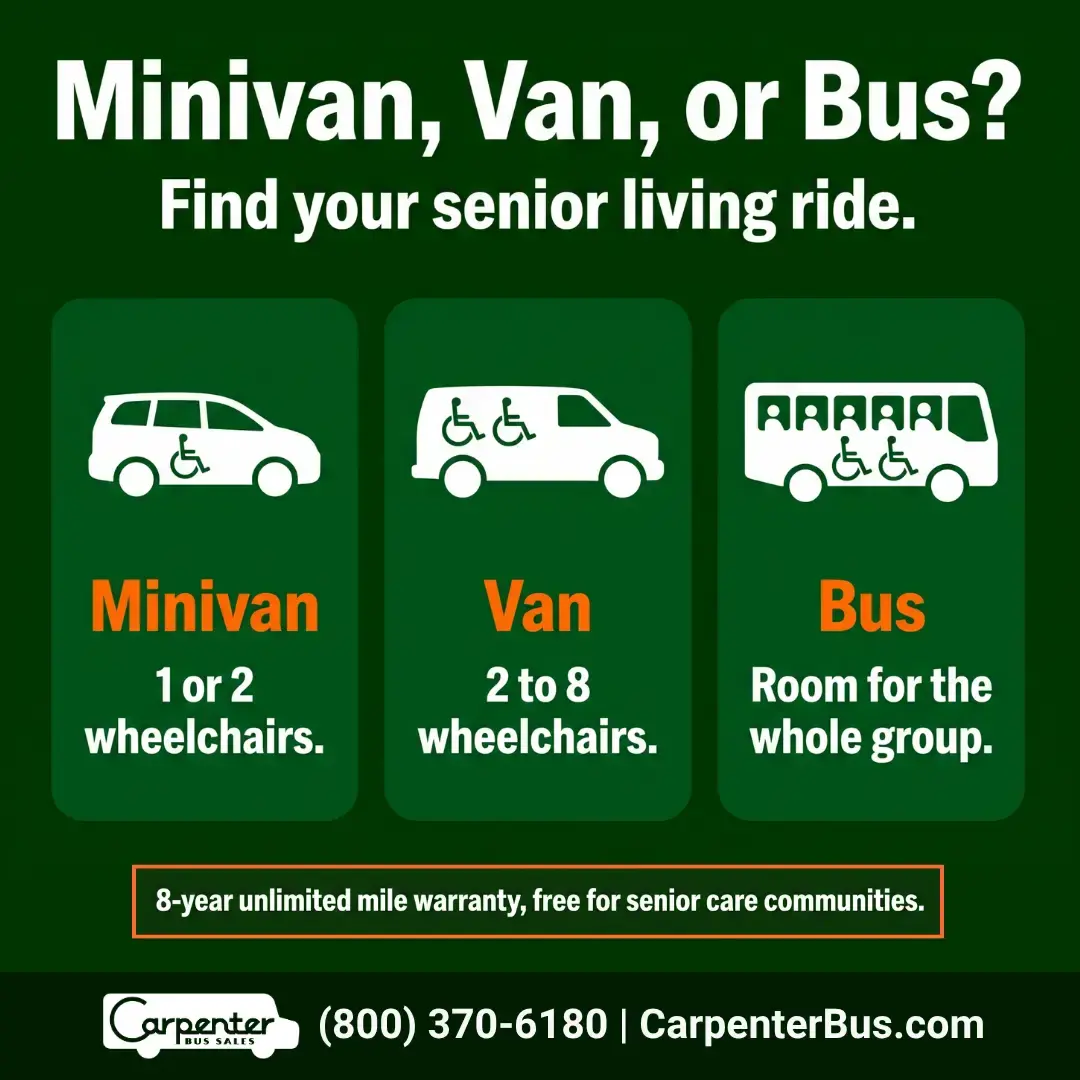
Carpenter Bus Sales sells everything from wheelchair minivans that carry one or two wheelchairs to wheelchair buses built for full group outings. The right setup comes down to how many residents ride at once and how many use wheelchairs. This table shows how the three main options compare.
Here is how the three compare on the points that tend to settle the choice.
| Question | Wheelchair minivan | Wheelchair van | Wheelchair bus |
|---|---|---|---|
| Wheelchair positions | 1 or 2, plus seats for up to 4 more riders on the rear-entry model | 2 to 8, depending on the model. Ford Transit models carry 2 to 4 and up to 12 passengers in all. | Many sizes, from small buses to larger layouts such as 17 passengers plus 2 wheelchair stations |
| How riders board | Rear-entry: fold-out ramp at the rear hatch. Side-entry: power or manual ramp at the sliding door. | Side-entry or rear-entry, depending on the model | Side or rear wheelchair lift |
| Brands Carpenter Bus carries | FR Conversions | Forest River, FR Conversions, and ADA Boy | Starcraft, Glaval, and Collins |
| Driving and parking | Drives like a car | Easier to drive than a bus, fits standard parking | Bigger, so plan for parking at home and at stops |
| License | Well under the federal passenger and weight lines* | Built to stay under the federal passenger line* | 15 passengers or fewer stays under the federal passenger line; larger buses generally need a CDL* |
*CDL (commercial driver's license) rules depend on how many people a vehicle is designed to carry, driver included, plus its weight and your state. A quick check with your state DMV before you buy means your drivers are set from day one. Our guide to shuttle buses and driver's licenses walks through it.
The two minivans solve different problems. Carpenter Bus Sales lists the FR Conversions rear-entry minivan as its most popular wheelchair minivan for organizational use, because the ramp needs no room at the side of the van. The side-entry model loads at the curb and seats the wheelchair rider up front, next to the driver, which makes it easier to talk on the way.
Don't see the setup you need? Talk to us. Carpenter Bus Sales can show you what's on the lot today, order a custom build from the factory, or help track down the right bus, van, or minivan for your community. Seating, wheelchair positions, and lifts can all be configured around your residents. Call Bryan George, our National Senior Care Manager, at (800) 370-6180, and he'll walk you through every option.
You do not have to pick only one. In Carpenter Bus Sales' experience, many organizations use a van for daily routes and a bus for group outings. If you are still deciding whether your community has reached the point of needing a bus, our guide to when a wheelchair bus makes sense walks through it. You can also browse wheelchair vans, wheelchair minivans, and wheelchair buses for sale.
What accessibility features should a senior living bus or van have?
A senior living vehicle should let every resident board without strain and ride without shifting. That means a wheelchair lift or ramp, four-point wheelchair tie-downs with a lap and shoulder belt, a low first step with sturdy grab rails, non-slip flooring, and heating and air that reach the back rows. Carpenter Bus Sales can order new buses built with a lift, tie-downs, and fold-away seating.
Use this table on a test drive. Each line tells you why the feature matters and what to check yourself.
| Feature | Why it matters for residents | What to check |
|---|---|---|
| Wheelchair lift (buses) | Lets residents in wheelchairs board without a transfer | Rear or side placement, weight rating, and controls staff can run easily. Commercial lifts from Braun and Ricon handle up to 800 pounds. |
| Ramp (minivans) | Quick boarding for one or two wheelchair users | How steep it is and whether it latches firmly |
| Wheelchair tie-downs | Keeps chairs from moving while the vehicle is moving | Four-point straps plus a lap and shoulder belt for each wheelchair position |
| Low first step and grab rails | Helps residents with walkers, canes, or poor balance | Step height and rails on both sides of the door |
| Aisle and floor space | Room for walkers and staff to help residents | Clear path to each seat, few things to trip over |
| Non-slip flooring | Lowers the chance of a fall when boarding in rain | Textured floor and high-contrast step edges |
| Front and rear heat and air | Older riders feel heat and cold more | Airflow at the back row, not just the driver's seat |
| Marked emergency exits | Staff need to get everyone out quickly | Labeled exits and a plan staff have practiced |
Your Carpenter Bus Sales representative will walk you through the exact equipment on any bus or van you are looking at. The word "accessible" can mean different things from one listing to the next, so a quick equipment check means you know exactly what your residents will have before it arrives.
How many seats and wheelchair positions does your community need?
Start with your most common trip, not the biggest outing of the year, and count the driver. Carpenter Bus Sales counts the driver in every passenger number: small buses carry 15 or fewer, medium buses 16 to 30, and large buses 31 or more. Then count wheelchair riders separately, because each wheelchair position takes floor space that would otherwise hold seats.
These four questions narrow it down quickly:
- How many residents ride on a typical trip?
- How many of them ride in a wheelchair?
- How long are most trips, and are they mostly local?
- Who will drive, and do they hold a CDL (commercial driver's license)?
Rick Cassels, Regional Sales Manager at Carpenter Bus Sales, puts it simply: "Don't size for your largest trip of the year. Size for the trip that you take most often." If you're moving 15 people or fewer each week (driver included), Rick says that's probably the size bus you need, and there are other ways to cover an event that happens once or twice a year. A second vehicle or a rental bus can carry the overflow, and your Carpenter Bus Sales representative can help you plan for both.
Why does the driver's license matter so much?
Because the size of your bus decides who on your team can drive it. A CDL (commercial driver's license) is a special license on top of a regular one. It takes extra training and testing, and for a bus, drivers also need a passenger endorsement, which is an add-on that lets them carry passengers. If your drivers only have a regular license, the bus has to stay under the CDL line.
Under federal rules (49 CFR 383.5), a driver generally needs a CDL when the vehicle meets any one of these:
- It's designed to carry 16 or more people, counting the driver.
- It has a gross vehicle weight rating of 26,001 pounds or more. That's the most the vehicle is rated to weigh fully loaded.
- It carries hazardous materials that need warning placards.
Here's the part that trips people up. A "15-passenger bus" usually means 14 riders plus the driver, which keeps it under the 16-person line. A bus with 15 passenger seats plus a driver's seat holds 16 people, so it generally needs a CDL driver.
This table shows the tradeoff in plain terms:
| Question | Small bus (15 or fewer, driver included) | Medium or large bus (16 or more, driver included) |
|---|---|---|
| Who can drive it? | In most states, staff with a regular driver's license | Only drivers with a CDL and a passenger endorsement |
| How many residents per trip? | Fewer, so a big outing may take two trips or two vehicles | More, so the whole group can ride together |
| What it takes to run | A bigger pool of possible drivers on your team | Recruiting or training CDL drivers, and keeping enough of them |

Sizing up gets more residents on board at once, and for some communities that's the right call. Just plan for the drivers first, because a bus only helps when someone can drive it. Rules also vary by state, and some states, including California and Connecticut, apply stricter rules to nonprofits, so confirm with your state DMV before you buy. Our guide to shuttle buses and driver's licenses walks through it, and your Carpenter Bus Sales representative is glad to help you sort it out.
Carpenter Bus Sales delivery records show that roughly two-thirds of the buses Carpenter Bus delivered since January 2022 (records through July 2026) were small buses with 15 passengers or fewer. That includes all our customers, not just senior care, and it isn't a national number. Still, it shows you what other buyers are choosing when they shop for a bus, which can help as you think about your own size.
What does a senior living bus or wheelchair van cost?
New commercial wheelchair vans from Carpenter Bus Sales run about $90,000 to $100,000*, and a new 13+2 bus (13 seats plus 2 wheelchair stations) starts around $125,000*. The price goes up with passenger capacity, chassis, and features. Used buses with a wheelchair lift usually run $50,000 to $70,000*, depending on year, mileage, and condition.
*These are rough starting points, not quotes. Prices change with the setup, model year, and what is in stock. For a price on a specific bus or van, call (800) 370-6180 or browse our senior care buses.
Should a senior living bus be gas or diesel?
Bryan George, National Senior Care Manager at Carpenter Bus Sales, recommends gas for senior living routes and says nearly all of his senior care customers buy it. His first question to anyone who asks for diesel is how many miles a year they drive, because in his experience diesel only starts to pay off around 25,000 miles a year, mostly highway.
Bryan has worked with senior care buyers at Carpenter Bus since 2011, and he gives three reasons for this advice:
- Short trips are hard on today's diesels. Modern diesel engines need long runs at highway speed to keep their emissions systems working the way they should. A route of doctor visits and grocery stops does not give them that.
- Old diesel advice is out of date. When a committee splits, Bryan says the diesel case usually comes from someone who drove older diesels. Those engines ran all day without trouble. Newer ones are different.
- The chassis can decide for you. Ford F-550 and F-650 chassis come with gas or diesel. Larger buses built on the Freightliner S2C chassis come with diesel only.
If your community really does drive long highway miles every week, diesel is worth a conversation. For the full comparison, see our guide to gas vs diesel bus engines.
Which warranty comes with a new senior living bus or van?
Senior care communities get PlatinumCare free on every new bus and van from Carpenter Bus Sales. It covers the entire vehicle, bumper to bumper, for 8 years with unlimited miles. Carpenter Bus Sales offers the only 8-year unlimited mile warranty in the industry for churches, ministries, and senior care communities. Adult day care centers get SilverCare free and can upgrade to GoldCare.
All three plans cover the entire vehicle. They differ in who qualifies, what they cost, and how long they last.
| Plan | Who gets it | Cost | Length | Coverage |
|---|---|---|---|---|
| PlatinumCare | Churches, ministries, and senior care communities | Included free | 8 years, unlimited miles | Entire vehicle, bumper to bumper |
| GoldCare | Any new bus buyer, including adult day care centers | $800 one time | 7 years or 70,000 miles | Entire vehicle, bumper to bumper |
| SilverCare | Every new bus and van buyer, including adult day care centers | Included free | 5 years or 60,000 miles | Entire vehicle, bumper to bumper |
Each plan ends at whichever limit comes first. It starts on the date of purchase or the official in-service date and runs alongside the factory warranty. Routine maintenance and wear items like filters, fluids, and wiper blades are not covered. When something does need repair, you call our warranty department first. Once the claim is approved, you can use a qualified local shop, pay a $100 deductible, and Carpenter Bus pays the shop directly. Carpenter Bus warranties stay with your community and do not transfer to a later owner.
How does the right vehicle help residents, staff, and families?
A reliable vehicle lets residents keep doing the things they did before they stopped driving: seeing the doctor, shopping, going to worship, and getting out with friends. For staff, one bus trip replaces a string of separate rides. For families, a clean, well-equipped vehicle out front is something they can see on a tour.
Here is where the right vehicle shows up day to day:
- Residents. Regular trips to appointments and outings, with seats and climate control that make longer rides comfortable.
- Staff. Simple lift controls, a clear view of riders from the driver's seat, and room to help someone into a seat.
- Families. Visible proof that residents can get where they need to go, every time they tour your community.
Can a bus help market your senior living community?
Yes. Carpenter Bus Sales can add bus graphics, lettering, and full custom wraps before delivery, so your bus arrives with your community's name, logo, and colors on it. Every trip to the doctor, the store, or a group outing becomes a chance for your neighborhood, and the families comparing communities, to see your name.
A few easy ways to make the most of it:
- Keep it simple. Your name, logo, phone number, and website, big enough to read from across a parking lot.
- Show it off. Park the bus where visitors see it on a tour, and share photos of residents on outings.
- Plan the timing. Allow a couple of extra weeks for graphics, lettering, or a wrap before your bus arrives.
Our Elm Mott, Texas, shop (just north of Waco) also has a 60-foot paint and body booth for bigger paint jobs. Your Carpenter Bus Sales representative can walk you through graphics, lettering, and wrap options for your bus.
How do you keep a senior living bus safe and running after you buy it?
Keep it maintained, train the people who use it, and write things down. Henry Headden, President and Owner of Carpenter Bus Sales, says a well-maintained commercial bus typically lasts 10 to 15 years, or 150,000 to 250,000 miles, and regular preventive maintenance is the biggest factor in which end of that range it reaches.
Henry has been with Carpenter Bus Sales since 1973. These habits protect your residents and your bus:
- Train drivers and aides on lift or ramp operation, wheelchair tie-downs, helping residents with limited mobility, and emergency exits.
- Do a pre-trip check every day: lift, belts, tires, lights, and heat and air.
- Keep records of driver training, maintenance, lift inspections, and any incident.
- Review your insurance with your agent, including coverage for wheelchair equipment.
When the bus needs work, our service department in Franklin, Tennessee, and Elm Mott, Texas, just north of Waco, handles diagnostics, warranty repairs, air conditioning, and wheelchair lift service. For replacement parts, you can order bus parts online any time.
Frequently Asked Questions
Can every bus be fitted with a wheelchair lift?
Most Carpenter Bus Sales buses can be ordered with a side or rear wheelchair lift, along with tie-downs and fold-away seating, but not every model can take one. The best time to plan for a lift is when you order, so choose the lift and the number of wheelchair stations up front. If you have a specific bus in mind, ask your Carpenter Bus representative whether it can be set up with a lift.
Can our senior living community rent a wheelchair-accessible bus?
Yes. Some Carpenter Bus Sales rental buses have wheelchair lifts, so just tell the rental team what your residents need when you ask for a quote. Rentals are self-drive buses for organizations in Tennessee and Texas. Your community provides the driver and $5 million in liability coverage. The rental fleet is buses, so vans and minivans are for sale only.
Will Carpenter Bus service a bus we did not buy from you?
Yes. The Carpenter Bus Sales service department works on buses no matter where you bought them, including wheelchair lift service. Franklin, Tennessee services buses and vans. Elm Mott, Texas, just north of Waco, services buses, vans, and other specialty vehicles, and its technicians are factory-trained on Braun and Ricon wheelchair lifts.
Does a used senior living bus come with a warranty?
A used bus still carries any factory warranty that is left, and you can add an optional service contract on qualifying used buses. Your Carpenter Bus Sales representative will tell you what a specific bus still carries and whether the service contract fits it. The Carpenter Bus warranty programs, like PlatinumCare, are for new buses and vans.
What is the next step for your community?
Talk with a senior care specialist. Bryan George and the Carpenter Bus Sales team can look at your residents, your routes, and your drivers and recommend the right minivan, van, or bus, then show you what is available. With generally 200 or more new and used buses in stock, we can show you real options on the first call.
Talk with a senior care specialist or call (800) 370-6180.
