
How Nonprofits Pay for a Bus: Grants, Donors, and Financing
A bus can turn good intentions into people who show up every week. Here's how nonprofits and churches line up the money to buy one.
By Dominic Menard - National Director of Marketing & Technology
Published • Last updated
Carpenter Bus Sales helps nonprofits and churches find a way to pay for a bus with grants, donor gifts, financing, or a mix of all three. Your Carpenter Bus rep will help you choose the right bus, give you a written quote for your funder, and help you plan how every dollar fits together, every step of the way.
Key takeaways
- You don't need one funding source. Grants, donor gifts, and financing can be combined, and Carpenter Bus Sales works with any mix.
- Heather Blackburn, Business Manager, says grant money is handled like any other payment and can count as your down payment.
- Get a written quote from your rep before you apply, and ask how long it's good for, since grants take time.
- A strong funding request shows who rides, what problem the bus solves, how often it runs, and who drives. Rick Cassels, Regional Sales Manager, recommends recruiting several drivers so the bus keeps serving.
- Price a bus your drivers can legally drive. Roughly two-thirds of Carpenter Bus Sales deliveries from January 2022 through July 2026 were 15 passengers or fewer.
Sources: Rick Cassels, Regional Sales Manager, and Heather Blackburn, Business Manager at Carpenter Bus Sales.
How does a bus expand your nonprofit's community impact?
A bus helps your nonprofit serve people who can't get to you on their own. Seniors who no longer drive, families without a car, kids whose parents work, and people with disabilities can all show up. That access is also the heart of any funding request, because it tells a funder exactly who the bus will serve. A bus helps you reach people who:
- No longer drive
- Don't have a car in the family
- Are kids or teens whose parents work during your programs
- Use a wheelchair or have trouble getting in and out of a car
- Live in rural or underserved areas outside your usual reach
It also feeds everything else you offer: worship services, after-school programs, community service days, camps, retreats, field trips, and counseling or recovery groups. And the ride itself matters. Time on the bus is time for conversation, and that's how riders and volunteers get to know each other.
Rick Cassels, Regional Sales Manager at Carpenter Bus Sales, saw this firsthand before he ever sold a bus. He spent about 22 years in local church ministry. In the early 2000s, his church in East Texas moved from vans to buses because it was worried about van safety for its kids and youth. The surprise, Rick says, was the senior adults. A ministry he describes as dormant became a vibrant, growing part of the church, because seniors could finally travel together and ride comfortably. The church used those buses for about 12 years before replacing them.
If your organization has a group like that, put its story in your funding request. If you serve a church, our church buses are built for exactly this kind of work.
What should your bus funding request show?
A strong bus funding request shows four things: who the bus will serve, what problem it solves, how often it will run, and who will drive it. Real numbers make it stronger. Count the people you serve each month, the rides you can't give today, and the programs that would grow with a bus.
Use this checklist when you write your request:
- Who rides: the groups you'll carry and about how many people a month.
- The problem: missed appointments, low attendance, people you can't reach, or safety worries with how you travel now.
- How often: weekly routes, regular events, and trips.
- Accessibility: if the bus will carry riders who use wheelchairs, say so plainly and name the lift and securements you plan to add.
- The bus you chose: your written quote, the warranty that comes with it, and why this bus is the right fit for your riders.
- Your driver plan: who will drive, and what license they need.
Why does your driver plan matter?
A bus only helps if someone can drive it. Rick Cassels tells the story of a rural church in Texas that called Carpenter Bus to sell its bus outright. It had only two drivers with a CDL (commercial driver's license), and those two drove every group, from children to senior adults. Instead of saying no to more trips, both quietly left the church. The church sold its bus and stopped offering rides altogether.
Rick's advice: if you buy a bus that needs a CDL, keep recruiting drivers so the work is shared. Or price a bus your volunteers can drive, which our section on choosing a bus covers below.
Where can a nonprofit find money for a bus?
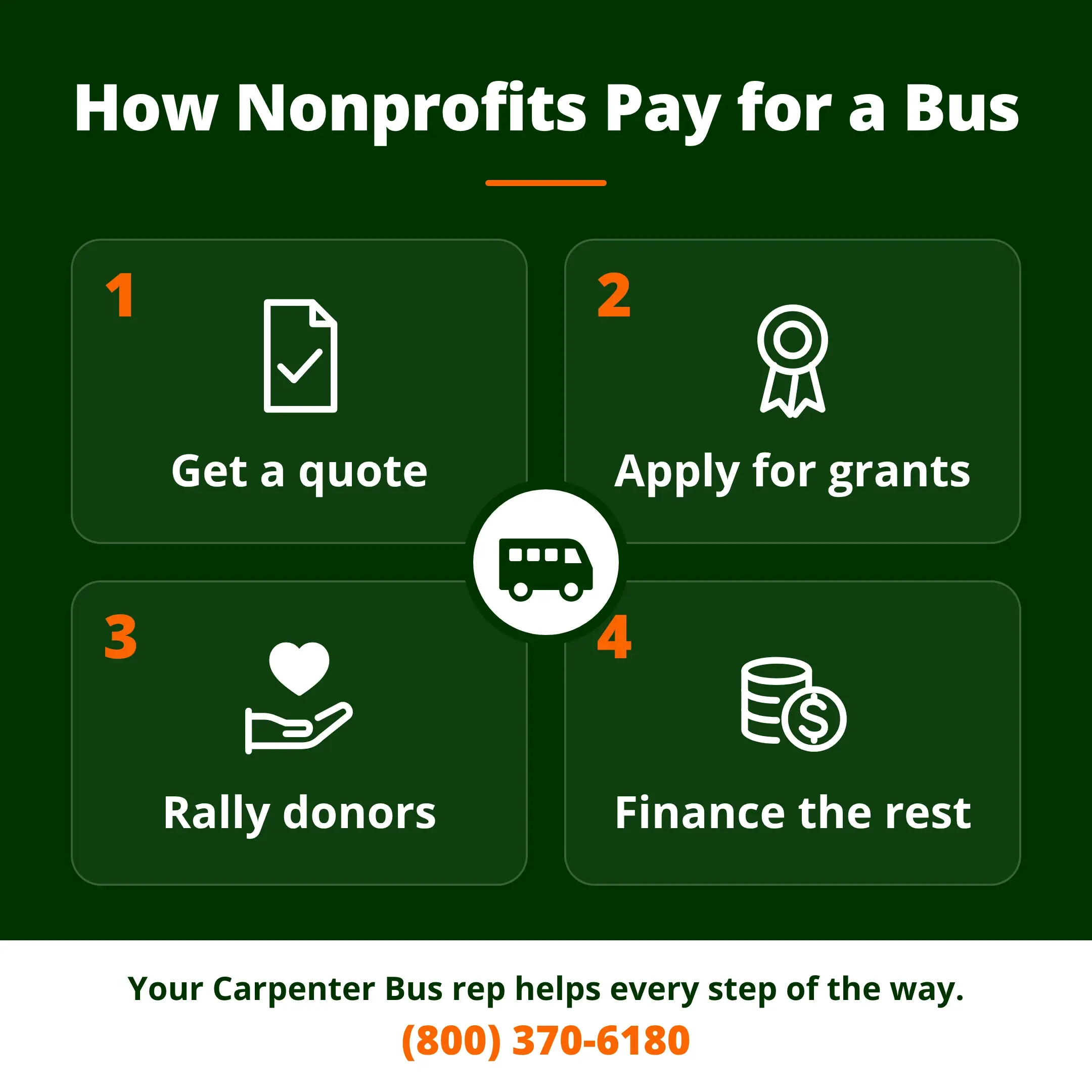
Look in four places: government transportation programs, foundations, your own giving network, and local businesses. You don't have to fund the whole bus from one source. A grant can cover part, donors can cover more, and financing can cover the rest. Carpenter Bus Sales works with any mix, because your funding source doesn't change how you buy.
Here's where to start, and what to bring to each:
| Funding source | Who it fits | What to bring or ask |
|---|---|---|
| Section 5310 program, through your state department of transportation | Nonprofits that carry older adults or people with disabilities, usually with rides open to those riders across the community, not only your members | Ask your state DOT about application dates, local match rules, and which vehicles qualify |
| Community foundations | Nonprofits serving a specific city, county, or region | Your rider numbers, the programs the bus supports, and a written quote |
| Denominational and faith-based giving networks | Churches and ministries | How the bus serves your ministry, plus your driver plan |
| Local businesses and utility giving programs | Any nonprofit with local ties | Who in their community the bus will serve, and how you'll recognize their gift |
| Major donors and matching gifts | Organizations with an active donor base | A clear goal, plus a donor willing to match other gifts |
| Financing | Any organization covering the rest of the cost | A completed credit application through your Carpenter Bus rep |

One option your church or nonprofit can run: a "Buy a Seat" campaign. Small donors sponsor a seat or a feature, like the wheelchair lift, and everyone can see exactly what their gift paid for.
Which bus should a nonprofit price for a grant?
Price the bus that carries your regular riders and that your drivers can legally drive. Carpenter Bus Sales delivery records show roughly two-thirds of buses delivered from January 2022 through July 2026 were small buses, 15 passengers or fewer, counting the driver. That makes a small bus a smart place to start your pricing.
That number covers all our buyers, not only nonprofits, and it isn't a national figure. Still, it shows you where other organizations land when they weigh seats against cost and drivers. Carpenter Bus Sales sells three sizes, and every count includes the driver:
- Small buses: 15 passengers or fewer. See our small buses for sale.
- Medium buses: 16 to 30 passengers. See our medium buses for sale.
- Large buses: 31 passengers or more. See our large buses for sale.
Will your drivers need a CDL?
Under federal rules, a CDL is required for a vehicle with a gross vehicle weight rating of 26,001 pounds or more, a vehicle designed to carry 16 or more people including the driver, or a vehicle carrying placarded hazardous materials. States set their own rules on top of that, and some states, including California and Connecticut, apply stricter rules to churches and nonprofits, not looser ones. Check with your state DMV before you choose a bus. Our guide to shuttle buses and driver's licenses walks through it, and your Carpenter Bus rep can help too.
Does your bus need a wheelchair lift?
If your riders include people who use wheelchairs, plan for it from the start. Most, but not all, Carpenter Bus buses can be set up with a wheelchair lift, and commercial lifts from Braun and Ricon handle up to 800 pounds. Browse our wheelchair buses for sale, or learn more about senior care buses if your riders are older adults.
How long will a bus serve your mission?
Henry Headden, President and Owner of Carpenter Bus Sales, says a well-maintained commercial bus typically lasts 10 to 15 years, or 150,000 to 250,000 miles. Regular preventive maintenance is the biggest factor in where your bus lands in that range. That's service life with good care, not a promise for any single bus, and it's a strong number to put in front of a funder.
What warranty comes with a new bus?
Every new bus and van from Carpenter Bus Sales comes with a warranty at no charge, and churches, ministries, and senior care communities get the longest one. All three plans cover the entire vehicle, bumper to bumper. They differ in length, mileage, who qualifies, and price:
| Plan | Who qualifies | Length and mileage | Coverage | Cost |
|---|---|---|---|---|
| PlatinumCare | Churches, ministries, and senior care communities | 8 years, unlimited miles | Entire vehicle, bumper to bumper | Free |
| GoldCare | Any new bus buyer who upgrades | 7 years or 70,000 miles | Entire vehicle, bumper to bumper | $800, one time |
| SilverCare | Every new bus and van buyer | 5 years or 60,000 miles | Entire vehicle, bumper to bumper | Free |
Carpenter Bus Sales offers the only 8-year unlimited mile warranty in the industry for churches, ministries, and senior care communities. If your nonprofit isn't one of those, SilverCare is still free, and GoldCare adds two more years for a one-time $800. All three plans have a $100 deductible per claim, don't cover routine maintenance, and stay with your organization rather than transferring to a new owner. For the full details, read the ins and outs of your bus warranty.
Buying used? Used buses don't carry a Carpenter Bus warranty. Some still have factory coverage left, and an optional service contract is available to purchase on qualifying used buses. Your rep can tell you exactly what applies to the bus you're looking at.
How does paying with grant money work at Carpenter Bus Sales?
Heather Blackburn, Business Manager at Carpenter Bus Sales, says paying with a grant or donations works just like any other purchase. Where your money comes from doesn't change the process. Grant or donation money can count as your down payment, and you can apply to finance the rest.
Here's how it goes, step by step:
- Pick the bus with your rep. Get a written quote to include with your application. Grants can take a while, so ask your rep how long your quote is good for.
- Send your tax-exempt form. If your organization is tax exempt and based in Tennessee or Texas, we'll need a copy of your tax-exempt form.
- Talk through timing and the deposit. A special-order bus requires a deposit. For a bus already on our lot, your rep will walk you through deposit terms and work with you on your grant timeline.
- Cover the rest. Your grant and donor money goes toward the purchase, and you can apply to finance what's left. See our guide to ways to buy a bus for loans and leases.
Frequently Asked Questions
Are there grants for church vans and buses?
Yes. Start with your denomination or faith-based giving networks, community foundations, and local businesses with giving programs. Read each grant's rules on who and what it funds before you apply. If your bus will serve seniors or people with disabilities, also ask your state department of transportation about the Section 5310 program. That program usually requires rides to be open to older adults or people with disabilities in your community, not only your church members.
How do you get a bus donated to your organization?
Ask your own network first: members, local businesses, and churches or schools that are replacing a bus. Before you accept one, have a qualified shop inspect it. Randy Sadler, Service Manager at Carpenter Bus Sales, says floor replacement on a used bus can run roughly $2,000 to $8,000 depending on the damage and repair scope, so a free bus isn't always free.
Can you use grant money to buy a used bus?
Carpenter Bus Sales handles grant money like any other payment, on new and used buses. Your grant's own rules decide what it can buy, so check whether your funder allows a used bus before you pick one. Used buses don't carry a Carpenter Bus warranty, so ask your rep what coverage a specific bus has.
Can a church finance a bus instead of waiting for a grant?
Yes. Carpenter Bus Sales offers loans and leases on new and used buses through a network of lenders, so you can apply to finance the whole bus or the part your grant and donors don't cover. Approval and terms depend on your organization, so confirm current options with your rep.
What's the next step for your nonprofit's bus?
Talk with your Carpenter Bus Sales rep before you send in your grant application. Your rep will help you choose the right bus, give you a written quote for your funder, and help you plan how your grant, donors, and financing fit together. You don't have to figure this out alone. We're glad to help.
Find your Carpenter Bus rep, or call us at (800) 370-6180.
