
How to Pay for a Bus: Loans, Leases, and Capital Campaigns
Capital campaigns, loans, leases, and lease-to-own compared, so your committee can pick the funding route that fits how long you plan to keep the bus.
By Dominic Menard - National Director of Marketing & Technology
Published • Last updated
Organizations buy a bus from Carpenter Bus Sales one of four ways: a capital campaign, a traditional loan, a lease, or a lease-to-own agreement. The right choice comes down to how long you plan to keep the bus and how many miles you add each year.
Key takeaways
- New buses from Carpenter Bus Sales start around $100,000, and used church buses generally run $40,000 to $80,000, based on 2026 starting prices.
- Buying a bus beats leasing one when you keep it 10 years or more. Well-maintained commercial buses last 10 to 15 years, says Carpenter Bus Sales owner Henry Headden.
- A church leasing a new bus from Carpenter Bus Sales still gets the 8-year unlimited mile PlatinumCare warranty, in the church's name not the lessor's, says Business Manager Heather Blackburn.
- Buying your bus at the end of a walk-away lease costs fair market value, not a balance reduced by payments already made, says Carpenter Bus Sales Business Manager Heather Blackburn.
What are the four ways to pay for a bus?
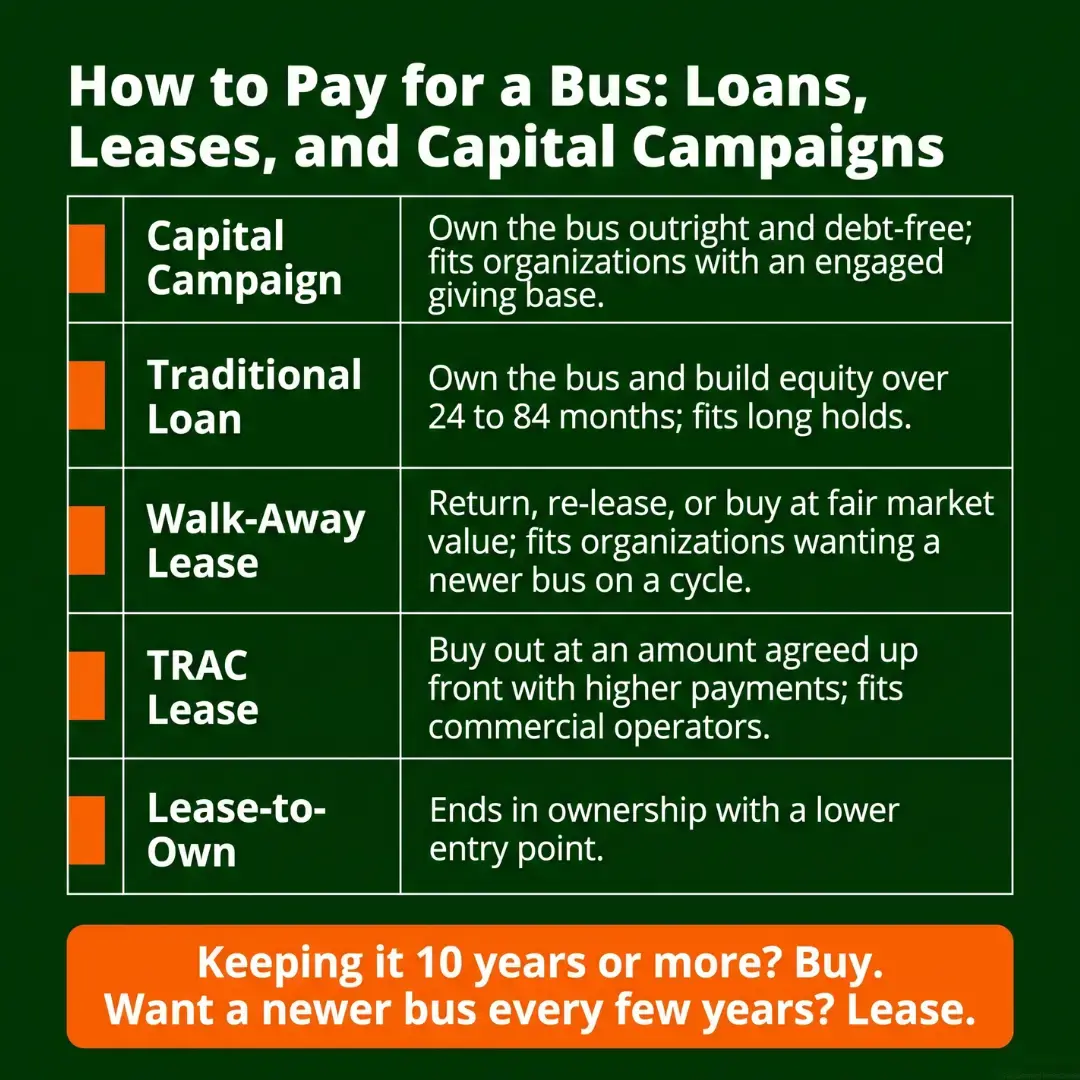
Carpenter Bus Sales customers fund a bus through a capital campaign, a traditional loan, a lease, or a lease-to-own agreement. Leases come in two structures, a walk-away lease and a TRAC lease, which end differently. The right route depends on whether your organization wants to own the bus at the end or hand it back.
| Funding route | What it is | What you have at the end | Usually fits |
|---|---|---|---|
| Capital campaign | Raising the purchase amount from your members or donors before you buy | A bus you own outright, debt free | Churches and nonprofits with an engaged giving base and time to plan |
| Traditional loan | Borrowing the purchase price and repaying it with interest | A bus you own, and equity while you pay | Organizations keeping the bus for the long haul |
| Walk-away lease | Paying for the use of the bus over a set term | Three choices: return it, re-lease, or buy it at fair market value | Organizations that want a newer bus on a predictable cycle |
| TRAC lease | A lease with the end value agreed up front | A purchase at the agreed amount, with higher payments along the way | Commercial operators planning to buy the bus out at term |
| Lease-to-own | Lease payments structured to end in ownership | A bus you own | Organizations that want ownership but need a lower entry point |
Carpenter Bus Sales offers all of these through a network of lenders. A new bus can be financed over 24 to 84 months, which is where most organizations find a payment that fits the annual budget. Used buses work differently. Heather Blackburn, Business Manager at Carpenter Bus Sales, says terms on a used bus are shorter and commonly top out around 48 months, because how old the bus is limits how long a lender will stretch the loan.
Two things about the process are worth knowing before your committee meets. A completed application typically gets a credit decision back within one business day, so you can bring a real answer to your next board meeting instead of leaving the question open for another month. And financing is almost always written with the church entity rather than with a personal guarantee, which means your pastor and your board members are not putting their own credit behind the bus. Terms change, so confirm current options when you apply.
How much does a bus cost to buy?
New buses from Carpenter Bus Sales start around $100,000 and go up with passenger capacity, chassis, and features such as a wheelchair lift. New passenger vans start around $75,000. Used church buses generally range from $40,000 to $80,000 depending on year, mileage, and condition.*
Those starting points matter because they size everything else. A capital campaign needs a target. A loan needs a principal. A lease payment is calculated from the vehicle price and the term.
Most organizations are not sizing a loan for the largest bus on the lot. Carpenter Bus Sales delivery records show that roughly two-thirds of the buses Carpenter Bus delivered since January 2022 (records through July 2026) were small buses carrying 15 passengers or fewer, driver included.
If your committee is building a budget, get a quote on the specific configuration you want before you set a number. A wheelchair lift, a longer chassis, or a particular floor plan moves the price more than most buyers expect.
*Pricing reflects 2026 starting points and changes with model year, configuration, and availability. Call (800) 370-6180 for current pricing on the bus you are considering.
How do you decide between leasing and buying a bus?
The decision comes down to how long your organization will keep the bus. If you plan to run it for a decade or more, buying through a loan or lease-to-own almost always costs less in total. If you want a newer vehicle every few years and cannot absorb downtime on an aging bus, a lease fits better.
Three questions settle it faster than a spreadsheet:
- How many years will you keep this bus? Long holds favor ownership, because the payments end and the bus keeps working.
- How many miles per year will you put on it? Leases carry mileage limits, and exceeding them costs money at the end.
- Can your operation tolerate a bus being down for service? If a vehicle out of commission means residents or riders go nowhere, a predictable replacement cycle is worth paying for.
Cash flow matters too, but it is the second question, not the first. A lease preserves capital because you are paying for use rather than for the asset. That is a real advantage for an organization that needs its reserves elsewhere, and it is a real cost if you end up leasing the same category of bus for fifteen years.
One accounting note worth raising with your treasurer: a purchase puts an asset on your books, while a lease is generally an ongoing operating expense. How that affects your organization depends on your structure and the lease type, so ask your accountant rather than relying on a general rule.
How long does a bus last, and why does that decide it?
A well-maintained commercial bus typically lasts 10 to 15 years, or 150,000 to 250,000 miles. Henry Headden, President and Owner of Carpenter Bus Sales, says regular preventive maintenance is the biggest factor in which end of that range a bus reaches.
That range is the hinge of the whole lease-versus-buy decision. A loan is paid off in seven years at most. If the bus runs another five to eight years after that, those are years of transportation with no payment attached, which is the entire financial argument for ownership.
The argument only works if the maintenance happens. A bus that skips service does not reach the top of that range, and an organization that buys without budgeting for upkeep gives away the advantage it just paid for. Service history is also what protects resale value when you do replace it.
That range describes service life under good maintenance. It is not a guarantee about any particular bus, and condition at purchase matters as much as age.
Do you still get the 8-year warranty if you lease a bus?
Yes. Heather Blackburn, Business Manager at Carpenter Bus Sales, confirms that a church leasing a new bus still receives PlatinumCare, and the coverage is held in the name of the church rather than the leasing company. Your organization is covered the same way whether you lease the bus or buy it outright.
That is worth knowing, because staying under warranty is one of the most common reasons organizations lean toward leasing. With Carpenter Bus Sales you get that protection either way, which frees your committee to choose the funding route on its own merits. Every new bus and van Carpenter Bus Sales sells carries coverage at one of three levels, and the levels differ by eligibility, price, duration, and mileage, not by what part of the vehicle is covered.
| Coverage | Who gets it | Cost | Length | Mileage |
|---|---|---|---|---|
| SilverCare | Every new bus and van buyer | Included | 5 years | 60,000 miles |
| GoldCare | Any new bus buyer who upgrades | $800 one time | 7 years | 70,000 miles |
| PlatinumCare | Churches, ministries, and senior care communities | Included | 8 years | Unlimited |
All three cover the entire vehicle, bumper to bumper, and all three carry a $100 deductible per claim and exclude routine maintenance and consumable items. Carpenter Bus Sales offers the only 8-year unlimited mile warranty in the industry for churches, ministries, and senior care communities.
Buyers outside that group are not left uncovered. Shuttle operators, schools, adult day care organizations, and commercial fleets receive SilverCare at no charge and can upgrade to GoldCare. You can see how claims are handled through the Carpenter Bus warranty department.
One limit to know before you plan around it: Carpenter Bus Sales extended warranty coverage does not transfer to a new owner. An underlying manufacturer chassis warranty may transfer under that manufacturer's own terms, which is a separate thing.
What happens when a bus lease ends?
At the end of a walk-away lease with Carpenter Bus Sales, your organization has three options, according to Heather Blackburn, Business Manager at Carpenter Bus Sales: return the bus, re-lease it subject to credit approval, or purchase it for fair market value. Which one makes sense usually depends on the bus's condition and what your needs look like by then.
Two parts of a lease are worth understanding up front, because knowing them early is what lets you plan around them. Blackburn points to both as the things organizations most often ask about after the fact:
- Return condition and mileage. Your organization is responsible for damage beyond normal wear and tear, and for any miles above the allowance. Knowing the number up front lets you match the mileage allowance to how you actually use the bus, and build light upkeep into the plan.
- How the buyout is priced. If you purchase at the end of a walk-away lease, the price is fair market value at that time rather than a balance reduced by the payments you have made. Lease payments cover the use of the bus, not equity in it, so if ownership is the goal, a loan or lease-to-own gets you there more directly.
Neither one is a drawback once you know about it going in. Ask your Carpenter Bus Sales representative to walk through the mileage allowance and the return condition language on your specific agreement, and you will know exactly what the lease expects of you from day one.
Which option do churches and senior care communities usually choose?
The pattern splits cleanly by organization type. Heather Blackburn, Business Manager at Carpenter Bus Sales, says senior care communities usually choose a walk-away lease, while churches usually choose a loan or a lease-to-own. The reasoning behind each choice is more useful than the choice itself.
Senior care communities lease because they do not want aged buses. As Blackburn puts it, they do not have the luxury of a bus sitting in the shop, or of a breakdown with seniors on board. A lease hands the vehicle back before it reaches the age where that becomes a real risk. If that describes your operation, the senior care bus options are worth reviewing alongside lease terms.
Churches buy because they plan to keep the bus a long time and typically do not put many miles on it in a year. A bus used for Sunday services, a midweek program, and a few trips a year is a bus that will still be serviceable long after the loan is paid. Mileage caps on a lease would be money spent on flexibility the church does not need.
These are the patterns Carpenter Bus sees among its own customers, not a rule about every organization. If your church runs a daily route or your community keeps buses for fifteen years, the usual answer may not be yours.
How does a capital campaign work for a bus purchase?
A capital campaign raises the purchase amount from your members or donors before you buy, which leaves your organization owning the bus outright with no monthly payment. It is the slowest route and the only one with no financing cost attached, and for churches and nonprofits it does something the other three cannot.
Raising the money as a group creates buy-in. When members contribute to a specific, visible purchase, the bus becomes a shared accomplishment rather than a line item the finance committee approved. In practice that tends to show up in how the vehicle gets treated and how willingly people volunteer to drive and maintain it.
Three things make a bus campaign easier to run than a building campaign:
- The goal is concrete and people can picture it.
- The amount is small enough to reach without a multi-year pledge drive.
- The result shows up in the parking lot, where everyone sees it.
Campaigns also combine well with the other routes. Raising part of the purchase price and financing the remainder lowers the principal, which lowers the payment. Get a quote on the configuration you want first, so your target is a real number rather than an estimate.
Can you finance a used bus?
Yes. Carpenter Bus Sales finances both new and used buses, though Heather Blackburn, Business Manager at Carpenter Bus Sales, notes that used bus terms are shorter than new, commonly topping out around 48 months depending on the age of the bus. A shorter term means a higher payment on the same amount borrowed, which is the part buyers tend to miss.
That shorter term is worth weighing against the lower purchase price. A used bus at half the price of a new one does not always produce half the payment, because you are repaying it in less time.
Two coverage differences also belong in the comparison. A used bus does not carry Carpenter Bus Sales warranty coverage, though an optional service contract is available on qualifying used buses. Ask your representative whether a specific bus qualifies and exactly what the contract covers. Some used buses also retain part of their original manufacturer warranty, which is manufacturer coverage rather than Carpenter Bus coverage.
If the budget points toward used, start with the current used buses for sale and get financing terms on a specific unit rather than on the category.
How does this work for a fleet instead of one bus?
Fleet buyers weigh the same four routes, but two factors carry more weight: residual value and replacement cycles. When you operate several buses, the question stops being what one vehicle costs and becomes what the fleet costs to keep current, since vehicles age into higher maintenance at different times.
Leasing a fleet keeps the replacement cycle predictable and the average vehicle age down, which matters most when downtime has a direct operational cost. Owning a fleet costs less over a long horizon and leaves resale value in your hands, which matters most when your buses stay in service past the point a lease would have ended.
Mixed approaches are common and often sensible. Owning the core vehicles that run every day while leasing the units that cover growth or seasonal demand gives you both a stable base and a flexible edge.
Multiple-unit purchases and fleet financing are worth a direct conversation rather than a web form, because the structure changes with the number of units and the timing. Start with a Carpenter Bus representative for your state.
Frequently asked questions
How fast is credit approval on a bus loan or lease?
Carpenter Bus Sales typically returns a credit decision within one business day of receiving a completed application. Gathering your financial documents before you apply is what usually determines the real timeline, since an incomplete application cannot be reviewed. Terms and approval depend on the lender and your organization's financial picture.
Does your church need a personal guarantee to finance a bus?
Carpenter Bus Sales finances almost always with the church entity rather than with individual pastors or board members. Heather Blackburn, Business Manager at Carpenter Bus Sales, confirms this is the standard structure. It is not a guarantee for every organization, so ask directly about your situation before you apply.
Can you put your church logo on a leased bus?
Graphics and lettering are common on leased buses, but ask before you order them. A lease holds your organization responsible for returning the bus in acceptable condition, so confirm with your Carpenter Bus Sales representative what your agreement requires if you plan to return the vehicle at the end of the term.
Does Carpenter Bus Sales buy buses from organizations?
Carpenter Bus Sales buys well-maintained buses and vans from organizations nationwide, with specific criteria covering model year, mileage, and passenger capacity. Selling your current bus is one way to fund the next one, either as a trade-in applied to a purchase or as an outright sale. See the We Buy Buses page for details.
What should you do next?
Decide how long you plan to keep the bus before you compare payments, because that single answer points you toward ownership or toward a lease. Then get a quote on the specific configuration your organization needs, since capacity, chassis, and a wheelchair lift move the price enough to change which funding route makes sense.
When you have that number, review the current options on the Carpenter Bus Sales financing page and apply with your financial documents in hand. If you are still deciding what size bus the budget has to cover, the church bus guide is the better starting point.
