Vans, Mini Buses, or MFSABs for Preschools and Schools
NHTSA's rules for daycares, preschools, and private schools in plain words, plus what to settle before you call a Carpenter Bus specialist.
By Dominic Menard - National Director of Marketing & Technology
Published • Last updated
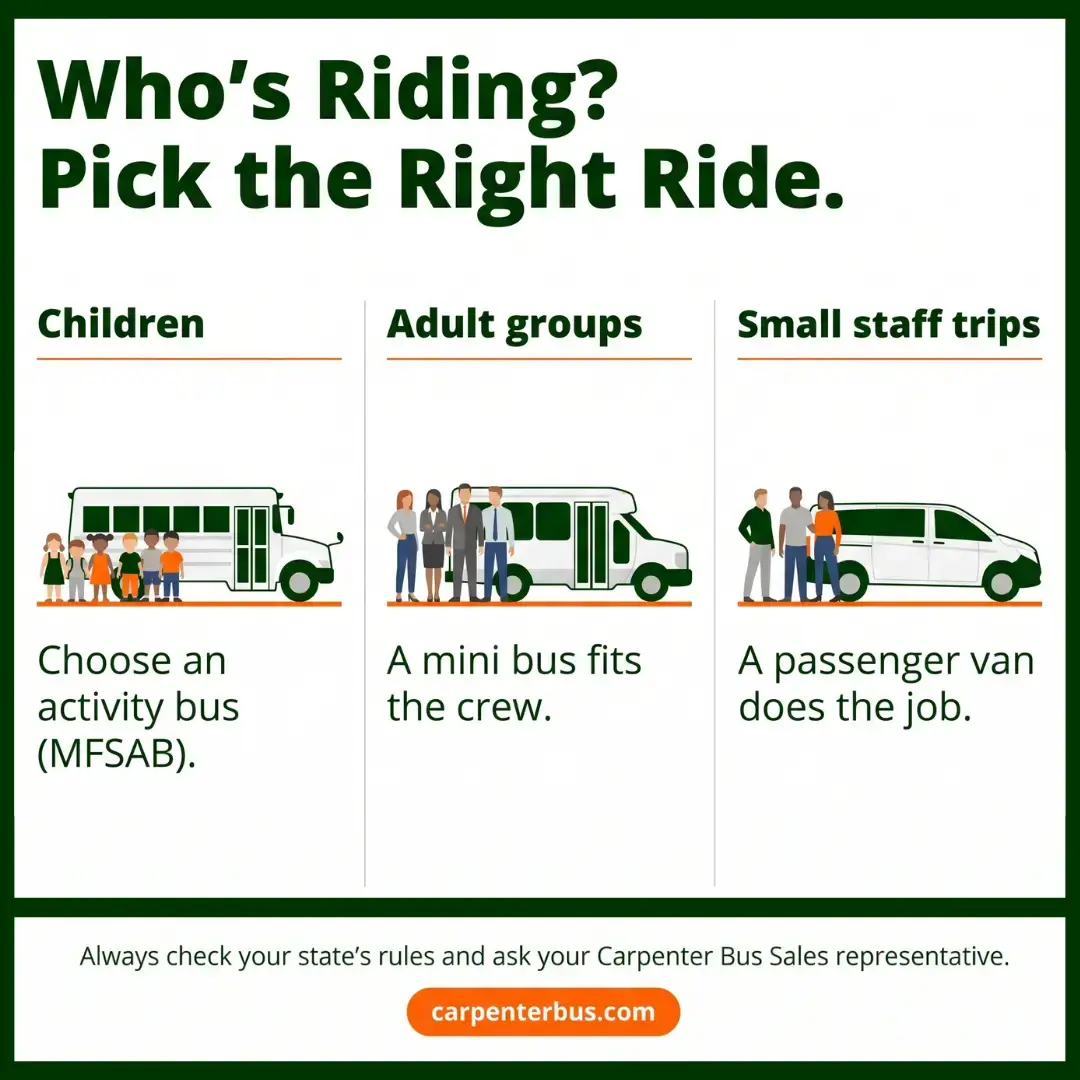
Carpenter Bus Sales can help you choose between a passenger van, a mini bus, and a multi-function school activity bus (MFSAB) for your school or childcare program. The right one comes down to who's riding. When children are on board, we recommend an MFSAB, and for adult groups a van or mini bus may be all you need.
Key takeaways
- NHTSA says daycares, childcare centers, and preschools aren't "schools" under its school bus rules. Private and parochial schools are.
- For children, Carpenter Bus Sales recommends an MFSAB, which meets the same federal structural safety standards as a yellow school bus.
- Carpenter Bus Sales sells passenger vans too, and NHTSA says electronic stability control means rollover is no longer a danger for newer 15-passenger vans.
- Count the driver when you check the federal CDL line of 16 or more people, and confirm your state's rules with your DMV or a Carpenter Bus Sales representative.
- Rick Cassels, Regional Sales Manager at Carpenter Bus Sales, says inadequate storage is the regret he hears most often from Carpenter Bus customers.
Can a daycare or preschool use a passenger van, or does it need a bus?
NHTSA doesn't count a daycare, childcare center, or preschool as a "school" under its school bus rules, so they don't choose your vehicle for you. They do apply if you also carry children to or from a school. Your state, licensing agency, and insurer may add their own rules, so check with each one first and nothing surprises you after you buy.
Head Start programs have their own vehicle rules. NHTSA points them to the Office of Head Start with compliance questions.
Vans have come a long way, too. NHTSA says that thanks to electronic stability control, rollover is no longer a danger for newer 15-passenger vans. Carpenter Bus Sales sells commercial grade passenger vans, and they're a solid fit for adult groups and staff trips.
When children are riding, though, we recommend an activity bus (MFSAB). It's built to the same federal structural safety standards as a yellow school bus, and private organizations can buy one. Some states require one for licensed childcare transport, so check your state rules before you buy.
Should you choose a van, a mini bus, or an MFSAB?
Match the vehicle to who's riding and where you're going. An MFSAB fits children's programs and school activity trips. A mini bus fits adult groups, like staff or chaperone shuttles. A passenger van fits smaller adult groups and staff trips. Carpenter Bus Sales sells all three, and a specialist can help you pick the right one for your organization.
Here's how the three compare for a school or childcare program.
| Vehicle | Built to school bus standards? | Best fit | Check before you buy |
|---|---|---|---|
| MFSAB (activity bus) | Yes, except flashing lights and stop arms (NHTSA) | Children's programs, school sports, field trips | It can't run home-to-school or bus stop routes. |
| Mini bus | No. It's sold as a commercial bus. | Adult groups and staff shuttles | NHTSA says a new bus sold for regular student trips must meet school bus standards. |
| Passenger van | Not as a standard 15-passenger van | Adult groups and staff trips | NHTSA says a school can't buy a new 15-passenger van for regular student trips unless it meets school bus or MFSAB standards. Ask your insurer too. |
If you run a private or parochial school, NHTSA counts you as a school. That means you can't buy or lease a new 15-passenger van for regular student trips unless it meets school bus or MFSAB standards. It doesn't matter who does the buying, either. If a church or daycare buys a new bus for those trips, the same rule applies.
Those federal rules cover what can be sold new. They don't set the rules for how a vehicle is used to carry students. Each state makes those rules, and they differ, so check with your state before you choose and you'll know the vehicle fits where you drive. NHTSA recommends that vehicles carrying students meet school bus standards, which is why we point children's programs to an MFSAB.
What is an MFSAB, and how is it different from a yellow school bus?
A multi-function school activity bus (MFSAB) is a school bus that doesn't carry students between home and school or school bus stops. NHTSA says it has to meet the federal school bus safety standards except the ones for flashing lights and stop arms. So it has no stop arms, red lights, or yellow paint, and private organizations can buy one.
For field trips, athletics, and daycare runs, an MFSAB is made for exactly that, and it's the one we'd point you to. If your school runs routes from home to school or to bus stops, you'll need a yellow school bus. Carpenter Bus Sales doesn't sell those, so your state or a school bus dealer can point you the right way.
Carpenter Bus Sales sells Collins Magellan activity buses, including wheelchair accessible models. Your representative can walk you through seating options for your riders' ages and tell you what's in stock now.
How many children can you carry without a CDL?
Federally, a CDL (commercial driver's license) is required for a vehicle designed for 16 or more people including the driver, a vehicle with a gross vehicle weight rating of 26,001 pounds or more, or placarded hazardous materials. A bus built for 15 or fewer, driver included, is under the passenger line. Some states can be more restrictive, so confirm with your DMV.
Count everyone on board: children, teachers, staff, volunteers, and the driver. That total decides which side of the line you're on. The federal baseline comes from 49 CFR 383.5.
Carpenter Bus Sales delivery records show that roughly two-thirds of the buses Carpenter Bus delivered since January 2022 (records through July 2026) were small buses, 15 passengers or fewer. That includes all our customers, not just schools, and it isn't a national number. Still, it shows you what other buyers are choosing when they shop for a bus, which can help as you think about your own size.
Does a church or nonprofit run your program? Ask your state DMV about that too. Some states, including California and Connecticut, apply stricter rules to churches and nonprofits, not looser ones. Our CDL guide explains more about how the rules vary.
Plan for your driver pool, too. Rick Cassels tells of a rural Texas church that owned a CDL bus and had only two CDL drivers. Both drivers left, and the church was not able to serve its congregation as effectively. His advice: if you run a CDL bus, keep recruiting CDL drivers. That was one church, but it's worth planning for in any program.
How do you choose a bus for athletic teams and field trips?
Start with your roster, then your gear, then comfort. Count players, coaches, staff, volunteers, and the driver. Then plan room for equipment, because Rick Cassels, Regional Sales Manager at Carpenter Bus Sales, says inadequate storage is the regret he hears most often from Carpenter Bus customers. Pick seating and climate control for your longest ride.
Here's a quick checklist to walk through with your coaches and teachers:
- Roster: Count players, coaches, staff, volunteers, and the driver for your biggest trip.
- Gear: List your biggest game-day load, such as bags, benches, and instruments, and ask your representative how it will fit. Our storage options guide has ideas.
- Comfort: Ask about the seating and climate control for your longest ride.
- Access: Most, not all, Carpenter Bus buses can be set up with a rear or side wheelchair lift. Ask about yours.
For a school, sports trips and field trips count as school-related events under NHTSA's rules. A new bus bought for them has to meet school bus standards, and an MFSAB does.
Should your school own, rent, or contract its transportation?
Own a bus if you travel a lot and want control of schedules, drivers, and how the bus looks. Rent if you only need a bus now and then. Contract it out if you'd rather someone else run the trips. Carpenter Bus Sales sells and rents buses, and on a rental you supply the driver.
- Owning: You set the schedule, keep the same drivers and vehicle, and can put your school name on the bus.
- Renting: You pick the right size for each trip and don't take on upkeep.
- Contracting: Someone else handles the vehicle and the maintenance.
Carpenter Bus Sales rents buses to organizations in Tennessee and Texas, including schools. Your own driver takes the wheel, since rentals are self-drive only. We don't rent 15-passenger vans, so check the rentals page for the buses we do have and the current requirements.
Can you put your school's name and colors on the bus?
Yes. Carpenter Bus Sales offers logos and lettering, custom graphics, and full wraps for any customer. Your bus can carry your school's name, logo, and colors wherever it goes. Ask your representative about the options for your bus when you order.
A bus with your name on it works like a rolling sign. Every trip puts your school in front of the people you pass. Learn more on our bus graphics page:
- Logos and lettering: Your school name and logo on the sides of the bus.
- Custom graphics: A design made for your bus and your school colors.
- Full wraps: Color and design across the whole bus.
Need paint or body work, too? The Carpenter Bus Sales service shop in Elm Mott, Texas, just north of Waco, has a 60-foot paint and body booth. Ask your representative what the shop can do for your bus.
Frequently Asked Questions
Does Carpenter Bus Sales sell school buses?
No. Carpenter Bus Sales doesn't sell yellow school buses. We sell activity buses (MFSABs), which are built to federal school bus structural safety standards and are available to private schools, daycares, churches, and camps. If you need a bus for home-to-school routes, ask your state or a school bus dealer.
Can an MFSAB be wheelchair accessible?
Yes. Carpenter Bus Sales sells Collins Magellan activity buses in a range of sizes, and they can be set up for wheelchair access with Braun or Ricon lifts. Most, not all, Carpenter Bus buses can take a lift, so ask your representative which size and layout fits your group, and how seats, wheelchair positions, and the driver count toward the CDL line.
What are small buses used for?
A small bus, built for 15 people or fewer including the driver, carries groups such as preschool classes, small teams, staff shuttles, and field trip groups. Ask a Carpenter Bus Sales representative which size fits your group.
What warranty comes with a new school or preschool bus?
Every new Carpenter Bus Sales bus and van includes SilverCare at no charge, covering the entire vehicle for 5 years or 60,000 miles. GoldCare upgrades that to 7 years or 70,000 miles for $800 one time. PlatinumCare, 8 years with unlimited miles, is for churches, ministries, and senior care communities. See the warranty page for terms.
Does a church-run preschool or school qualify for PlatinumCare?
Some church-run programs may qualify, and your Carpenter Bus Sales representative can confirm case by case. PlatinumCare is the 8-year unlimited mile warranty for churches, ministries, and senior care communities. Every other new bus buyer still gets SilverCare free and can upgrade to GoldCare.
Is there a warranty on a used bus?
Some used buses still carry part of the original manufacturer warranty, and Carpenter Bus Sales offers an optional service contract on qualifying used buses. Carpenter Bus Sales doesn't provide its own warranty on used buses, and a service contract isn't a warranty, so ask your representative whether your bus qualifies, what it covers, and the current terms.
What is the next step?
Talk with a Carpenter Bus Sales bus specialist. Tell them who's riding, where you're driving, and whether any trips go to or from a school. We'll help you match the right vehicle, and we deliver nationwide. Call (800) 370-6180 or find your Carpenter Bus Sales representative.
This article is general information, not legal or insurance advice. Rules for transporting students differ by state and can change, so before you buy, confirm the requirements with your state agency, your insurer, and your attorney. That's how you make sure the vehicle you choose fits the rules where you operate.
