
Church Bus Customer Stories: What Each Church Decided
How one Texas church replaced rented coaches with a leased shuttle fleet, and what three other churches faced with drivers, trade-ins, and leases.
By Dominic Menard - National Director of Marketing & Technology
Published
Carpenter Bus Sales has worked with churches facing parking shortages, driver shortages, ending leases, and more. The right fix depended on each church's drivers, budget, and plans for the bus. The stories below come from Carpenter Bus Sales customers, so you can see how others weighed the same choices.
Key takeaways
- Sugar Creek Baptist Church in Sugar Land, Texas, solved its parking problem with 14 leased vehicles and no cash reserves spent, with help from Rick Cassels, Regional Sales Manager at Carpenter Bus Sales.
- Share the driving. A very active rural Texas church with only two CDL drivers lost both of those drivers and stopped running buses entirely, says Rick Cassels. Carpenter Bus Sales can help you match a bus to your drivers.
- Trading in an old bus or van starts with a form, online on the Carpenter Bus Sales We Buy Buses page or from your representative. Carpenter Bus Sales was able to make a large Texas church an offer on all four of its vehicles.
- A walkaway lease gives your church three choices at the end: return the bus, re-lease it (with credit approval), or buy it at fair market value, says Heather Blackburn, Business Manager at Carpenter Bus Sales. Your representative can walk you through the details, including return damage and mileage overages, so you are prepared.
Sources: Rick Cassels, Regional Sales Manager at Carpenter Bus Sales, and Heather Blackburn, Business Manager at Carpenter Bus Sales.
How can a church solve a parking shortage with its own shuttle buses?
A church can solve a parking shortage by running its own shuttle buses, as Sugar Creek Baptist Church in Sugar Land, Texas, did with a leased fleet of 14 vehicles and help from Carpenter Bus Sales. Their new fleet is eleven 25-passenger buses and three low-floor buses. Rick Cassels, Regional Sales Manager at Carpenter Bus Sales, worked with the church's leaders to design a fleet that fit their traffic flow and passenger needs.
What problem was Sugar Creek Baptist Church trying to fix?
Before the change, the church rented large travel coaches every Sunday to carry people from off-campus parking lots. That worked in the short term, but church leaders wanted something more permanent, more flexible, and more cost-effective. The church's executive pastor contacted Carpenter Bus to explore buying or leasing its own fleet.
Which buses did Sugar Creek Baptist Church choose for its shuttle fleet?
Rick spent about 22 years in church ministry before he joined Carpenter Bus Sales in 2015. He worked with Sugar Creek's leaders to understand their traffic flow and passenger needs. The church settled on a mixed fleet:
- Eleven 25-passenger buses. These carry most riders. A 25-passenger bus is a medium bus (16 to 30 passengers, with the driver counted), a balance of capacity and ease of getting around a parking lot.
- Three low-floor buses. These have an entrance close to the ground and no steps, so riders who use wheelchairs or have limited mobility can board.
Carpenter Bus Sales sells church buses in small, medium, and large sizes.
Why did Sugar Creek Baptist Church lease its shuttle buses instead of buying them?
The church leased the buses rather than buying them outright. That let it add the fleet without spending its cash reserves, which kept money available for ministry. To compare leasing and buying for your own church, see our guide to ways to buy a bus. If parking is your problem, a Carpenter Bus Sales representative will work through your traffic flow and passenger needs with you, the way Rick did with Sugar Creek.
What can a church do when it does not have enough CDL drivers?
A church short on CDL drivers can build a bigger pool of drivers to share the driving, or look at smaller buses that may not need a CDL driver, depending on your state. Rick Cassels says a rural Texas church with only two CDL drivers stopped running buses after both left. Those two drove for every group, and in his words, "two drivers weren't enough for that particular church."
What happened to the rural Texas church with only two CDL drivers?
The church called Rick because it wanted to sell a bus outright. It was frustrated with running buses entirely. Its two CDL drivers (a CDL is a commercial driver's license) had driven for every part of the church: adults, senior adults, youth, and children. Because they were the only two, they were called on to drive everywhere. Rather than say no, they quietly left the church. Rick says stories like this are becoming "a little too common." That is his observation from his own customers, not a measured trend.
What does the federal rule say about when a bus needs a CDL driver?
Federal rules (49 CFR 383.5) describe a commercial motor vehicle with three triggers:
- A gross vehicle weight rating (the most the maker says the loaded vehicle can weigh) of 26,001 pounds or more.
- A design to carry 16 or more people, including the driver.
- Use in carrying placarded hazardous materials.
States add their own rules. A seat count alone does not tell you whether a specific driver or vehicle needs a CDL, so check with your state DMV (department of motor vehicles) or a Carpenter Bus Sales representative. For more detail, read our guide to shuttle bus and driver's license rules.
What are your options if your church cannot find CDL drivers?
Carpenter Bus can help you work through this. Tell a representative what your driver pool looks like. Depending on your state, two smaller buses that do not need a CDL driver might fit your church better than one medium or large bus that may need one. Carpenter Bus Sales sells small buses (15 passengers or fewer, with the driver counted) and passenger vans as well as larger buses. Depending on your state and the vehicle, some can be driven without a CDL, and a representative can help you check what applies to you.
How do you trade in an old church bus or van?
Carpenter Bus buys well-maintained buses and vans nationwide, and it starts with the online form on the We Buy Buses page. You enter your vehicle details, a specialist checks the year, make, model, and condition against current market data, and you get an offer with no obligation to accept if the vehicle meets Carpenter Bus Sales' criteria.
After you agree to a deal, Carpenter Bus arranges delivery or pickup. If you are buying another vehicle, your old bus or van's value can go toward a new or pre-owned vehicle from us. The form covers buses and vans.
Rick Cassels gave one example. He took a call from a large Texas church with four vehicles, sent the church the form, and worked out an offer to buy all four buses. Every offer depends on the vehicle.
You can fill out the form on the We Buy Buses page yourself, or ask your representative to send it to you. Not sure your vehicle qualifies? Your representative can tell you what Carpenter Bus Sales looks for in a trade-in vehicle.
What are your options when a church bus lease ends?
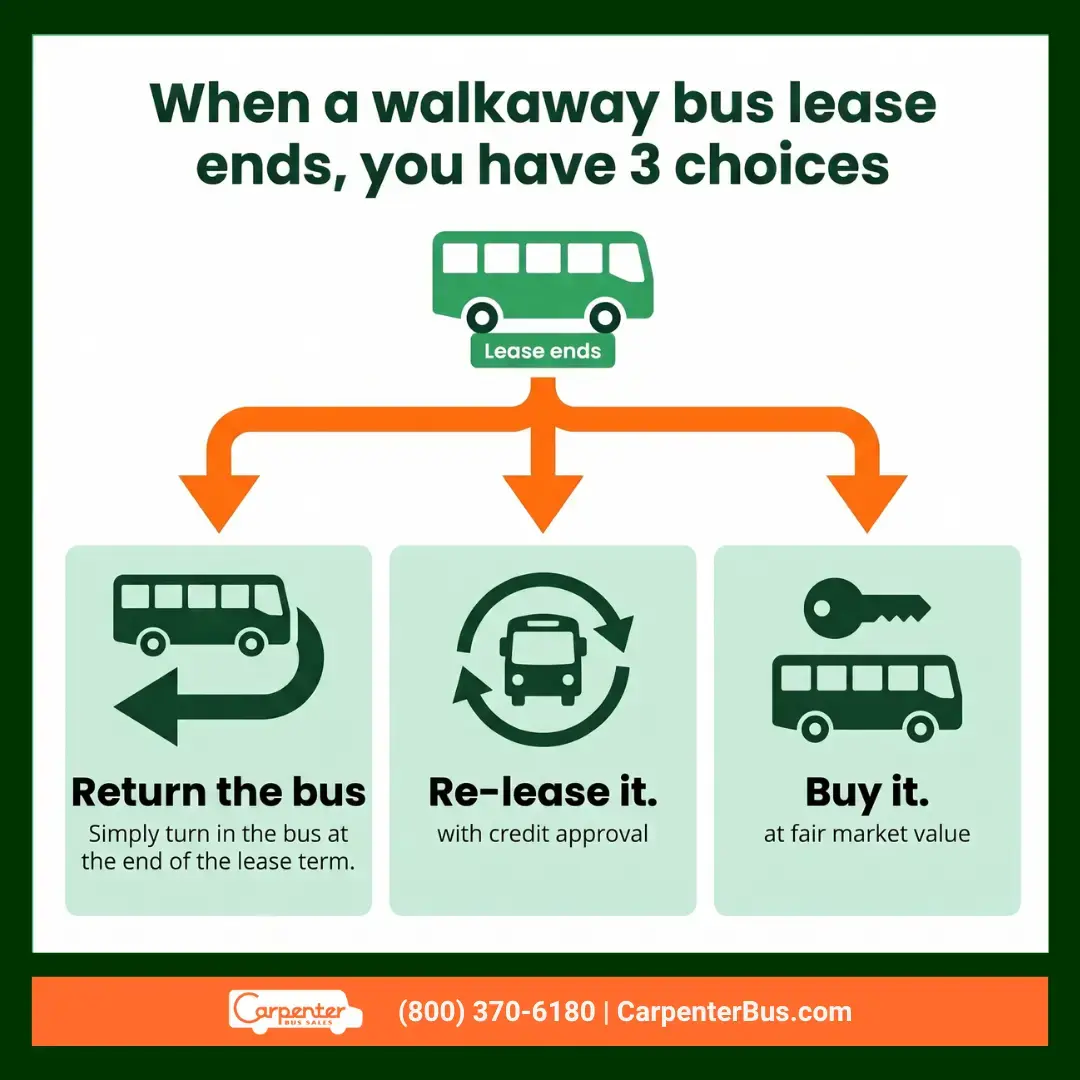
On a walkaway lease, a church can return the bus to Carpenter Bus, re-lease it depending on credit approval, or buy it for fair market value, according to Heather Blackburn, Business Manager at Carpenter Bus Sales. Leasing gives a church choices at the end of the term, so it is not locked into one bus.
What did one Texas church do when its lease ended?
Rick Cassels tells the story of a Texas church whose lease ran out after a term of five or six years. The church had the option to buy the bus it had been using. Rick says the church knew how that bus had been serviced and how it drove. The church could also have turned the bus in and chosen another solution. Lease terms depend on the lease type, and the details below are for walkaway leases.
What should a church know before signing a walkaway lease?
Heather Blackburn says organizations most often misunderstand two things:
- You are responsible for lease return damage that goes beyond normal wear and tear, and for mileage overages.
- If you buy the bus at the end of a walkaway lease, the price is fair market value. It is not based on what you have already paid on the bus.
Ask your representative to walk you through both before you sign. You will know what to expect and feel fully prepared when the term ends.
Which bus financing do churches choose: a loan, a lease, or lease-to-own?
Heather says churches usually choose a loan or a lease-to-own, because they plan to keep the bus a long time and typically do not put many miles on it each year. Carpenter Bus Sales offers walkaway leases and lease-to-own through a network of lenders. Loans on new buses run 24 to 84 months. On used buses, the length depends on the bus's age, and Heather says loans usually go up to 48 months. Terms can change, so confirm current details with your representative before you decide.
What do these church bus customer stories have in common?
Each church started with a practical problem, not a bus: too little parking, too few drivers, vehicles to move, or a lease coming due. The decision that followed depended on drivers, budget, and how long the church planned to keep the vehicle. The table shows each situation and the solution.
| Church | What it faced | The solution |
|---|---|---|
| Sugar Creek Baptist Church, Sugar Land, Texas | Not enough parking, with large travel coaches rented every Sunday | Carpenter Bus helped the church lease a fleet of 14 vehicles: eleven 25-passenger buses and three low-floor buses |
| A rural Texas church | Only two CDL drivers, and both left the church | Rick took the church's call about selling its bus outright, and what he learned helps other churches build a bigger driver pool or choose a bus that fits their drivers |
| A large Texas church | Four vehicles to move out | Carpenter Bus made an offer on all four vehicles |
| A Texas church whose lease ended | A lease term of five or six years coming to an end | The church could buy the bus it knew, or turn it in and choose another solution |
Frequently Asked Questions
Are churches and nonprofits exempt from CDL requirements?
Do not assume so. Some states, including California and Connecticut, apply stricter rules to churches and nonprofits, not looser ones. CDL rules vary by state and by vehicle, so confirm what applies to your church with your state DMV or a Carpenter Bus Sales representative, and see our guide to shuttle bus and driver's license rules.
How fast will I get a credit decision on church bus financing?
Heather Blackburn says a credit decision usually comes within one business day of a completed application. She also says financing is almost always with the church as an organization, not backed by a personal guarantee, which keeps the commitment with the church itself and not with any one person. Approval, rates, and terms vary, so confirm current details with your representative.
Do you still get PlatinumCare if your church leases a new bus?
Yes, a church that leases a new bus from Carpenter Bus Sales still gets PlatinumCare, the 8-year unlimited mile warranty for churches, ministries, and senior care communities, according to Heather Blackburn. The coverage is in the church's name, not the leasing company's. Ask your representative for the full warranty terms.
Does Carpenter Bus Sales serve churches in Texas?
Yes. Carpenter Bus Sales delivers nationwide, with locations in Franklin, Tennessee and Elm Mott, Texas, just north of Waco. Sugar Creek Baptist Church, the church in the story above, is in Sugar Land, Texas. A representative can work with your church wherever you are.
Who can help my church decide on a bus, a lease, or a trade-in?
Call Carpenter Bus Sales at (800) 370-6180, or find the representative for your area. Tell them what your church is facing, whether that is parking, drivers, a lease that is ending, or an older bus or van to move. A representative will help you look at your options and tell you what happens next.
