
40 Passenger Bus: The Complete Guide for Buyers
40 people including the driver on a 40 foot body. What the floor plans actually give you, and when renting beats owning one outright.
By Dominic Menard - National Director of Marketing & Technology
Published • Last updated
A 40 passenger bus from Carpenter Bus Sales carries 40 people including the driver, on a 40 foot body built on a Ford F-650 or a Freightliner S2C chassis. Most 40 passenger floor plans reach that number by giving the last few rows to a rear luggage compartment. Federal rules require a commercial driver's license for a 40 passenger bus, and the exact class varies by state.
A 40 passenger bus sits in the large bus category at Carpenter Bus Sales, which covers everything seating 31 passengers and up. Larger layouts are available on the same models, so the choice at this point is rarely about finding more seats. It is about how many people you actually move, how often, and whether owning the vehicle beats renting one.
What are the key specifications of a 40 passenger bus?
A 40 passenger bus from Carpenter Bus Sales runs 40 feet long, carries 40 people including the driver, and is built on a Ford F-650 or Freightliner S2C chassis. The table below covers the questions buyers ask most often, before the sections that explain each one in detail.
| Question | Answer |
|---|---|
| Body length | 40 feet |
| Passenger count | 40, including the driver |
| Riders, excluding the driver | 39 |
| Chassis options | Ford F-650 (gas or diesel) or Freightliner S2C (diesel only) |
| Models | Starcraft XLT, Starcraft Allstar XL, Glaval Concorde II, Glaval Legacy |
| Commercial driver's license | The federal passenger threshold of 16 or more is met. The license class depends on the configuration, and requirements vary by state |
| Typical luggage configuration | Enclosed rear compartment, loaded from outside the cabin |
| Maximum capacity on the same body | 46 passengers, with overhead storage instead of a rear compartment |
| Wheelchair accessible version | Available on the Glaval models, with a reduced seat count |
| Best suited to | Organizations moving this many people on a regular schedule |
One point causes more confusion than any other: a 40 passenger bus is not 40 passengers plus a driver. Carpenter Bus Sales counts the driver in every published capacity, so a 40 passenger bus seats 39 riders. Charter operators and some manufacturers quote riders only, which is how the same vehicle ends up described two different ways.
What is a 40 passenger bus?
A 40 passenger bus is a heavy duty bus with a 40 foot body, built by Starcraft or Glaval on a commercial truck chassis. Carpenter Bus Sales sells it in the large bus category, which covers every bus seating 31 passengers and up. Manufacturers list these models in their shuttle bus series, and they are built for group transport rather than long distance touring.
The same 40 foot body is sold in several capacities. Ordering a 40 passenger bus rather than a 46 passenger bus is a choice about how to divide the interior, not a choice of a different vehicle.
How does Carpenter Bus Sales count passengers?
Every capacity figure Carpenter Bus Sales publishes includes the driver. A 40 passenger bus seats 39 riders plus the person behind the wheel. This is stated directly on the Carpenter Bus Sales floor plans page and it applies across the whole lineup.
That detail matters more than it sounds. Some manufacturers and most charter operators quote riders only, so the same bus can appear as a 39 or a 40 depending on who is describing it. When you compare quotes, confirm whether the driver is in the number before you assume two buses are the same size.
Why do most 40 passenger floor plans include rear luggage?
Because 40 is not the maximum for this body. The maximum on the 40 foot Starcraft Allstar XL, the Glaval Concorde II, and the Glaval Legacy is 46 passengers. A 40 passenger layout reaches that number by converting the rear of the bus into an enclosed luggage compartment loaded from outside the passenger cabin.
That trade is usually deliberate. Groups that fill a bus this size are typically going somewhere overnight, and 40 people with weekend bags need real storage. The buyers who skip the luggage area and take all 46 seats are usually running short local routes where nobody brings more than a coat.
Which 40 passenger bus floor plans can you order?
Carpenter Bus Sales offers 40 passenger layouts from both Starcraft and Glaval, all on a 40 foot body. The table below lists the published layouts closest to 40 passengers, with capacities including the driver. Floor plans change by model year and configuration, so confirm the exact layout with a bus specialist before you order.
| Model | Chassis | Capacity (includes driver) | Luggage |
|---|---|---|---|
| Starcraft XLT 40' | Ford F-650 or Freightliner S2C | 40 passengers | Rear storage with wall |
| Starcraft XLT 40' | Ford F-650 or Freightliner S2C | 41 passengers | Rear storage with wall |
| Starcraft Allstar XL 40' | Ford F-650 or Freightliner S2C | 46 passengers | Overhead or rear wall |
| Glaval Legacy 40' | Freightliner S2C | 40 passengers | Rear storage with wall |
| Glaval Legacy 40' | Freightliner S2C | 42 passengers | Rear luggage area |
| Glaval Legacy 40' | Freightliner S2C | 46 passengers | Overhead |
| Glaval Concorde II 40' | Ford F-650 | 40 passengers | Rear luggage area |
| Glaval Concorde II 40' | Ford F-650 | 46 passengers | Overhead |
What if you need more than 40 seats?
Carpenter Bus Sales sells buses larger than a 40 passenger bus. The same 40 foot body is offered at 41, 42, and 46 passengers, and longer bodies with higher capacities are available beyond that. If your group has outgrown 40 seats, talk with your Carpenter Bus Sales representative about what is currently available.
This is worth a conversation rather than a guess, because capacity is only one of the variables. A longer body changes where the bus can turn and park, and adding seats usually means giving up the rear luggage compartment. A representative can weigh those against each other for your actual routes and tell you which size fits, including when the smaller bus is the better buy.
Wheelchair accessible versions are available on the Glaval models using flip and foldaway seats with lift options from Braun. Adding a lift and securement positions reduces the seat count, so a wheelchair equipped bus in this body will not also carry 40 seated passengers. You can browse the full library on the Carpenter Bus Sales floor plans page, and a specialist can source a layout that is not shown there.
Which chassis should a 40 passenger bus use?
A 40 passenger bus is built on one of two chassis. The Ford F-650 carries the Glaval Concorde II and is available with a gas or a diesel engine. The Freightliner S2C carries the Glaval Legacy and is diesel only. The Starcraft Allstar XL and XLT are offered on both.
The practical difference is fuel and service, not capability.
- Ford F-650. The only way to get a gas engine in a 40 passenger bus. Gas is simpler to service, and most general truck shops can work on it. Organizations without a diesel mechanic nearby tend to end up here.
- Freightliner S2C. Diesel only, and the platform most often chosen for heavy daily mileage. Glaval undercoats the chassis on the Legacy, which matters in salt country and on buses that live outdoors.
The honest version of this decision is that annual mileage settles it. A bus that runs a few times a month rarely earns back the diesel premium. A bus on a daily route usually does.
Do you need a CDL to drive a 40 passenger bus?
Yes, under the federal standard. Federal regulation 49 CFR 383.5 defines a commercial motor vehicle to include any vehicle designed to transport 16 or more passengers including the driver. Every 40 passenger bus clears that line by a wide margin. Requirements vary by state, so confirm the specific class and endorsements with your state DMV or a Carpenter Bus Sales representative.
The seat count is what triggers the requirement, and it is worth understanding why before you plan around it. Our shuttle bus driver's license guide covers the licensing question in full, including the terminology differences between states.
Does the license class change with the chassis?
It can. The same federal regulation sets a second threshold based on weight, at a gross vehicle weight rating of 26,001 pounds or more. A bus can cross the passenger threshold, the weight threshold, or both, and which ones it crosses affects the class of license required.
Ask for the gross vehicle weight rating of the specific configuration you are considering, then take that number to your state agency. Weight ratings vary by chassis and by how the 40 passenger bus is built, so this is not a question that can be answered by seat count alone.
What changes if you tow a trailer?
Towing can move you into a different license class. Federal rules treat a vehicle towing a heavy trailer as a combination vehicle, and that is a separate category from a single heavy vehicle. If your group tows equipment, gear, or a supply trailer, raise it with your state agency before you order the 40 passenger bus rather than after.
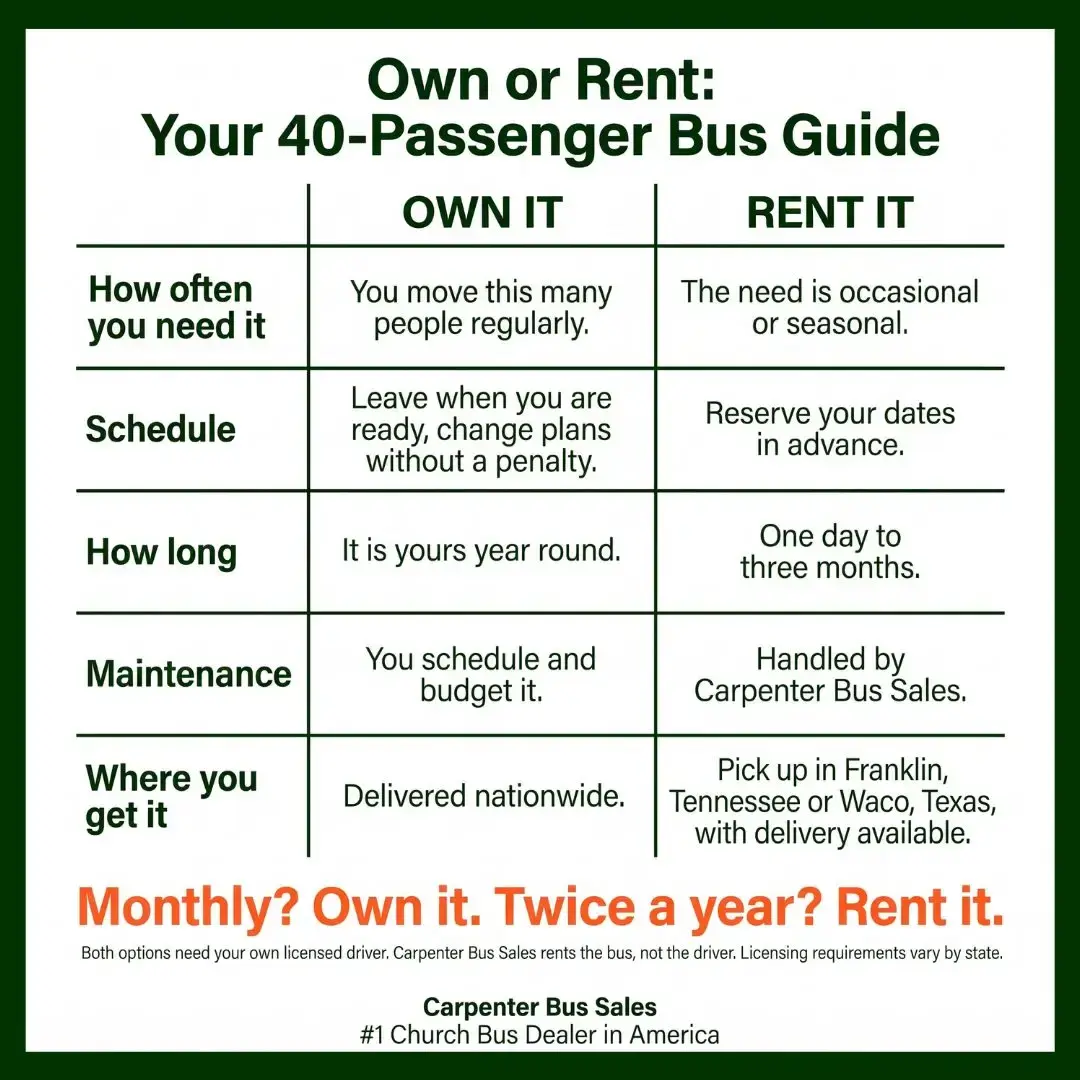
Should you own a 40 passenger bus or rent one?
Own a 40 passenger bus if your organization moves this many people often enough to keep it busy, and has drivers who are licensed for it. Rent when the need is occasional or seasonal. Carpenter Bus Sales offers both, including large rental buses seating 27 to 44 passengers in Tennessee and Texas, so the choice does not have to be all or nothing.
Most pages that answer this question are written by charter companies, which is worth knowing when you read them. Here is the comparison from a dealership that sells buses and rents them.
| Consideration | Owning a 40 passenger bus | Renting a large bus |
|---|---|---|
| Best when | You move large groups regularly and can use a 40 passenger bus between trips | The need is occasional, seasonal, or your own bus is in the shop |
| Schedule | Yours. Leave when you are ready, change plans without a penalty | Booked in advance, from one day up to 12 months |
| Driver | Your own licensed driver | Your own licensed driver. Carpenter Bus Sales does not provide one |
| Insurance | Carried by your organization year round | Carried by your organization, with minimums confirmed at quote |
| Maintenance | Yours to schedule and budget | Handled by Carpenter Bus Sales |
| Branding | Your name and logo on the side | Not applicable |
| Locations | Delivered nationwide | Pick up in Franklin, Tennessee or Elm Mott, Texas (Waco Area), with delivery available |

One distinction is worth being clear about, because it changes the math. Carpenter Bus Sales rents the bus itself, not a bus with a driver. Charter companies sell both together, and you pay for both. Renting the vehicle alone costs less and leaves the schedule and the route entirely under your control. Details for both states are on the bus rentals in Tennessee and Texas page.
How do you run the numbers for your organization?
Compare a full year, not a single trip. A single rental almost always looks cheaper than a monthly payment, and that comparison tells you nothing. Add up the year on each side.
- Count the trips you actually took last year that needed this capacity, not the trips you hope to take.
- Get a rental quote for that number of trips at their real lengths, including any delivery.
- Against that, put the annual cost of ownership: the payment, insurance, fuel, maintenance, and a place to park a 40 foot vehicle.
- Subtract the value of the uses you would add if a 40 passenger bus were sitting in your lot. Regular routes and midweek programs are the ones that usually tip the decision.
- Ask which side leaves your organization better off in year three, not month three.
Parking deserves its own line. A 40 foot bus needs somewhere to sit, with room to turn and space to maneuver. Organizations that skip this step sometimes find out after delivery that their lot does not work.
When does renting make more sense than owning?
Renting wins in more cases than a bus dealer is usually willing to say.
- One or two big trips a year. A bus used twice a year still costs a full year of payments, insurance, and storage.
- You already own a smaller bus. Many organizations are best served by owning the vehicle that fits their weekly need and renting up for the annual retreat or conference.
- Your bus is out of service. A rental keeps the schedule intact while your own vehicle is being repaired.
- You are not certain about the size. Renting a large bus before buying one is the cheapest way to learn whether 40 passengers is really your number.
- Driver availability is thin. If only one person on staff holds the right license, a 40 passenger bus will sit unused more than you expect.
If the honest answer is that you need this capacity a few times a year, renting is the better buy, and a Carpenter Bus Sales representative will tell you so.
How long is a 40 passenger bus?
A 40 passenger bus from Carpenter Bus Sales is built on a 40 foot body. Every published 40 passenger floor plan in the Starcraft and Glaval lineups uses that length, whether the 40 passenger bus is on a Ford F-650 or a Freightliner S2C chassis.
The Glaval Concorde II is also offered in a 96 inch or a 102 inch wide body. The wider body was the first of its kind on a medium duty F-650 platform, and it buys aisle room rather than seats. On a 40 passenger bus where everyone is aboard for several hours, that is often the more valuable of the two dimensions.
What safety and comfort features come standard?
Every 40 passenger bus Carpenter Bus Sales sells is purpose built rather than converted, with a welded structural cage and LED lighting inside and out. Starcraft builds the Allstar with a fully welded steel cage and states that it is compliant with Federal Motor Vehicle Safety Standards. Glaval builds the Concorde II and Legacy with a fully welded aluminized steel structure.
Published standard features across these models include the following.
- Welded structural cage. Steel on Starcraft, aluminized steel on Glaval. This is the difference between a bus and a body bolted to a frame.
- One piece fiberglass front and rear caps. Fewer seams means fewer places for water to find its way in over an eight year life.
- LED interior and exterior lighting. Standard across the Glaval and Starcraft lineups.
- Marine grade plywood flooring. Standard 5/8 inch on the Glaval models. Starcraft uses Altro safety flooring.
- Undercoated chassis. Standard on the Glaval Legacy, and worth asking about anywhere winter roads are salted.
- Stainless steel exterior screws. A small detail that shows up as a lack of rust streaks five years in.
Common options include overhead luggage racks with reading lights, a rear luggage storage area, a roof hatch, a rear emergency door with windows, rear heat and air conditioning, stainless steel wheel inserts, a PA ready audio system, and custom paint with a painted skirt. Rear climate control deserves real thought in a 40 passenger bus, since the back of a 40 foot body is a long way from the front vents.
Which options on a 40 passenger bus are worth the money?
Spend on what riders notice and cut what they do not. Rick Cassels, Regional Sales Manager at Carpenter Bus Sales, names four options that earn their cost on almost any 40 passenger bus: overhead storage, dual compressor air conditioning, level five seat coverings, and side sliders.
"Spend money on what your riders notice and cut what they don't. Overhead storage is worth its weight in gold. I tell all my customers that. Don't buy a bus with a single compressor unless you live at the North Pole. For most of us, we want a bus that's going to really rapidly cool our bus, and a dual compressor bus will do that for you. Level five seat coverings are going to last longer and look better if you spend just a little bit more. And the side sliders, which allow the seat to slide about three to four inches into the aisle, creating a little more hip room. Really worth it, and a very inexpensive option to add."
Everything past those four depends on how the bus gets used. Reclining seats, video systems, and onboard Wi-Fi all have real value on the right route and none on the wrong one. The test is who is riding and for how long.
"Seniors notice comfort. Junior high boys, not so much."
That distinction is worth applying before the order goes in. A 40 passenger bus running senior trips and long retreats earns back reclining seats and better upholstery. The same bus hauling a middle school team across town on a forty minute ride does not, and the money is better spent on storage and cooling.
What affects the cost of a 40 passenger bus?
The price of a 40 passenger bus depends on the configuration rather than the seat count, so two of them can be far apart. Carpenter Bus Sales does not publish pricing, because chassis availability and manufacturer pricing move throughout the year. Call for a current quote on the configuration you are considering.
The factors that move the number most:
- Chassis and engine. The gas F-650 is the entry point into the 40 passenger bus class. Diesel adds cost up front.
- New or used. Carpenter Bus Sales carries both. A used bus in this class is often what makes owning realistic for an organization that would otherwise rent.
- Luggage configuration. A rear compartment with a wall is built into the body, not added later.
- Body width. The 102 inch wide body on the Concorde II costs more than the 96 inch.
- Accessibility. A lift and securement positions add cost and change the floor plan.
- Interior and exterior options. Seating, rear climate control, audio, and custom paint all move the total.
When you are ready to see what is available now, browse the large buses for sale inventory, which covers every bus seating 31 passengers and up.
What warranty comes with a new 40 passenger bus?
Every new bus from Carpenter Bus Sales includes SilverCare at no cost, which covers the entire vehicle, bumper to bumper, for five years or 60,000 miles, whichever comes first. GoldCare is an available upgrade that extends that coverage for a longer term. Full terms are on the Carpenter Bus Sales warranty coverage page.
Manufacturer coverage runs alongside this. Starcraft provides a structural warranty on the body construction and welded steel frame, and Glaval provides a structural warranty covering the body and welded frame, with chassis coverage from Ford or Freightliner. A manufacturer warranty and a Carpenter Bus Sales warranty are separate things and cover different parts of the bus.
What do churches and senior care communities get?
Churches and senior care communities receive PlatinumCare free with every qualifying new purchase from Carpenter Bus Sales. It covers the entire bus, bumper to bumper, for eight years with unlimited miles. On a 40 passenger bus running long routes, unlimited miles is the term that matters most.
PlatinumCare applies to churches and senior care communities only. Shuttle operators, tour and charter companies, schools, and dealers receive SilverCare free on every new bus and can upgrade to GoldCare. If you are buying for a congregation or a senior living community, confirm with your representative that the purchase qualifies before you sign.
Who buys a 40 passenger bus?
Organizations that move 40 people at a time on a regular schedule. A 40 passenger bus is a poor fit for a group that fills it twice a year, and an excellent one for a group that fills it twice a month.
- Large churches. Congregations running retreats, conferences, and mission trips where a single vehicle carries the whole group. The rear luggage layout is the one most churches end up ordering.
- Private schools and universities. A full roster plus coaching staff in one vehicle, with a rear compartment for equipment.
- Hotels and resorts. High volume airport transfers, where the rear luggage area is doing the real work.
- Tour operators. Groups large enough to need the seats, on routes where a full size coach is more vehicle than the itinerary requires.
- Corporate campuses. Daily employee routes where one large bus replaces two smaller ones and cuts the number of drivers needed.
- Senior living communities. Larger communities with high daily ridership and accessible transport needs.
- Government and transit. Municipal routes, park and ride programs, and community transit.
Frequently asked questions
Where can I find a 40 passenger bus for sale?
Carpenter Bus Sales lists new and used buses in this size class on its large buses page, which covers every bus seating 31 passengers and up. Inventory changes constantly, so call a bus specialist to find out what is on the lot in Franklin, Tennessee or Elm Mott, Texas (Waco Area) before you make the trip.
Is a 40 passenger bus the same as a 35 passenger bus?
They share the same 40 foot body and the same chassis options. The difference is how the interior is divided. A 40 passenger layout gives several rows to a rear luggage compartment. A 35 passenger layout gives up more seats still, usually for wider spacing or wheelchair positions. Our 35 passenger bus guide covers that trade in detail.
Does the CDL rule count seats or riders?
It counts designated seats. Federal guidance from the FMCSA states that designed to transport refers only to the number of designated seating positions, and does not include standing room. A 40 passenger bus carrying eight people is still a 40 passenger bus for licensing purposes.
Can a 40 passenger bus be made wheelchair accessible?
Yes. Glaval offers wheelchair accessible floor plans on both the Concorde II and the Legacy, using flip and foldaway seats together with lift options from Braun. Wheelchair positions take the place of seats, so the final passenger count comes down once a lift and securement area are added.
Can you add luggage space without giving up seats?
Yes. Overhead luggage racks with reading lights are an option on the Glaval Concorde II and Legacy, and Starcraft offers overhead racks as well. Overhead racks hold coats and small bags. A rear luggage compartment is the only option that holds suitcases, and that one does cost seats.
What should you do next?
Start with the question this guide exists to answer: how many times a year does your organization actually need to move 40 people? If the honest number is a handful, rent a large bus and put the savings somewhere else. If the number is closer to monthly, ownership will look better every year you keep the bus.
If you are leaning toward owning, have two figures ready before you call. The first is the passenger count you need with the driver included. The second is whether you need a rear luggage compartment, because that single choice determines which floor plans are even on the table. Call Carpenter Bus Sales at 800-370-6180 and a specialist can narrow a 40 passenger bus down to two or three real configurations in one conversation.
Carpenter Bus Sales has been selling buses since 1953, more than 70 years, and is the number one church bus dealer in America. We go the extra mile.
